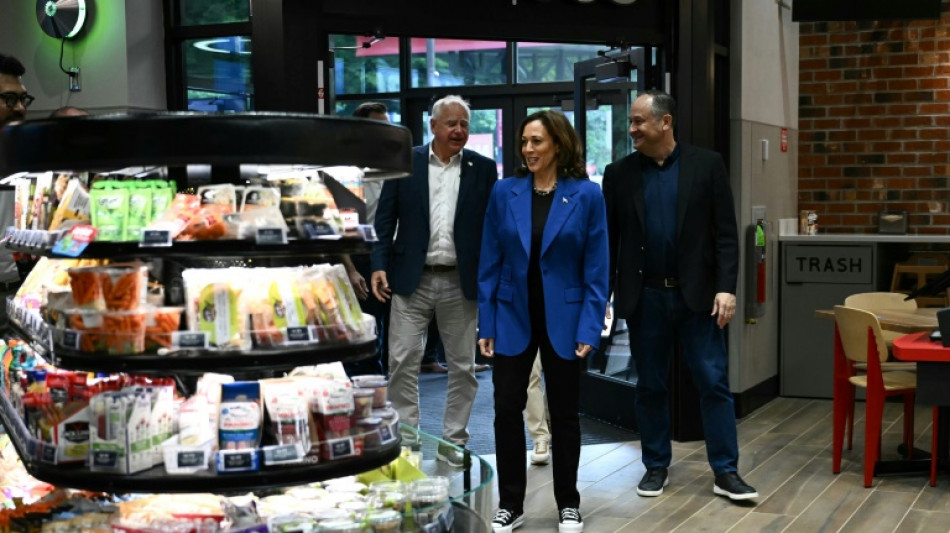
Economists push back on Harris price gouging plan / Photo: © AFP

 Bacteria suspected in deaths of hundreds of baby whales off Argentina

 US 'must choose' whether to end war: Iran president to Fox News

 UN approves resolution on dealing with rising sea levels

 Yalcouye makes dream debut as Ivory Coast beat Ghana in AFCON qualifier

 Chicago's White Sox and Cubs book MLB playoff berths

 Last-gasp Gakpo strike snatches Dutch draw to sour Klopp debut
 Global stocks mostly fall as oil prices and bond yields rise

 Israel's Netanyahu denounces enemies, allies in fiery UN speech

 Hollywood stars among arrests in NY anti-Netanyahu protest

 Losing start in AFCON qualifying for 78-year-old coach Le Roy
 Italy bans burqas in schools, caps numbers of foreign students per class

 Israel policies threaten 'life and existence' of Palestinians, Abbas says
 Paolini steers Italy past China in BJK
 Zidane admits emotion on eve of first game as France coach
 Breetzke and Maharaj sink Australia in first one-day international

 Zelensky broke confidentiality with North Korea POWs disclosure: South's president

 Former Liverpool star Carroll reveals he was sexually assaulted

 Dominican Republic calls for Haiti force to be strengthened
 Dolly Parton's nephew ordered to stay away from estate staff, properties

 Early exit for Philippine darling Eala at Singapore Open
 Hurricane Polo triggers huge waves in coastal Mexican city
 What happens if the US bans diesel exports

 Macklemore hits back with 'Free Palestine Tour' after Sheeran split

 Met Opera to give New Yorkers free tickets in affordability push

 Top ECB official to resign to take up IMF role

Kamala Harris's price gouging policy has been criticized by economists and analysts, who say it is an uncompetitive proposal that could end up hurting, and not helping, US consumers.
Harris, the Democratic nominee for president, announced the policy last week as part of a raft of populist proposals which included a $6,000-a-year tax credit for families with newborn children and a $10,000 tax credit for first-time home buyers.
If elected President, Harris would work with Congress to advance "the first-ever federal ban on price gouging on food and groceries," her campaign said in a statement.
The proposals would look to set "clear rules of the road" to stop big corporations from running up "excessive" profits on food and groceries, and beef up state and federal regulatory powers to penalize rule-breakers.
While popular with the Democratic base, the price gouging plans elicited a fierce reaction from Republican presidential candidate Donald Trump, who is running against Harris in November's elections.
"Kamala will implement SOVIET Style Price Controls," he wrote in a social media post a day after the proposals were published.
Supporters of the policy say it has been mischaracterized and misunderstood.
"When there is more concentration in an industry, we have seen much greater increases in the profit margins," US Senator Elizabeth Warren said in an interview with CNBC on Friday.
The Harris campaign did not respond to a request for comment. But several US media organizations, including the Washington Post, reported that the Harris campaign sees the policy as an attempt to elevate existing state-level rules on price gouging to the federal level.
- What price gouging? -
A global inflationary surge at the tail-end of the Covid-19 pandemic contributed to a sharp rise in the cost of everyday items across the United States.
Consumer inflation has eased dramatically since peaking at more than nine percent in 2022. But Americans are still contending with an overall price increase of just over 20 percent since Joe Biden took office, according to data from the US Labor Department.
However, "very little" of that increase is down to price gouging, Oxford Economics chief US economist Ryan Sweet told AFP.
Instead, Sweet points to a pandemic-fueled supply shock, and an increase in demand for goods and services spurred -- in part -- by generous federal support for households during the pandemic.
"What this gouging does is pivot the blame from the Biden administration, which Harris was part of, to corporations," said Gary Hufbauer, a nonresident senior fellow at the Peterson Institute for International Economics.
"It's a pretty successful political argument," he told AFP. "It has no economic basis."
- 'Penny business' -
The retail business is notoriously tough, with profit margins often in the low single digits -- in stark contrast to higher-margin sectors like tech.
"Is there a more competitive space than retail?" Target chief executive Brian Cornell said in an interview with CNBC on Wednesday that touched on Harris's price gouging plans.
"It is a penny business, and it's a very competitive space, and we provide the value consumers are looking for," he added.
But for people struggling with the cost of living, it's a difficult argument to make.
"People see that gasoline prices are higher than they were a few years ago, food prices are going to be higher than they were a few years ago," said Sweet, from Oxford Economics.
"But we're not going back down to the prices that we saw pre-pandemic," he added.
That's because easing inflation does not translate into lower sticker prices at the grocery store.
Instead, when wages increase faster than inflation -- as they have been for well over a year now -- the cost of those items relative to wages declines over time.
But it's a slow process.
The Federal Reserve appears increasingly confident that it is winning its battle to bring inflation back down to its long-term target of two percent.
On Friday, Fed chair Jerome Powell said "the time has come" to start lowering interest rates, lifting expectations of a rate cut next month.
"There's clear evidence that businesses' pricing power has started to diminish," said Sweet.
"I think over time, as inflation gets back down to the Fed's target, this discussion of price gouging is going to start to fade to the background," he added.
C.Bruderer--VB