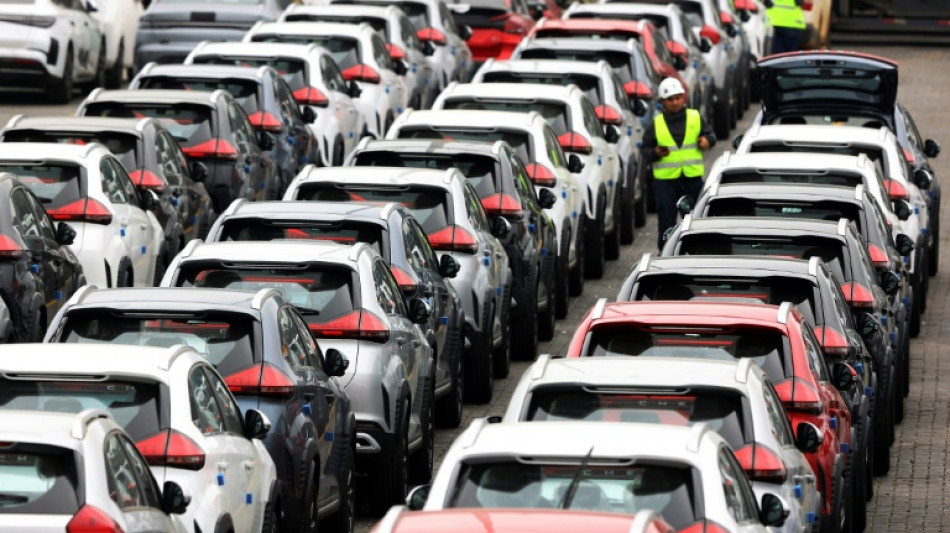
Chinese cars make inroads in Latin America / Photo: © AFP

 Saudi PIF Retains Top Sovereign Wealth Fund Brand Title for Third Year

 Phoenix Weekend Guide: Sangria Socials, Pie Markets, and New Brunch Spots

 Trent Perry’s Late Heroics Lift No. 7 UCLA Past Cal State Fullerton

 2027 Hyundai Elantra Review: Brutalist Design and Expanded Dimensions

 Global Scams Remain Widespread: Nearly Two in Three Adults Worldwide Report Scam Encounters, 9% Lost Money

 Shinde Clarifies Torn Photo Controversy Amid Sonia Gandhi Book Protest
Chilean truck driver Claudio Perez was dubious about his first purchase of a Chinese-made family car two years ago. But the price and quick delivery time convinced him, and now he is a convert.
Perez, 47, is one of millions of car buyers in Latin America to have made the shift from US- and Brazilian-built cars to Chinese models in recent years.
In 2019, the Asian economic giant sold $2.2 billion worth of cars in the region. Last year, the figure reached $8.5 billion, according to the International Trade Center (ITC), a UN agency.
Chinese car sales represented 20 percent of the region's total in money terms -- ahead of the United States with 17 percent and Brazil with 11 percent.
No other market outside Asia now has a larger share of Chinese cars, according to the ITC.
"We tend to stigmatize Chinese brands, but no... this one was super good, super good. So I don't regret buying it," Perez said of his first purchase, which he said he had expected to be "plastic-like."
And his next car will be Chinese too, he said.
Chinese carmakers have redoubled their efforts in recent years to offer products at competitive prices, without compromising on quality, according to analysts.
In the emerging market of electric vehicles, they have taken an even bigger slice of the Latin American market, with 51 percent of all sales.
Almost all electric buses in the region are made in China.
"The growth of Chinese car manufacturers in recent years has been exponential, thanks to significant improvements in quality, technology and design," said Andres Polverigiani of Nyvus, a consultancy firm that studies vehicle competitiveness.
In the United States and Europe, both with their own automotive industries, protective import tariffs have slowed China's advance, unlike in Latin America.
In Chile, with near-zero duties, Chinese models represented nearly 30 percent of car sales last year.
- 'A question of survival' -
In Mexico and Brazil, Latin America's biggest car producers, China is also making inroads.
Chinese giant BYD is building its largest electric car plant outside of Asia in Camacari, northeastern Brazil, with a targeted production capacity of 150,000 units every year.
In Latin America, Chinese cars, which tend to be cheaper than rivals, have enabled segments of the middle- and low-income population to buy their first vehicle, said Sebastian Herreros, an economist at the Economic Commission for Latin America and the Caribbean (ECLAC).
It has also allowed the introduction of cleaner engine technologies in polluted metropolises such as Santiago, Bogota and Mexico City.
"All our countries must adopt electro-mobility quickly, it is almost a question of survival," said Herreros.
"China is an ideal partner: it has the necessary production capacity and offers competitive prices."
P.Staeheli--VB

