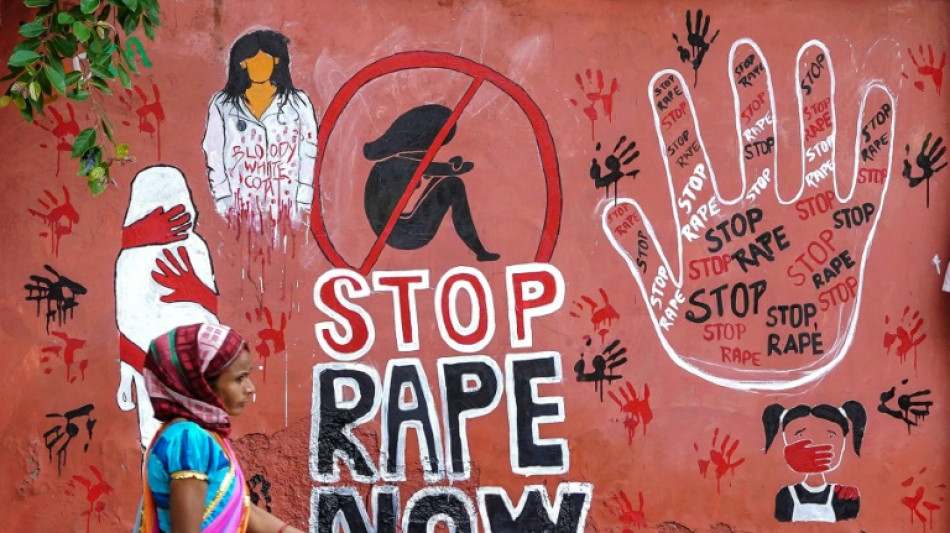
'Abuse every day': Indian female medics speak out after brutal murder / Photo: © AFP

 Bijan Robinson destroys Packers in 35-14 win for Falcons

 Harimoto hails new era as Japan dethrone table tennis kings China

 India rape cases turn focus back onto women's safety
 Rebellious Afghan taxi drivers defy ban on music

 Brazil candidates mount digital armies for fierce online campaign

 Nepal PM says floods 'a warning to the world' about climate change

 Trump hosts Xi for state dinner as pomp masks tensions

 Scheffler and Burns give US 3-2 Presidents Cup lead

 Hollywood stars among 100 arrested in NY anti-Netanyahu protest

 Klopp denied on Germany debut as Portugal win in Nations League

 Rich nations should foot climate bill, says Nepal minister

 Wellalage and Mendis star as Sri Lanka level England series in thriller

 Felix gives Portugal win over Wales as Ronaldo misfires

 Wellalage and Mendis star as Sri Lanka level England ODI series

 Guyana urges Venezuela at UN to respect ICJ's ruling on Essequibo region

 Argentina coach says Messi deserves to go out on own terms

 Xi sets red lines for Trump despite lavish White House welcome

 Cowboys, Ravens happy with footing for first Rio NFL clash

 Starbucks to close 250 more cafes in North America

 French actress Marina Vlady dies at 88

 CNN, MS NOW, Politico allowed back in White House after judge's order

 Morocco's ruling coalition dominates low-turnout parliament election

 Napoli hoping to build new stadium, says owner

 What's behind the Pakistani strikes on Afghanistan?
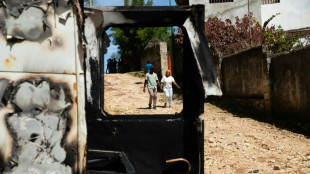
 Hundreds protest for return of Nobel peace laureate Machado to Venezuela

Saving lives was the childhood dream for 28-year-old Indian doctor Radhika, but after the brutal rape and murder of a colleague her own safety has increasingly become a top concern.
Earlier this month, at the government-run hospital where Radhika works in the eastern city of Kolkata, the battered and bloodied body of a 31-year-old woman doctor was found, sparking outrage.
One man has been detained, but the attack has focused anger on the lack of measures for female doctors to work without fear, and triggered protests and medical strikes.
"I was on night duty just two days before this incident," Radhika said at Kolkata's R.G. Kar Medical College and Hospital.
"What she did is what any of us do -– resting whenever, wherever we can".
The murdered doctor -- who has not been formally named but is being called "Abhaya", or "fearless" by protesters -- was found in the teaching hospital's seminar hall, suggesting she had gone there for a break during a long shift.
Radhika, whose name has been changed for fear of repercussions at her work, said conditions such as long working hours -- with barely any time to eat or rest -- were not unusual.
"This could have been any of us, and this still can be any of us," she added.
- Attacks all too common -
Tens of thousands of ordinary Indians have joined protests, channelling anger not only at the chronic issue of violence against women, but also at the failure to provide secure working conditions for them.
According to the philanthropic organisation Dasra, women make up nearly 30 percent of doctors in India and 80 percent of nursing staff.
Attacks on female medics are all too common.
India's Supreme Court on Tuesday ordered a national task force to examine how to bolster security for healthcare workers, saying the brutality of the killing had "shocked the conscience of the nation".
"The lack of institutional safety norms at medical establishments, against both violence and sexual violence against medical professionals, is a matter of serious concern," the court order read.
It highlighted a lack of CCTV cameras and a failure to screen visitors to hospitals for weapons.
Medical superintendent Indira Kabade, who works at KC General Hospital in the southern city of Bengaluru, said she worries her staff can get home safely.
"We never know if anyone is following them from the hospital," said Kabade, adding she and many female colleagues want "airport-like security", including police posted inside the campus.
"Despite us working non-stop to save lives, there is a need to rethink safety at workplace," Kabade said.
The gruesome nature of the doctor's killing has invoked comparisons with the horrific 2012 gang rape and murder of a young woman on a Delhi bus.
Nearly 90 rapes a day were reported in 2022 in the country of 1.4 billion people.
- Foul toilets -
Exhausted doctors sleep where they can, snatching rest on a chair or the floor.
"They are just completely tired and their bodies cannot push anymore," Radhika said.
There are restrooms for doctors -- but men and women have to share, and some have no lock.
She described one moment of terror when two men barged into the room as she rested.
"I was really scared," she said.
Foul sanitation -- including often one toilet for male and female medics -- illustrate a failure by the authorities to provide basic infrastructure.
The situation was particularly worrying when the women were menstruating, Radhika said.
In the Himalayan territory of Kashmir, doctor Rubeena Bhat said some medics would rather use washrooms in houses neighbouring the hospital.
"It's that bad," she said.
- 'Abuse every day' -
One female doctor in Thiruvananthapuram, a city in the southern state of Kerala, said she and her colleagues faced abuse every day, from verbal insults to physical molestation.
"There is no end to it," she said.
Female doctors have been encouraged to participate in self-defence classes organised by the medical association.
"Doctors are called gods or angels by some people," the Kerala-based doctor said.
"So we think we are immune to crimes. And when such a crime happens at a place which we consider the safest place, we are all afraid".
But while questions remain over her safety, Radhika is certain of her future.
"I will fight and continue to be in the healthcare service", she said.
E.Burkhard--VB