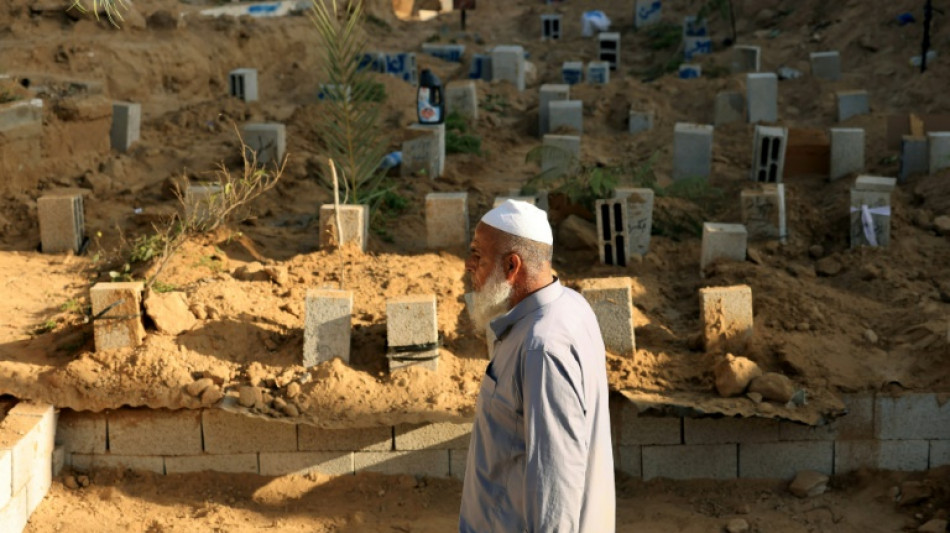
Gaza's overwhelmed undertakers stack 'graves on top of graves' / Photo: © AFP

 Williams boss hails Chadwick as F1 inspiration for women
 World No.1 Sinner delays return with China Open withdrawal

 South Lebanon children return to school destroyed by Israel strike

 Jewish group urges Berlin far-left vote winners to tackle antisemitism

 European stock markets climb as oil prices drop

 Trump accuser E. Jean Carroll finally has her damages

 Germany's Havertz, Musiala ruled out of Greece match with injury

 Ireland's Gaza stance spills from Eurovision into football

 Welcome aboard the Costa Serena, the Asian Games floating hotel

 Asian markets mixed after recent oil surge
 Cash for nature protection: hotelier's offer to Principe islanders
 US miner KoBold bets on AI to gain edge in DR Congo mineral hunt
 Internet disrupted in Ethiopia as conflict rages
 Asian markets mixed after oil gains

 'Genius' Ohashi bids for third Asian Games gold after world record

 India's 'Tree Father' plants for a greener future
 Hopping mad: New health warning stirs up Belgian brewers

 Canadian capital to rename 'Trump Ave'

 Pope heads to France on first state visit in 18 years

 Bacteria suspected in deaths of hundreds of baby whales off Argentina

 US 'must choose' whether to end war: Iran president to Fox News

 UN approves resolution on dealing with rising sea levels

 Yalcouye makes dream debut as Ivory Coast beat Ghana in AFCON qualifier

 Chicago's White Sox and Cubs book MLB playoff berths

 Last-gasp Gakpo strike snatches Dutch draw to sour Klopp debut

Undertakers are working like bricklayers in a Gaza cemetery, piling cinder blocks into tight rectangles, side by side, for freshly dug graves.
More than 10 months into the Gaza war, so many bodies are arriving at the cemetery in Deir el-Balah that the men, working in the hot sun, hardly have space to bury them.
"The cemetery is so full that we now dig graves on top of other graves, we've piled the dead in levels," says Saadi Hassan Barakeh, leading his team of gravediggers.
Barakeh, 63, has been burying the dead for 28 years. In "all the wars in Gaza", he says he has "never seen this".
Previously, Barakeh also oversaw burials at the nearby Ansar cemetery, which covers 3.5 hectares (8.6 acres).
But now "the Ansar cemetery is completely full. There were too many dead", he says, his clothes smeared in dirt from digging graves.
He now handles just the Al-Soueid cemetery, with its 5.5 hectares of graves. Yet even with one cemetery instead of two, he works "every day, from six in the morning to six in the evening".
"Before the war, we had one or two funerals per week, maximum five," he says, wearing a white prayer cap that matches his long beard.
"Now, there are weeks when I bury 200 to 300 people. It's unbelievable."
- 'I can't sleep' -
Gaza's death toll of just over 40,000 in more than 10 months of war, according to the Hamas-run territory's health ministry, is straining its people as well as its cemeteries.
Barakeh bears daily witness to the tragedies. Hoe in hand, he gives encouragement to his 12 workers as they prepare and close dozens of graves every day.
At night, however, some images are hard to forget.
"I can't sleep after seeing so many mangled children's bodies and dead women," he said, adding: "I buried 47 women from one family."
The October 7 Hamas attack which triggered the war resulted in the deaths of 1,198 people, mostly civilians, according to an AFP tally of Israeli official figures.
Militants also seized 251 people, 111 of whom are still held in Gaza, including 39 the military says are dead.
Israel's retaliatory military offensive has killed at least 40,005 people in Gaza, according to the health ministry, which does not provide a breakdown of civilian and militant deaths.
"I buried a lot of women and children, and only two or three guys from Hamas," says Barakeh.
- 'Why the children?' -
If Israelis "have a problem with (Yahya) Sinwar, why do they harm children?" he adds, referring to the alleged October 7 attacks mastermind who is now Hamas's overall leader.
"Let them kill Sinwar and all the others, but why the women and children?"
Mounds of freshly dug soil are reminders of recent burials. Graves with white headstones fill nearly all the available space, while men dig new holes in the few vacant areas.
The team forms a human chain to carry the cinder blocks, whose price has soared since Gaza's factories closed due to a lack of fuel and raw materials.
"One shekel ($0.27) before the war, 10 or 12 today," he lamented.
Besides gravediggers and the workers carrying cinder blocks, hardly anyone comes to funerals anymore, Barakeh says.
"Before the war, there were sometimes 1,000 people at one funeral; today there are days when we bury 100 people and there aren't even 20 to lay them to rest."
High above his head, the constant hum of an Israeli surveillance drone serves as a reminder of the aerial threat creating a steady stream of bodies.
N.Schaad--VB