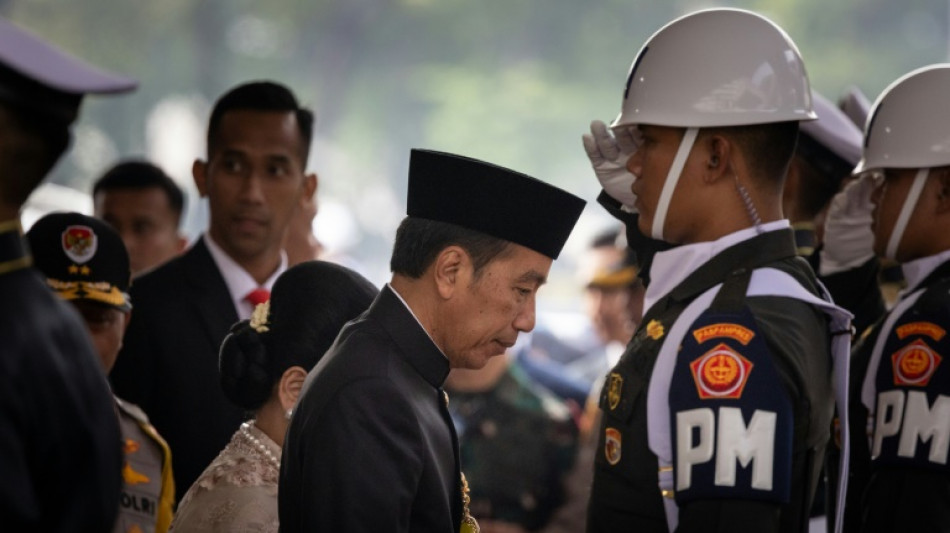
Indonesia leader touts economic success in final state address / Photo: © AFP

 Jimmy Carr Confirms 25-Year Estrangement From Father Amid Podcast Reflections

 Arizona Superintendent Tom Horne to Leave Office, Plans Law Practice and Charter School

 Japan and Peru Mark 150 Years of Diplomatic Ties Amidst Trade and Investment Talks

 Ian Jackson Scores Game-High 22 Points After Rick Pitino's Prank Suspension

 Khan Welcomes Milburn’s Youth Employment Reforms Amid High NEET Rates

Indonesian President Joko Widodo hailed his economic track record on Friday in a final state of the nation address before he leaves office in October after a decade in power.
Widodo, more popularly known as Jokowi, will be replaced by defence chief Prabowo Subianto after serving the maximum two terms, with more than three-quarters of Indonesians approving of his rule in recent opinion polls.
He will leave office with an economic legacy of consistent growth of about five percent and large infrastructure projects including roads, bridges and airports aimed at better connecting the archipelago.
"In the past 10 years, we have been able to build a new foundation and civilisation, with Indonesia-centred development, building from peripheries, building from villages, and building from outermost areas," he told lawmakers in capital Jakarta.
Widodo, raised in a bamboo shack in a riverside slum on Indonesia's biggest island of Java, said his government had built 50 new ports and airports, 1.1 million hectares of irrigation canals and 2,700 kilometres (1,677 miles) of new toll roads.
"Our economic growth has been maintained at around five percent, even though many countries are not growing or even slowing down," he said, adding inflation had held steady between 2 and 3 percent despite the Covid-19 pandemic.
He did not mention his final legacy project, Nusantara, the newly planned capital city on Borneo island that is to replace sinking and traffic-clogged Jakarta as the country's political centre this year.
The $32-billion megaproject has faced building delays and funding woes that have cast doubt on the schedule.
An official decree moving the capital from Jakarta could be delayed until after his successor Prabowo takes office.
Despite economic progress, Jokowi faced criticism in the build-up to February's presidential election for what some called an attempt to create his own political dynasty.
His son Gibran Rakabuming Raka will serve as Prabowo's vice president after candidate eligibility rules were changed by Jokowi's brother-in-law and then-chief justice, allowing his 36-year-old offspring to run for office.
"Ten years is not a long period to solve all problems in our nation," Jokowi said.
"It is very possible that I have committed a lot of mistakes," he added, apologising to his critics.
K.Hofmann--VB


