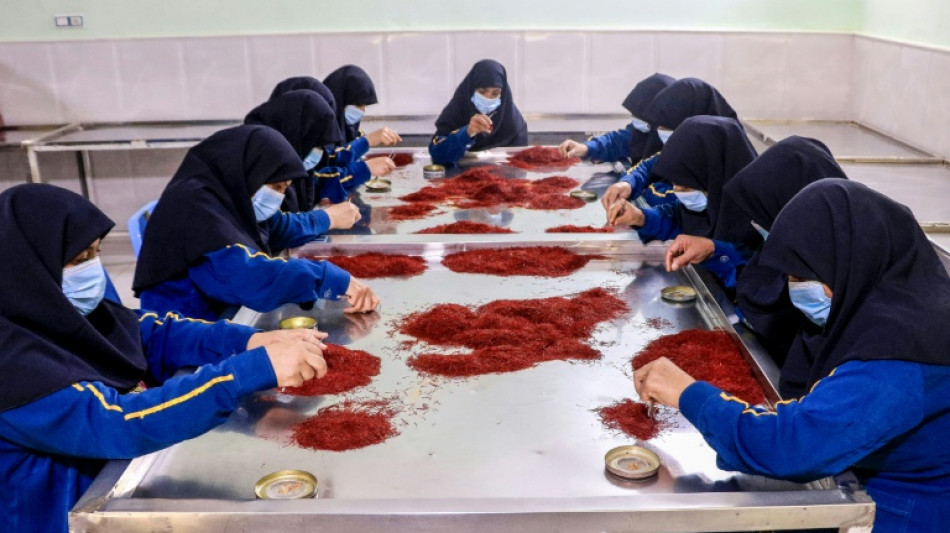
Three years after Taliban return, economic woes loom large / Photo: © AFP/File

 Spotting AI writing: how reliable are the detectors?

 French youth await pope after AI 'paradise of machines' warning
 Man City found guilty of Premier League charges, set to appeal: reports

 Embolo follows Xhaka out of Swiss squad over fake Covid documents
 Trump, Xi inspect founding documents of US democracy to close summit

 'Bottle Claus': Kipchoge's 'hero' helping runners chase Berlin marathon glory

 Olympic medallist Samba-Mayela handed provisional doping ban

 First US trial against TikTok to open Monday

 Palmer misses 'too many' England games, says Tuchel

 UN refugees chief warns conditions in W.Sahara 'deteriorating'

 Antonelli 'mad' about crash in Azerbaijan qualifying

 'Perfect lap' gives Russell pole for Azerbaijan GP as Antonelli crashes out
 UN Security Council condemns Houthi attacks on Saudi Arabia

 China swimmer makes Asian Games history as Thai wins 100m sprint

 Top French literary prize drops best-selling novel over AI claims

 US 'must choose' whether to end war: Iran president

 Pope warns against losing humanity in AI-driven 'paradise of machines'

 Pope warns against losing humanity in 'paradise of machines'

 From FBI warning to literary acclaim: the Russian journalist who took on Putin
 China swimmer in Asian Games first as North Korea lifters reign

 French literary prize removes novel from longlist after AI claims

 China's Zhang wins record seventh Asian Games swimming gold

 Verstappen edges Russell in final practice in Azerbaijan

 English, Spanish, Italian, German football leagues call for FIFA reform

 Pope arrives in France on first official visit in 18 years

Despite three years of improved security following the end of the Taliban's insurgency, Afghanistan's economy remains stagnant and its population is in the grips of a worsening humanitarian crisis.
A third of Afghanistan's roughly 40 million people live on bread and tea, according to the United Nations, there is massive unemployment, and the World Bank warns of zero growth over the next three years.
But there have been some positive changes since the Taliban takeover in 2021 -- even if their government remains unrecognised by any other country.
The currency has been resilient, corruption is no longer ubiquitous, and tax collection has improved.
Authorities have also built "economic, commercial, transit and investment" ties in the region, according to Ahmad Zahid, deputy commerce and industry minister.
Afghanistan has great mineral and agricultural potential, which the Taliban government is attempting to exploit, but they are impeded by poor infrastructure and a lack of domestic and foreign expertise and capital.
Though Afghans welcome the improved security in their lives, many are just trying to make ends meet.
AFP spoke to four people from different parts of the country ahead of the anniversary of the fall of Kabul this week:
- The optimistic businessman -
For 54-year-old Azizullah Rehmati, business is booming -- his saffron company in the western province of Herat is set to double production this year.
Until 2021, his "Red Gold Saffron Company" hired armed guards to escort the valuable spice from the factory to the airport, but the improved security climate has done away with the need for such overt protection.
"Now there is no problem," said Rehmati, who exports to 27 countries.
At his processing facility, women sort the red stigmas of the precious saffron spice with tongs.
Taliban government restrictions on women have slashed their participation in the workforce, but Rehmati's company is among the 50 percent of Afghan employers who still hire women.
Still, a key challenge for Rehmati -- and Afghanistan as a whole -- is the crippled banking sector.
"It is so important that we have the banking channels reopened," said Sulaiman Bin Shah, deputy trade minister under the previous government.
The sector has been blocked by international sanctions and the freezing of central bank assets.
Rehmati's bank can't send money abroad -- or receive transfers -- meaning he has to resort to more expensive private money changers in Dubai.
Getting visas for foreign trips is also a major problem.
Many foreign nations shuttered their embassies in the wake of the Taliban takeover and Afghan passports are rated the worst in the world by the Henley Index, which tracks global ease of travel.
"We will fall back from the world market," Rehmati said.
- The out-of-work musician -
Wahid Nekzai Logari played in Afghanistan's national orchestra and performed concerts on the sarinda, a traditional stringed instrument, as well as the harmonium.
"I supported my whole family. We had a good life," said the 46-year-old in his modest home in a Kabul suburb.
But the Taliban government has prohibited public performances of music, deeming it un-Islamic, leaving thousands involved in the industry destitute.
"Now I'm unemployed," Logari said.
To feed his family of seven he sometimes drives a cab -- earning just 5,000 afghanis a month ($70), a fifth of what he used to earn from his concerts.
"Nobody told us, 'you can't play music anymore, but we'll find you a way to feed your family'," he said.
- The insurgent-turned-bureaucrat -
Abdul Wali Shaheen wanted to "die a martyr's death" in the Taliban ranks, but after their victory he swapped his rocket launcher for a computer at the Department of Information and Culture in Ghazni province.
"I wasn't as stressed (then) as I am today," the 31-year-old said wryly.
"All we did was wage jihad, now it's harder. I have more responsibilities in regards to the people."
Still, Shaheen'smonthly salary of 10,000 afghanis is enough to feed his family of five, and he is happy with the direction the country is going.
"I give the Emirate a 10/10 for these three years," he said.
"Everything is going well and we have hope for the future."
- The hidden beautician -
The order to close beauty salons last year "broke her heart", but Sayeda -- not her real name -- reopened in secret four months ago elsewhere in Kabul.
"We found this place to rent, with the condition that customers come very discreetly and that some of our employees sleep here so that neighbours think a family lives here," said the 21-year-old manager.
"Before, we had 30 to 40 customers a day, now it's six or seven," said Sayeda, who has nevertheless kept her 25 employees so that "everyone has an income".
Sayeda's salary has dropped from 25,000 afghanis per month to between 8,000 and 12,000.
"We're working in hiding and we don't know for how much longer," she said, noting the risk of being shut down by the police.
When they've "found some (underground) salons, they broke the equipment, mistreated the staff" and imposed fines, she said.
G.Frei--VB