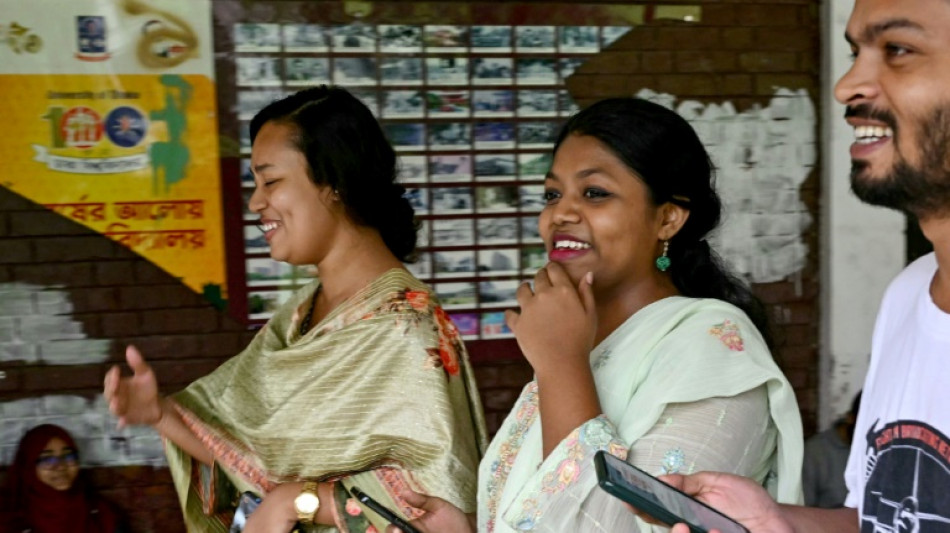
How Gen Z women and the military transformed Bangladesh / Photo: © AFP

 Jay-Z rape accuser says she made 'false accusations'

 Senegal draw first match under Vieira and Nigeria survive scare
 Trump, Xi end summit long on pomp, but short on progress

 Russia not preparing for conflict with Europe, Putin says

 Trump's photo of Xi greeting carries signs of AI

 Six missing after building blast in historic Athens district

 Millions in US northeast brace for powerful storm

 Assefa seeks 'better than my best' at Berlin marathon
 US court refuses to overturn Pentagon ban on Anthropic

 Verstappen and Norris blame slow cars as Mercedes tops qualifying

 Crowds cheer pope in Paris after AI 'paradise of machines' warning

 Teen swimmer makes Games history as Thai, Chinese sprinters win gold
 Man City found guilty of 114 Premier League charges - reports

 Concerns over 'missing' UK explorer Ranulph Fiennes

 Suspected Paris killer of Argentine rugby star begs forgiveness
 Oil prices fall on cautious hopes for US-Iran progress

 Noskova, Muchova take Czech Republic into BJK Cup final

 Thai sprinter Puripol breaks own Asian Games record to win 100m gold
 Russell takes pole for Azerbaijan GP, Antonelli crashes out
 Williams boss hails Chadwick as F1 inspiration for women

 World No.1 Sinner delays return with China Open withdrawal

 South Lebanon children return to school destroyed by Israel strike

 Jewish group urges Berlin far-left vote winners to tackle antisemitism

 European stock markets climb as oil prices drop

 Trump accuser E. Jean Carroll finally has her damages

Adored by her classmates and defiant even after police seized her, student Nusrat Tabassum is one of the many women who helped spearhead the movement that toppled autocratic ex-premier Sheikh Hasina.
Sizable protests against Hasina's 15-year rule were nothing new, but this was the first time that young women took to the streets against her in large numbers.
Soldiers refused to fire on them, a pivotal moment in Hasina's ouster.
"The people had no way back," Tabassum, 23, told AFP. "Anger was increasing, and the demand for equality was increasing."
Tabassum is a campus hero for helping lead a movement that began as a protest against civil service job quotas and ended in revolution.
As she strolled the grounds of the elite Dhaka University, friends and other pupils rose from their seats to offer handshakes, hugs and high-fives.
Two weeks ago she was among six top student leaders snatched by plainclothes police and held in custody for several days, officially for their own safety.
With Hasina's grip on power slipping, her security forces held the group at gunpoint and made them sign a statement calling off the protests.
"I thought of suicide several times," Tabassum said. "I could not bear the thought of the people of this country thinking that we had cheated, that we had sold out."
But Bangladeshis saw through the ruse.
"When we saw people did not misunderstand us, and were still protesting on the street, then I regained my strength and power to continue," she said.
- 'Women were deprived' -
Protests began last month over a court decision to reintroduce loathed quotas for government jobs, seen as a tool for Hasina's government to stack the bureaucracy with loyalists.
One aspect was a 10 percent reservation for women applicants, but Tabassum said the politicised nature of the scheme meant that "women were deprived more than they benefitted".
Soon after protests began, Hasina said the quotas had to remain because women were otherwise unable to get those jobs on their own merits.
The irony of her statement, from one of the world's longest-serving women heads of government, was not lost on its audience.
"Women are more concerned about their rights these days," said Nahida Bushra, a human sciences graduate student at Dhaka University.
"That's why women spontaneously joined the protests."
Muslim-majority Bangladesh has a history of extremist attacks, and one way Hasina sailed through earlier bouts of unrest was by blaming Islamist troublemakers.
She tried again this time, but the sight of young women leading protests undercut her argument.
- 'We moved forward' -
Bushra, 23, played a key role mobilising her fellow women classmates to attend rallies.
She sidestepped government efforts to stop her and ignored a concerted online campaign to demonise students.
"There was a storm of rumours and disinformation on social media, but we kept our unity with courage and bravery," she told AFP.
Telecoms were ordered to block access to Facebook and other platforms used to organise demonstrations, so Bushra and others circumvented the bans through virtual private networks (VPNs).
The government then imposed a complete national shutdown of mobile and broadband internet, so they organised rallies through SMS messages and phone calls.
When police began firing on protesters, they rushed to the front of the crowd in the expectation that officers would be more reluctant to shoot women.
"We moved forward and took the protest forward," Bushra said.
- 'Absolute bloodbath' -
In a final desperate move to remain in power, Hasina's government ordered soldiers to suppress the protests.
They refused.
"It would have been an absolute bloodbath and the army was unwilling to perpetrate a massacre," Thomas Kean of the International Crisis Group told AFP.
"To have sided with Hasina at this juncture would have tarnished their image massively."
Bangladesh's armed forces are outsized contributors to UN peacekeeping operations, a source of deep institutional pride.
Kean said their complicity in the crackdown would have opened up the military to Western sanctions and international pariahdom, as well as a potential revolt from rank-and-file soldiers.
Despite army chief Waker-Uz-Zaman being a distant relative of Hasina's, Kean said the general had "little choice but to put institutional interests first".
As the dust settles from some of the most tempestuous weeks in Bangladesh's history, Tabassaum said work had just begun.
"My country has not been able to practice what democracy really looks like," she said.
"The responsibility to build the country remains."
G.Frei--VB