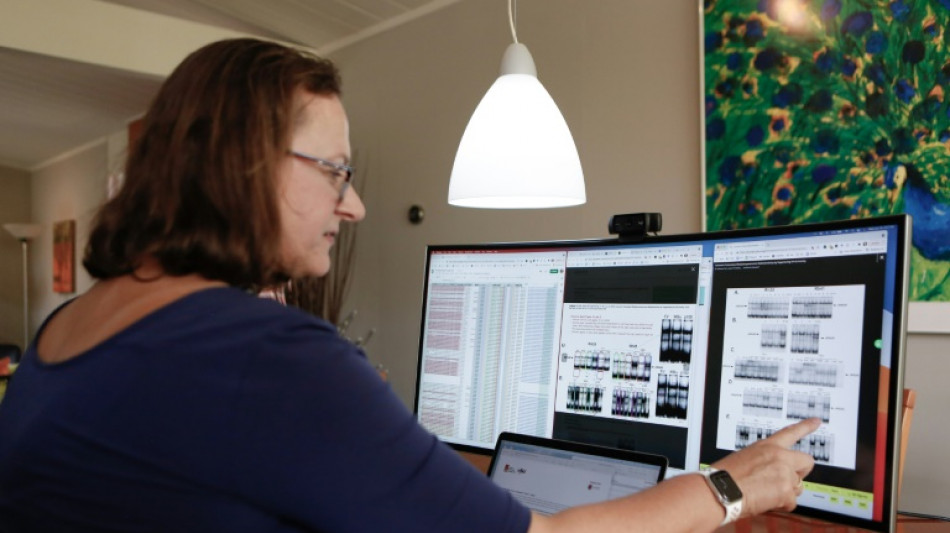
Flood of 'junk': How AI is changing scientific publishing / Photo: © AFP/File

 TikTok agrees to teen limits in US settlement following Meta

 Venezuela's oil cradle pins hopes on US energy deals

 US, China buy time with trade truce as pressure builds

 'Leo, Leo': Young Catholics give pope rockstar welcome in France

 Lula bans sports betting days ahead of Brazil's election

 Guatemala ensures survival of vulnerable 'fossil' fish
 Mancini finds positives in Italy loss, accepts fans' jeers

 Alcaraz helps Europe into Laver Cup lead

 Six missing after building collapses in historic Athens district

 Mbappe scores but suffers knee injury as Zidane gets debut France win

 Mancini's Italy return spoiled by Belgium defeat
 Rodri confident in Man City innocence despite reported charges

 Jay-Z rape accuser says she made 'false accusations'

 Senegal draw first match under Vieira and Nigeria survive scare

 Trump, Xi end summit long on pomp, but short on progress

 Russia not preparing for conflict with Europe, Putin says

 Trump's photo of Xi greeting carries signs of AI

 Six missing after building blast in historic Athens district

 Millions in US northeast brace for powerful storm

 Assefa seeks 'better than my best' at Berlin marathon

 US court refuses to overturn Pentagon ban on Anthropic

 Verstappen and Norris blame slow cars as Mercedes tops qualifying

 Crowds cheer pope in Paris after AI 'paradise of machines' warning

 Teen swimmer makes Games history as Thai, Chinese sprinters win gold

 Man City found guilty of 114 Premier League charges - reports

An infographic of a rat with a preposterously large penis. Another showing human legs with way too many bones. An introduction that starts: "Certainly, here is a possible introduction for your topic".
These are a few of the most egregious examples of artificial intelligence that have recently made their way into scientific journals, shining a light on the wave of AI-generated text and images washing over the academic publishing industry.
Several experts who track down problems in studies told AFP that the rise of AI has turbocharged the existing problems in the multi-billion-dollar sector.
All the experts emphasised that AI programmes such as ChatGPT can be a helpful tool for writing or translating papers -- if thoroughly checked and disclosed.
But that was not the case for several recent cases that somehow snuck past peer review.
Earlier this year, a clearly AI-generated graphic of a rat with impossibly huge genitals was shared widely on social media.
It was published in a journal of academic giant Frontiers, which later retracted the study.
Another study was retracted last month for an AI graphic showing legs with odd multi-jointed bones that resembled hands.
While these examples were images, it is thought to be ChatGPT, a chatbot launched in November 2022, that has most changed how the world's researchers present their findings.
A study published by Elsevier went viral in March for its introduction, which was clearly a ChatGPT prompt that read: "Certainly, here is a possible introduction for your topic".
Such embarrassing examples are rare and would be unlikely to make it through the peer review process at the most prestigious journals, several experts told AFP.
- Tilting at paper mills -
It is not always so easy to spot the use of AI. But one clue is that ChatGPT tends to favour certain words.
Andrew Gray, a librarian at University College London, trawled through millions of papers searching for the overuse of words such as meticulous, intricate or commendable.
He determined that at least 60,000 papers involved the use of AI in 2023 -- over one percent of the annual total.
"For 2024 we are going to see very significantly increased numbers," Gray told AFP.
Meanwhile, more than 13,000 papers were retracted last year, by far the most in history, according to the US-based group Retraction Watch.
AI has allowed the bad actors in scientific publishing and academia to "industrialise the overflow" of "junk" papers, Retraction Watch co-founder Ivan Oransky told AFP.
Such bad actors include what are known as paper mills.
These "scammers" sell authorship to researchers, pumping out vast amounts of very poor quality, plagiarised or fake papers, said Elisabeth Bik, a Dutch researcher who detects scientific image manipulation.
Two percent of all studies are thought to be published by paper mills, but the rate is "exploding" as AI opens the floodgates, Bik told AFP.
This problem was highlighted when academic publishing giant Wiley purchased troubled publisher Hindawi in 2021.
Since then, the US firm has retracted more than 11,300 papers related to special issues of Hindawi, a Wiley spokesperson told AFP.
Wiley has now introduced a "paper mill detection service" to detect AI misuse -- which itself is powered by AI.
- 'Vicious cycle' -
Oransky emphasised that the problem was not just paper mills, but a broader academic culture which pushes researchers to "publish or perish".
"Publishers have created 30 to 40 percent profit margins and billions of dollars in profit by creating these systems that demand volume," he said.
The insatiable demand for ever-more papers piles pressure on academics who are ranked by their output, creating a "vicious cycle," he said.
Many have turned to ChatGPT to save time -- which is not necessarily a bad thing.
Because nearly all papers are published in English, Bik said that AI translation tools can be invaluable to researchers -- including herself -- for whom English is not their first language.
But there are also fears that the errors, inventions and unwitting plagiarism by AI could increasingly erode society's trust in science.
Another example of AI misuse came last week, when a researcher discovered what appeared to be a ChatGPT re-written version of one his own studies had been published in an academic journal.
Samuel Payne, a bioinformatics professor at Brigham Young University in the United States, told AFP that he had been asked to peer review the study in March.
After realising it was "100 percent plagiarism" of his own study -- but with the text seemingly rephrased by an AI programme -- he rejected the paper.
Payne said he was "shocked" to find the plagiarised work had simply been published elsewhere, in a new Wiley journal called Proteomics.
It has not been retracted.
R.Kloeti--VB