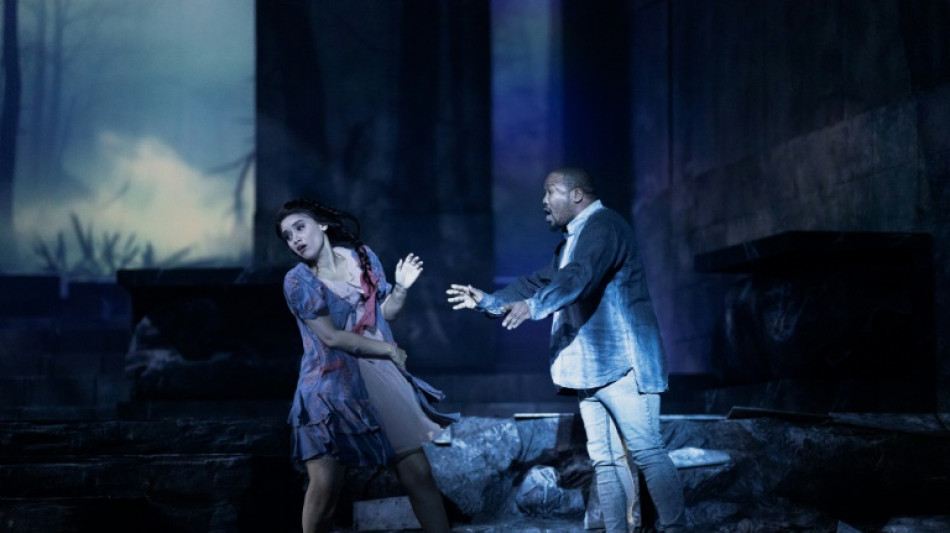
South Africa makes opera its own at home as its stars shine abroad / Photo: © AFP

 AVEVA and PETROJET Sign MoU for Digital Twin Projects in Egypt

 Daily Horoscope November 20, 2026: Astrological Predictions for All Signs

 Desire Under the Elms review - a horror show that bruises more than it moves

 Saudi PIF Retains Top Sovereign Wealth Fund Brand Title for Third Year

 Phoenix Weekend Guide: Sangria Socials, Pie Markets, and New Brunch Spots

 Trent Perry’s Late Heroics Lift No. 7 UCLA Past Cal State Fullerton

 2027 Hyundai Elantra Review: Brutalist Design and Expanded Dimensions
South African opera has developed its own uniquely local style -- both in the make-up of its casts and its dramatic themes -- in the three decades since the end of apartheid, experts argue.
With South African stars shining on the international stage, opera has boomed since racial barriers were scrapped in 1994, drawing in talent from the country's great choral traditions to carve out an important place in a hugely diverse cultural landscape.
Much of the change has been driven by the 25-year-old Cape Town Opera that is considered Africa's most successful company.
The grandfather of it all is Italian-born Angelo Gobbato, a former singer who co-founded the company five years after apartheid ended and was honoured in March with a lifetime achievement award for his contribution to South African opera.
When the company was starting out, Gobbato staged Donizetti's dramatic "Lucia di Lammermoor" with lead singers brought in from abroad.
The cast of a just-ended 25th birthday run of the same opera was entirely South African and featured only one white singer -- an illustration of the changes, he said.
After white-minority rule was scrapped, "we suddenly got a lot of interest from black students who wanted to be trained in opera," Gobbato, 81, told AFP.
"This was very unusual because at the Cape Town opera school we had so-called coloured students -- non-white students -- but no black students."
- Big-name singers -
His students, who include the internationally acclaimed Pretty Yende and Levy Sekgapane, often came from community choirs trained in the Western signing fashion. "They responded very naturally to opera and they wanted to sing it," said Gobbato, who has now retired.
And, as the casts have become more representative of South Africa's racial make-up, so too have the audiences.
"I feel like a grandfather," Gobbato said. "I haven't got physical children or grandchildren, but seeing students I am desperately proud of them and convinced that I have done something for the good of the country."
Opera in South Africa was once a niche performing art with mainly white audiences, said soprano Brittany Smith, the tragic heroine in this year's run of "Lucia di Lammermoor".
Now, "Cape Town Opera is standing on the forefront of reintroducing opera and making it more accessible to everyone and that makes us relevant," the 29-year-old told AFP while prepping for a rehearsal at the Nelson Mandela Theatre.
Smith highlighted the company's outreach programme that sends performers to schools and townships to show youngsters what it is all about.
The dramatic themes of opera are relevant to today's South Africa, said her co-star Conroy Scott, a deep baritone who developed his voice in church choirs.
- 'A South African genre' -
"It deals with real issues, with human emotion. It deals with issues that haven't really gone away -- politics, sex, violence, child abuse, death," the 43-year-old added.
Stagings of European opera classics post-apartheid have moulded a form that is distinctly South African in the portrayal of characters and music, with settings that are recognisable to local audiences, argued critic and author Wayne Muller.
A "La Boheme" was set in Cape Town's District Six area that was bulldozed by the apartheid authorities, Macbeth was played as a Central African militant leader, and Porgy and Bess confessed their love in the shacks of Soweto, he wrote in his 2023 book "Opera in Cape Town: The Critic's Voice".
"This process of transforming the arts and opera in South Africa has not ended by any means," Muller said.
"Nonetheless, there is an ease with opera as being African and the possibilities that even the standard Western European repertoire brings to make opera relevant here," the critic added.
"Opera, as scholars and artists have expressed, has become a South African genre -- an art form that is also from here."
E.Gasser--VB


