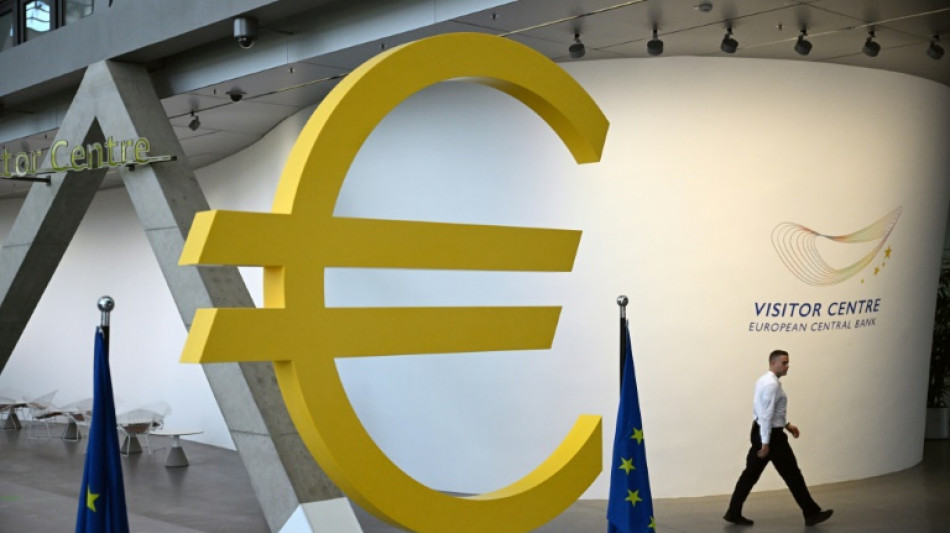
Eurozone inflation unexpectedly rises in July / Photo: © AFP/File

 AVEVA and PETROJET Sign MoU for Digital Twin Projects in Egypt

 Daily Horoscope November 20, 2026: Astrological Predictions for All Signs

 Desire Under the Elms review - a horror show that bruises more than it moves

 Saudi PIF Retains Top Sovereign Wealth Fund Brand Title for Third Year

 Phoenix Weekend Guide: Sangria Socials, Pie Markets, and New Brunch Spots

 Trent Perry’s Late Heroics Lift No. 7 UCLA Past Cal State Fullerton

 2027 Hyundai Elantra Review: Brutalist Design and Expanded Dimensions
The eurozone's annual inflation rate unexpectedly edged up in July due to rising energy costs, official data showed on Wednesday.
Consumer price increases in the single currency area reached 2.6 percent in July, up from a 2.5-percent rate in June, the EU's statistics agency said, higher than experts' forecast.
Economists surveyed by FactSet had predicted that inflation would ease to 2.4 percent in July.
The rise was thanks to energy prices, which accelerated in July to 1.3 percent, significantly higher than the 0.2 percent recorded last month, according to Eurostat.
Food and drinks prices rose by 2.3 percent this month, albeit at a slightly slower rate than the 2.4 percent registered in June.
Core inflation, which strips out volatile energy, food, alcohol and tobacco prices and is a key indicator for the bank, was unchanged at 2.9 percent in July, Eurostat said.
Experts for FactSet had expected it to cool to 2.8 percent.
The data proves inflation remains sticky since the eurozone recorded a rate of 2.6 percent in February this year despite slight drops to 2.4 percent before rising again.
It still remains above the European Central Bank's two-percent target.
But it has come down significantly since the peak of 10.6 percent recorded in October 2022 after energy prices soared following Russia's invasion of Ukraine.
That prompted the ECB to aggressively raise interest rates to cool red-hot inflation until it cut rates for the first time in five years last month.
The ECB held off from a second rate cut in July but there are expectations it will lower borrowing costs again in September.
- Eurozone economic growth -
Inflation also rose in Europe's two biggest economies, Germany and France, edging up to 2.6 percent in July from 2.5 percent in June in both countries.
Across the eurozone, Finland recorded the lowest inflation rate in July, at 0.6 percent, Eurostat data showed.
Latvia came second, registering 0.8 percent inflation this month.
Belgium remained the highest, reaching 5.5 percent in July.
The figures come out a day after official data showed the eurozone grew by 0.3 percent between April and June this year, slightly higher than the predicted 0.2 percent.
But there are concerns about the eurozone economy's lacklustre performance, especially when compared with the United States and China, which are growing at a faster rate.
S.Leonhard--VB


