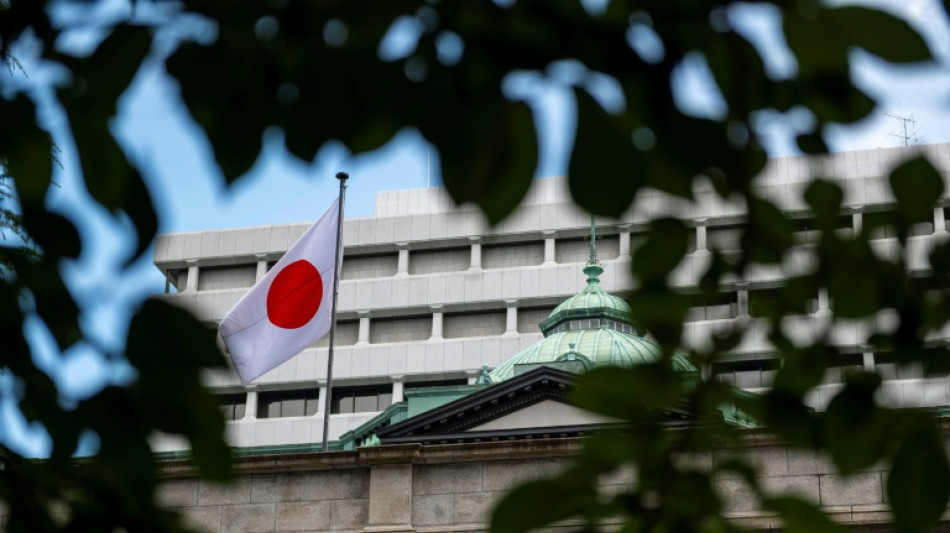
Bank of Japan raises key interest rate for second time in 17 years / Photo: © AFP

 AVEVA and PETROJET Sign MoU for Digital Twin Projects in Egypt

 Daily Horoscope November 20, 2026: Astrological Predictions for All Signs

 Desire Under the Elms review - a horror show that bruises more than it moves

 Saudi PIF Retains Top Sovereign Wealth Fund Brand Title for Third Year

 Phoenix Weekend Guide: Sangria Socials, Pie Markets, and New Brunch Spots

 Trent Perry’s Late Heroics Lift No. 7 UCLA Past Cal State Fullerton

 2027 Hyundai Elantra Review: Brutalist Design and Expanded Dimensions
The Bank of Japan lifted its main interest rate Wednesday for just the second time in 17 years in another step away from its long-standing ultra-loose monetary policies.
The central bank said in a statement it had set an interest rate of 0.25 percent -- up from around zero to 0.1 percent -- having ditched its maverick negative rate policy aimed at boosting economic growth in March.
Its decision, announced after a two-day policy meeting, caused the yen to surge briefly before weakening to levels above 153 per dollar.
"Moves to raise wages have been spreading" in Japan while "economic activity and prices have been developing generally in line with the bank's outlook", the BoJ said.
If the world's fourth largest economy moves in line with the bank's expectations, officials "will accordingly continue to raise the policy interest rate and adjust the degree of monetary accommodation", it said.
Analysts had been divided on whether the BoJ would hike rates, with some predicting policymakers would wait until the autumn because of sluggish consumption in Japan.
And while wages are rising -- with unions this year securing their biggest gains in three decades -- workers' pay has failed to keep up with the pace of inflation.
The bank is seeking to normalise its outlier ultra-loose policies, which have driven down the value of the yen.
But there has been concern about the impact a hike could have on economic growth.
Before the announcement, Stefan Angrick at Moody's Analytics warned that at best a small increase will be an added drag.
At worst, "it would tip the economy into recession and precipitate broader financial market disruptions", he said.
However, Hiroshi Namioka at T&D Asset Management told AFP a rate hike was "appropriate".
"The impact on the real economy, such as consumption and capital investment, will be limited," he said.
The yen has plunged against the dollar over the past two and a half years -- partly due to the BoJ's policy of maintaining ultra-low interest rates to support the economy, while other central banks have hiked theirs.
In early July it hit its weakest value since 1986 but it has strengthened since then -- triggering speculation among analysts that authorities had intervened.
The BoJ decision comes ahead of a policy announcement from the Federal Reserve due later in the day.
Analysts and traders are widely expecting another pause by the Fed while hoping for clues about a September rate cut.
W.Huber--VB


