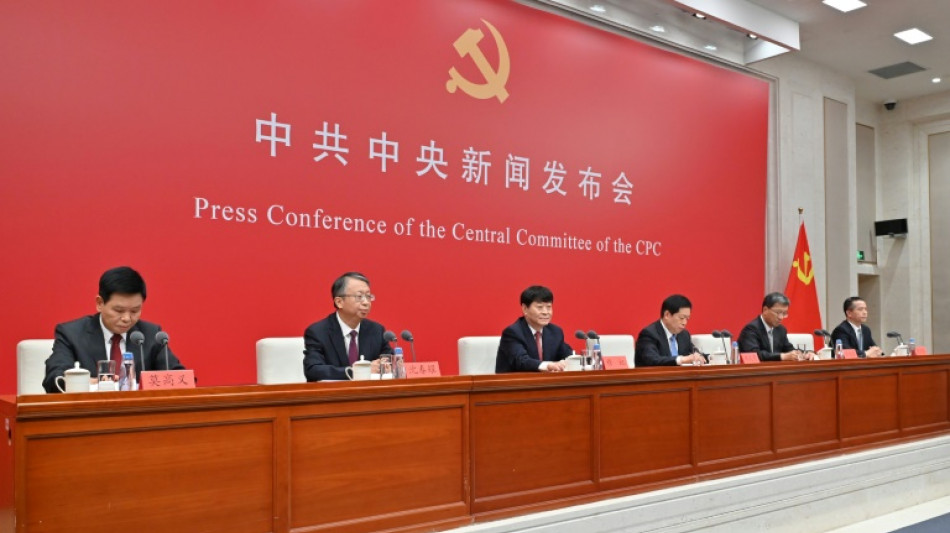
Beijing vows to ease local government debt woes after key meeting / Photo: © AFP

 ALIX LASERS shareholders remove Michael Sobitsch as managing director in view of the circumstances

 Progressive Vision Wins Irish Healthcare Awards 2026 Innovation Prize for Office-Based Cataract Surgery

 Eight-Year-Old Georgia Wins Penrith Valley Public Speaking Competition

 Steven Berkoff on Memory and His New Autobiography 'Shouting At Night'

 Jimmy Carr Confirms 25-Year Estrangement From Father Amid Podcast Reflections

 Arizona Superintendent Tom Horne to Leave Office, Plans Law Practice and Charter School

Chinese officials pledged Friday to help ease debt pressure on local governments through reforms to the tax system, after a key political gathering in the capital focused on jumpstarting the faltering economy.
All eyes were on how this week's Third Plenum of the Communist Party in Beijing, attended by President Xi Jinping, might tackle the deepening economic malaise.
But few new policies were announced as the meeting wrapped up Thursday, with officials pledging to tackle "risks" in the economy.
The world's second-largest economy is grappling with a property debt crisis, weakening consumption and an ageing population.
Adding further strain, local governments in China face a ballooning debt burden of $5.6 trillion, according to the central government, raising worries about wider economic stability.
Beijing sought to allay concerns at a Friday press conference featuring a lineup of officials.
"In response to the financial difficulties of local governments and basic organisations, it is proposed to refine the financial relationship between the central and local governments," said Han Wenxiu, an official responsible for financial and economic policy planning.
Authorities would seek to expand local sources of tax revenue and limit expenditure requirements on local governments that violated "regulations", Han said, without sharing specifics.
Fitch lowered its outlook on China's sovereign credit rating in April, citing soaring general government debt that it forecast would reach 61.3 percent of the country's gross domestic product this year.
Han also sought to allay fears over the struggling property market, long a key driver of national growth but now grappling with spiraling debt at some of its leading firms.
He said there had been recent "positive changes in the real estate market", noting that the next step was "eliminating the disadvantages of the previous model of high debt".
Earlier this week, China posted official statistics showing the economy grew by just 4.7 percent in the second quarter of the year.
It represented the slowest rate of expansion since early 2023, when China was emerging from a crippling zero-Covid policy that strangled growth.
Analysts polled by Bloomberg had expected 5.1 percent.
Beijing has said it is aiming for five percent growth this year -- enviable for many Western countries but a far cry from the double-digit expansion that for years drove the Chinese economy.
L.Stucki--VB

