Black truffle production booms in Spain / Photo: © STR/AFP

 Latvian partial election results suggest pro-European choice

 In Egypt's Sinai, Gazan builds school for children displaced by war

 Trump tariffs a mixed bag for US auto industry

 Yemen government forces say struck Houthi targets

 Music links past, present for Pedro Pascal's cellist in 'Behemoth!'

 ALEX BODI ȘI AMBASADORUL REPUBLICII SUDANUL DE SUD, GUM DOMINIC MATIOK, DISCUTĂ LA BERLIN DESPRE POSIBILITATEA ÎNFIINȚĂRII UNUI CONSULAT ONORIFIC LA BUCUREȘTI

 Dodgers step up World Series three-peat bid with 5-3 win over Braves

 Spain break down Czechs as England outclass Croatia in Nations League

 Yamal on target as Spain hold off Czech Republic

 Latvian exit polls suggest pro-European choice

 Lula, Bolsonaro wrap up campaigns ahead of knife-edge election
 Tuchel hails 'complete' England after Croatia demolition

 Fury to invite Trump to lead ring walk before Joshua showdown

 Fashion industry in 'precarious moment', says Vivienne Westwood supremo
 Seventh heaven for England in Nations League rout of Croatia

 Storms, flooding cause chaos on Greek holiday island of Crete

 #IAmJaneDoe: online support campaign in US university rape case

 Brazil shine on Selecao's first visit to India

 Zverev sets up Djokovic quarter-final at China Open, Rybakina out
 Happier at home, Bordeaux hammer Lyon in Top 14

 Lula, Bolsonaro in final push for votes ahead of knife-edge election

 Boisterous fashion week barnstorms 'sleepy' Nigerian capital

 UAE investigators say flydubai co-pilot was planning 'terrorist act'

 Rahul smacks century in India v Windies ODI

 Daryz seeks to join exclusive club of dual Arc winners

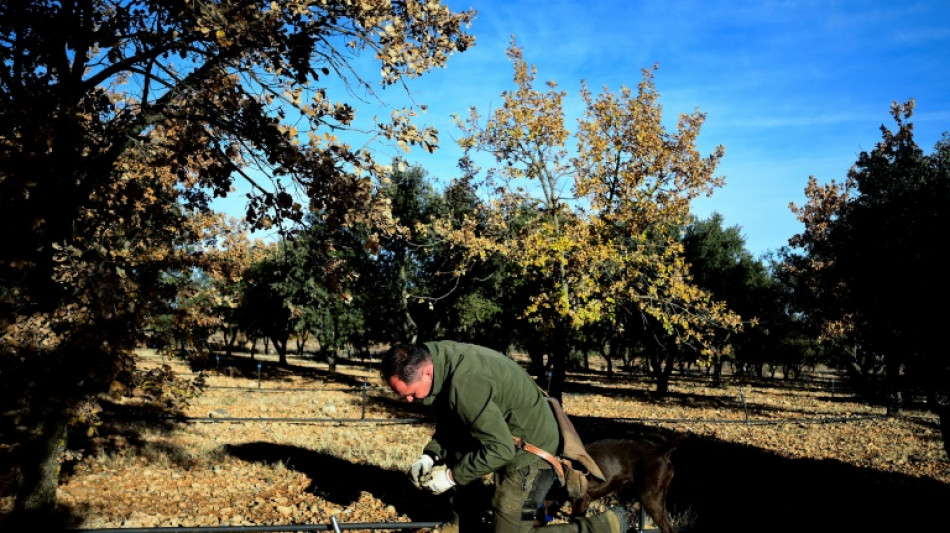
When Jose Soriano was a child, the hills near the village of Sarrion in Spain's remote and sparsely populated eastern province of Teruel were mostly uncultivated, covered in brush and rocks.
Now they are home to rows of oak trees, where large quantities of black truffles -- one of the most exclusive and expensive delicacies on the planet -- grow underground, nestled in their roots.
"Here everything revolves around truffles," said Soriano, who owns 30 hectares (74 acres) of land near Sarrion, which is home to some 1,200 people.
This athletic 38-year-old left his forest ranger job a few years ago to dedicate himself full time to cultivating black truffles, which grow among the roots of trees planted two decades ago by his father-in-law.
"It was complicated doing both things at the same time," said Soriano as he petted his dog, Pista. "In the end you earn more with truffles."
The setter has been trained to hunt for the underground fungi, which look like knobbly balls of damp mud and offer a unique taste when added to dishes.
Production of "tuber melanosporum", the scientific name for black truffles, has soared in recent years in Spain, which is now the world's leading producer of the delicacy.
Often called "black diamonds", the truffles can fetch up to 1,500 euros ($1,600) per kilogramme.
"The land here is very poor. Not much grows. But paradoxically this type of terrain appeals to the truffle," Daniel Brito, head of the Teruel Association of Truffle Growers, said of the province's limestone terrain.
- 'It's a lifeline' -
Spain produced around 120 tonnes of black truffles in 2022.
That is four times more than the 30 tonnes harvested in Italy and three times the 40 tonnes produced in France, which until recently was the world's top producer.
And roughly 80 percent of Spain's black truffles come from the area around Sarrion, which has 8,000 hectares of black truffle cultivation, making it the world's biggest source.
The village holds an annual fair dedicated to black truffles, which Brito said were exported from the region to the "whole world".
Extensive irrigation is behind this success, he said, along with the widespread use of controlled mycorrhisation -- a technique that creates a symbiotic association between the truffle fungus and the root of the tree.
The truffles extract sugar and water from their host tree's roots and in return feed soil nutrients back into the tree.
Under the right conditions this allows "for a much bigger crop" of black truffles, Brito said.
For villages in the area, which like much of the Spanish interior have struggled with a shrinking population as people move to urban areas in search of more opportunity, the boom in truffle production has been something of a miracle.
"For those who want to stay here, it's a lifeline," said Sarrion's 32-year-old mayor, Estefania Donate.
- 'A lot of work' -
Before the truffle boom began in the 2000s, the village was losing its younger inhabitants due to a lack of jobs and prospects.
Now the population is inching up, with the village school experiencing a jump in enrolment.
"There is very little unemployment here... It's more housing that we're short of," Donate said.
"The truffle brings life... We even attract a few tourists," she added.
The success of the truffle sector remains fragile, though.
Truffles can not go for long without water and "love the cold", so changing weather patterns -- with warmer winters and less rain -- are "worrying", Brito said.
"We have managed to stabilise production thanks to irrigation," he added.
Truffle cultivation "requires a lot of work and investment" because trees only begin to produce them after 10 years and, like all fungi, truffles are "unpredictable".
T.Ziegler--VB