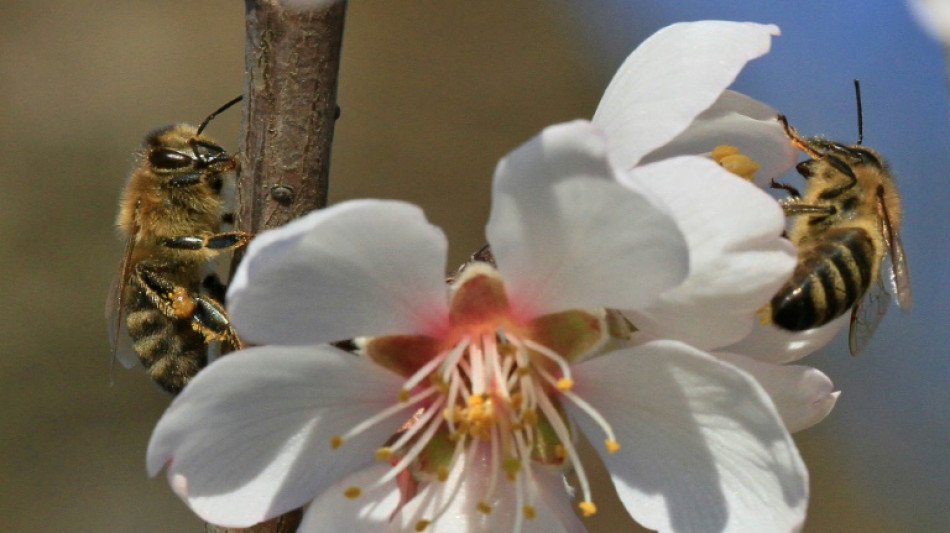
Biodiversity loss threatens economic stability: central banks report / Photo: ©

 Newcomers South Korea face holders Italy in Davis Cup finals

 Japan's Kojima sounds Marchand warning with Asian Games gold

 England rugby star Pollock signs new Northampton deal

 STARTRADER Expands Its Chinese Equity CFD Range with CXMT and Unitree Robotics

 MEXC Expands Opportunity Compass with Stock Trading Handbook to Help Crypto Users Build Investment Knowledge

 England paceman Wood retires from international cricket

 Magnificent Mandhana's 79 helps India to Asian Games cricket gold

 Marchand 'stressed' about racing Japanese rivals at LA Olympics

 Mobile boat clinics bring healthcare to India's remote islands
 Former India paceman Zaheer Khan named Chennai coach in IPL

 Six-year-old Chinese girl sets world record with Rubik's Cube
 Swimming prodigy Yu, 13, says 'interviews way harder than racing'

 Star coaches make their bows as Nations League returns
 Rams bounce back as Giants reel from Dart injury

 In Bangladesh, Pakistan's Jinnah photo stirs anger

 Two New Zealand naval ships transit Taiwan Strait

 Zidane gets down to work as France start new era

 Inside the Venezuelan prison meant to 'drive you insane'

 UK king braces as memoir by Diana's brother goes on sale

 No green light to lift EU sanctions on Russian oligarchs, talks to resume

 UK agrees support for Saudi in struggle with Houthis: reports

 EU foreign policy chief calls for continued sanctions on Russia

 Flights scrapped, evacuations urged as Typhoon Dujuan wallops Japan

 Fonseca to take break from tennis

 A Cuban zoo, and its animals, in epic battle for survival

Central banks have underestimated the significant threat posed by biodiversity loss, a new report said Thursday, warning that financial institutions and businesses were destroying the natural assets that they depend on.
While climate change is increasingly factored into calculations of systemic economic risks, the report by central bankers, financial supervisors and academics said the comparable threats from the biodiversity crisis had only recently begun to be appreciated.
"Biodiversity supports all life on our planet," said Ravi Menon, chairman of the Central Banks and Supervisors' Network for Greening the Financial System, in his foreword to the report.
"But we are eroding this biodiversity at a pace that is severely damaging the natural ecosystems that provide us with food, water and clean air. This in turn could pose significant risks to economic, financial and social stability."
The report, compiled with input from dozens of central banks, comes amid international negotiations in Geneva to thrash out a global deal to protect nature up to mid-century that has been compared to the Paris Agreement for climate change.
Some 200 nations are set to sign off on this biodiversity framework, which includes a proposal to protect 30 percent of the world's habitats, at the UN's COP15 conference later this year in China.
The new report stressed the impact the financial system can make on biodiversity, through lending, investment and insurance choices.
- Appetite for destruction -
It also underscored how dependent economic and financial systems are on healthy and functioning ecosystems and the risks that arise when these natural processes are damaged.
For example, crops yields are threatened by losses of pollinator species, which are caused by the destruction and break-up of habitats, pesticide pollution, and climate change.
Meanwhile, deforestation can cause changes not just to the local habitat, but the hydrological cycle as well, it said, noting research suggesting human pressures could cause the Amazon rainforest to pass a tipping point that would transform it into a savannah.
The Inter-American Development Bank has estimated that policies to prevent the Amazon reaching this threshold -- curbing deforestation, investing in sustainable agriculture, improving fire management -- would generate approximately $339.3 billion in additional wealth.
Researchers did, however, also warn that transition to a global economy that protects nature creates its own potential challenges.
"It's not that these government policies are wrong," said Nick Robins, of the Grantham Research Institute on Climate Change and the Environment at the London School of Economics, who was co-chair of the study group behind the report.
"It's just that maybe the current investments of these businesses and financial institutions are misaligned with a healthy ecosystem."
The report said some countries had begun to take action, but it urged central banks to come up with a coordinated global response to the biodiversity crisis.
"Inaction is also a choice" with inherent costs, said Robins, stressing that threats to nature should be integrated into the risk outlooks and calculations of central banks.
"Biodiversity loss is a threat to financial stability," he added.
J.Bergmann--BTB