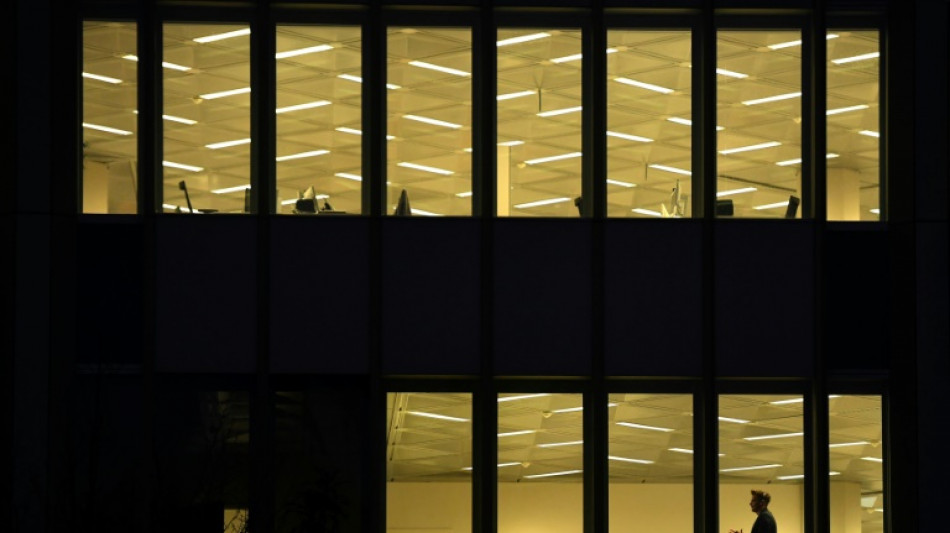
Europe's economic powerhouse tests a shorter working week / Photo: © AFP

 Zverev thrashes Shang to set up Djokovic quarter-final at China Open

 Turkey football ref chief jailed pending trial for graft
 North Korea says test of intermediate-range strategic missile included use of AI

 Rampant Sayers leads Hong Kong to third men's rugby gold in a row

 Ethiopia's Tigray rebels abandon regional capital as govt advances

 Bulgaria's Tsar Samuel returns 'home' after 1,000 years

 'Glad it's over': Kim powers to Games gold and military exemption

 After 11 World Cups, football finally comes home for one Indian fan

 Marc Marquez wins sprint at Japan MotoGP, Martin grabs pole

 Alcaraz fends off Arnaldi to reach Japan Open quarters

 Antonelli tops times in final practice at Bahrain GP
 Gauff digs deep to beat Osorio in China Open second round

 Fresh protests to hit Spain after housing measures defeated
 'He's here with me': Japan cycle queen dedicates gold to late brother

 Japan Olympic chief says 'lot more' athletes at Games than expected
 Asian carmakers besting US rivals at home, China poised to strike

 Widgets & Web Offers All-Inclusive Investor Relations Websites for Public Companies, IPOs and SPACs

 Adams named new US captain to 2030 World Cup

 China a better influence in Latin America than US: poll

 Judge pauses construction of border project in Texas national park

 Belgium's De Bruyne fires double to sink Turkey, France held by Italy

 US jobs data boosts stocks as oil prices dip

 US Supreme Court to hear high-stakes climate case

 Trump expected to name intel chief Clayton as AI czar: reports

 Argentina unveils passports-for-investment scheme

Maximilian Hermann's weekend starts on Friday morning, when he puts his motorcycle helmet on and takes his bike out for a ride to the southern German Alps.
Like all his colleagues, the 29-year-old project manager shifted to a four-day week at the beginning of the year and is making the most of it.
His new, shorter working hours are part of a trend that is gaining traction in Germany, where companies are looking to balance between worker shortages and the need to stay competitive.
Among the pioneers of the four-day week is Hermann's employer KlimaShop, a purveyor of heat pumps and air-conditioning systems based near Augsburg in southern Germany.
Instead of working 40 hours a week across five days, Hermann now spends a total of 38 hours at work over four working days.
Otherwise put, each of KlimaShop's 30 employees works an hour-and-a-half more for each day they are in the office, while having an extra day to themselves each week.
Hermann's colleague Michael Pankoke sees the shift switch as "big progress".
"You work much more intensely, everything you do is more precise," the 58-year-old customer advisor told AFP.
- Test run -
Management consultancy Intraprenoer is leading the first large-scale experiment with the shorter schedule in Germany together with the organisation 4 Day Week Global, which has already run similar trials in other countries, such as the United Kingdom.
Starting in 2024, up to 50 companies of varying size are set to test the new hours, with the aim of avoiding a drop-off in productivity.
Intraprenoer, which already "abolished Friday" for its workers in 2016, said it has 33 interested candidates for the trial.
But an increasing number of businesses in Europe's largest economy have already taken the leap.
Wolfgang Schmidt, the founder of a manufacturing business near Hamburg, in the north, said he flipped his staff onto a four-day week at the end of 2022 to save his employees, some of whom commute long distances, "fuel and money".
In nearby Wedel, the town administration has introduced a four-day week to attract more "competent and motivated" workers.
During the annual round of wage negotiations in the steel industry, starting in November, Germany's biggest union IG Metall will call for the introduction of a four-day week with hours reduced from 35 to 32, for the same pay.
Beyond a better work-life balance and increased productivity, the move would reduce "one of the highest rates of part-time employees of Europe", said Sophie Jaenicke, working time lead at IG Metall.
According to a study by the Hans-Boeckler foundation, fully 81 percent of Germans would support a shift to a four-day week.
- Lukewarm -
While in Belgium workers have had the right to ask for a four-day week with the same number of hours since the end of 2022, in Germany, workers and employers agree their own work times up to a maximum 48 hours a week.
Enthusiasm for the idea of a shorter week is lukewarm among many managers and economists, however. A 20 percent reduction in working hours would have "a disastrous economic impact", according to economist Holger Schaefer.
While "limiting unproductive activities and condensing work" is still feasible in the office, all the options for increasing productivity in industry have already been exhausted, said Schaefer from the IW economic institute in Cologne.
With the labour supply already stretched by the exit of the baby-boomer generation from the work force, cutting hours would lead "inevitably to a reduction in the amount of goods and services produced", he warned.
A shorter week was, in short, an "unrealistic dream", said Michael Huether, also of the IW economic institute in Cologne. Instead the solution to labour shortages would be longer, not shorter hours, he said.
H.Weber--VB