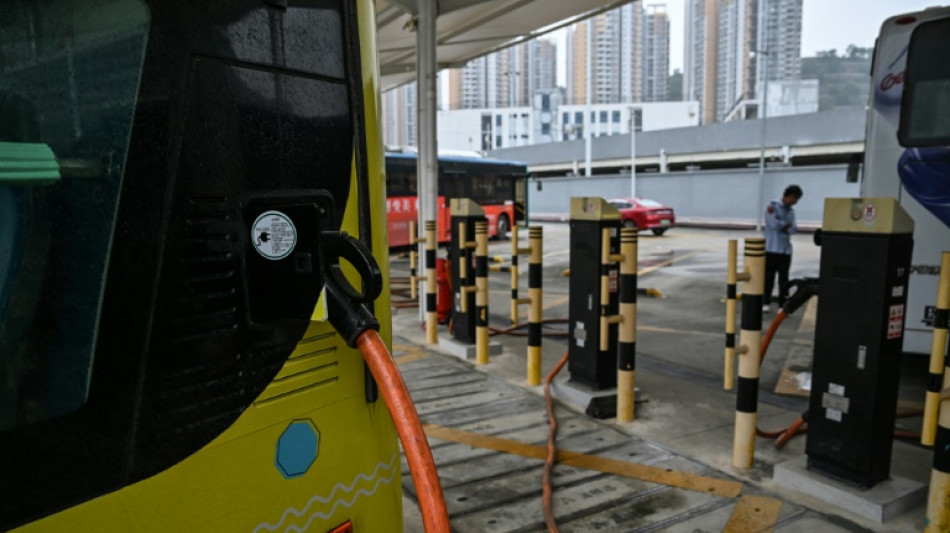
China's electric bus revolution glides on / Photo: © AFP

 Zverev thrashes Shang to set up Djokovic quarter-final at China Open

 Turkey football ref chief jailed pending trial for graft
 North Korea says test of intermediate-range strategic missile included use of AI

 Rampant Sayers leads Hong Kong to third men's rugby gold in a row

 Ethiopia's Tigray rebels abandon regional capital as govt advances
 Bulgaria's Tsar Samuel returns 'home' after 1,000 years

 'Glad it's over': Kim powers to Games gold and military exemption

 After 11 World Cups, football finally comes home for one Indian fan
 Marc Marquez wins sprint at Japan MotoGP, Martin grabs pole

 Alcaraz fends off Arnaldi to reach Japan Open quarters

 Antonelli tops times in final practice at Bahrain GP

 Gauff digs deep to beat Osorio in China Open second round

 Fresh protests to hit Spain after housing measures defeated

 'He's here with me': Japan cycle queen dedicates gold to late brother

 Japan Olympic chief says 'lot more' athletes at Games than expected
 Asian carmakers besting US rivals at home, China poised to strike
 Widgets & Web Offers All-Inclusive Investor Relations Websites for Public Companies, IPOs and SPACs

 Adams named new US captain to 2030 World Cup

 China a better influence in Latin America than US: poll

 Judge pauses construction of border project in Texas national park

 Belgium's De Bruyne fires double to sink Turkey, France held by Italy
 US jobs data boosts stocks as oil prices dip

 US Supreme Court to hear high-stakes climate case

 Trump expected to name intel chief Clayton as AI czar: reports

 Argentina unveils passports-for-investment scheme

On a rainy afternoon in Shenzhen, damp passengers jostle their way onto the megacity's buses, the quiet foot soldiers of an electric revolution for coal-guzzling China's public transport network.
Shenzhen ditched diesel buses and went fully electric in 2017 -- a world first -- with its taxi fleet not far behind.
Other Chinese cities have since followed suit, with many aiming to fully switch their systems before 2025.
"Electrification is one of the most important strategies" for reaching net-zero carbon emissions by 2050, according to the International Energy Agency (IEA), with bus decarbonisation representing around five percent of cumulative emissions reductions in transport.
But so far China is an outlier, accounting for over 90 percent of the world's electric buses and trucks in 2021, according to the International Council on Clean Transportation (ICCT).
"It didn't happen in a night," EV specialist Elliot Richards told AFP.
"It was many years of planning and huge amounts of infrastructure work. But it's made such a huge difference in terms of global awareness."
Wrangling over the path to a net-zero future will be at the heart of the United Nations' upcoming COP28 climate summit in oil-producer Dubai, which begins in late November.
So far though, budget and planning constraints, a lack of knowledge and the difficulty of rejigging infrastructure in older cities have prevented others from replicating China's experience, Richards said.
- Step-by-step -
At a Shenzhen bus depot, driver Ou Zhenjian told AFP he had been ferrying passengers around the city for 18 years and saw a "big difference" with the shift to electric.
"It is really comfortable to drive... easy to operate, and environmentally friendly. It's soundless too -- it's great to drive like this."
"At the beginning of the service, we had to step-by-step solve problems," Ethan Ma, deputy general manager of the Shenzhen Bus Group (SZBG), told AFP.
"Now we can say we almost have the same technical performance of our e-buses compared to diesel buses in the past."
There have been other, more obvious benefits.
For a huge metropolis crisscrossed by four-to-five lane avenues, traffic noise is noticeably subdued.
"(Diesel buses) emitted a lot of exhaust... Especially when walking on the road, the smell made me very uncomfortable, but now it's gone," a young male passenger told AFP as the bus purred through the city.
- 'Political will' -
A World Bank case study on SZBG, the city's largest public transport operator, found emissions from an e-bus over its service time were 52 percent that of a diesel bus.
The analysis takes into account the fact that the local grid generates about half its electricity from coal, and found the switch had saved 194,000 tonnes of carbon dioxide annually.
Pollution in Chinese cities was a major factor pushing the central government to prioritise the switch in public transport, said Tu Le, managing director of Sino Auto Insights.
And that top-down directive was key, with the World Bank noting transition "not only depends on technology but also political will".
"They were thinking about this way before any other country was even considering it," said Le.
Strong government financial support and close collaboration with automaker BYD -- then a fledgling, now a giant in the global EV field -- greatly contributed to success in Shenzhen.
By 2021 China supplied more than 90 percent of the world's e-buses, according to the ICCT.
The changes are already having a measurable effect.
In September, the IEA chief said the growth of electric vehicles globally -- especially in China -- meant oil demand was on course to peak before 2030, and coal "in the next few years".
- Coal-sourced electricity -
However, China remains the world's largest emitter, with the IEA predicting it will account for 45 percent of the global total from now until 2050, and the country relies on coal for nearly 60 percent of its electricity.
Last year, Beijing approved the largest expansion of coal-fired power plants since 2015, despite President Xi Jinping pledging to peak CO2 emissions between 2026 and 2030.
China is investing heavily in renewable energy, but "they need the coal to cover the gaps in the grid for the time being", said Richards.
"Even 100 percent coal-fired power (for EV charging) wins over gasoline though" in terms of emissions, said David Fishman, energy consultant at The Lantau Group.
For SZBG's Ma, the switch to electric has given the company a new outlook.
"We don't consider ourselves anymore as a pure bus operator, but a new energy service operator or provider," he said.
Bus systems in 10 other cities in Guangdong province are now fully electric, as is the eastern city of Hangzhou's.
And over 90 percent of the bus systems in major cities like Beijing and Shanghai have made the switch.
Less developed power grids and charging infrastructure, as well as maintenance issues, have slowed progress in smaller cities, said Sino Auto Insights' Le.
Still, he predicts seeing "a high percentage -- in the 70s -- of the whole country's networks electrified by 2030, no problem".
R.Flueckiger--VB