Crypto provides fix for some in crisis-hit Afghanistan / Photo: ©

 Newcomers South Korea face holders Italy in Davis Cup finals

 Japan's Kojima sounds Marchand warning with Asian Games gold

 England rugby star Pollock signs new Northampton deal

 STARTRADER Expands Its Chinese Equity CFD Range with CXMT and Unitree Robotics

 MEXC Expands Opportunity Compass with Stock Trading Handbook to Help Crypto Users Build Investment Knowledge

 England paceman Wood retires from international cricket

 Magnificent Mandhana's 79 helps India to Asian Games cricket gold

 Marchand 'stressed' about racing Japanese rivals at LA Olympics

 Mobile boat clinics bring healthcare to India's remote islands

 Former India paceman Zaheer Khan named Chennai coach in IPL

 Six-year-old Chinese girl sets world record with Rubik's Cube

 Swimming prodigy Yu, 13, says 'interviews way harder than racing'
 Star coaches make their bows as Nations League returns

 Rams bounce back as Giants reel from Dart injury

 In Bangladesh, Pakistan's Jinnah photo stirs anger

 Two New Zealand naval ships transit Taiwan Strait

 Zidane gets down to work as France start new era
 Inside the Venezuelan prison meant to 'drive you insane'

 UK king braces as memoir by Diana's brother goes on sale
 No green light to lift EU sanctions on Russian oligarchs, talks to resume

 UK agrees support for Saudi in struggle with Houthis: reports

 EU foreign policy chief calls for continued sanctions on Russia

 Flights scrapped, evacuations urged as Typhoon Dujuan wallops Japan

 Fonseca to take break from tennis

 A Cuban zoo, and its animals, in epic battle for survival

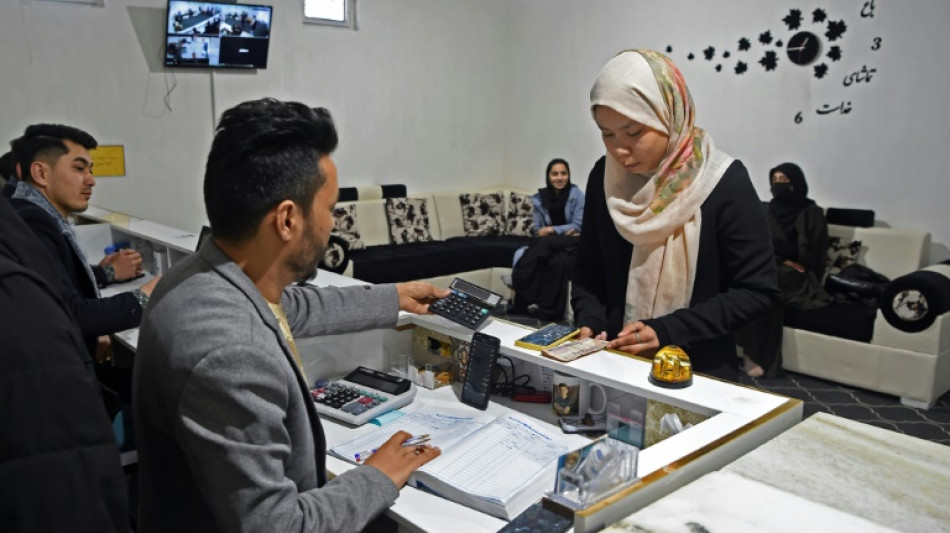
In the middle of a bazaar in western Afghanistan, Arezo Akrimi takes out her smartphone and, after a few taps of the screen, changes some cryptocurrency for a bundle of hard cash.
Arezo, 19, is one of a hundred students in Herat receiving around $200 a month in cryptocurrency since September thanks to an American NGO Code To Inspire.
This sum, which she converts at a bureau de change into Afghanis, is crucial for the rent and to help feed her family of six.
Since the Taliban returned in August, Afghanistan's economy has virtually collapsed and the country is in the grip of a crisis caused by the seizure of billions of dollars of assets held abroad.
But digital currencies and their decentralised architecture, impervious to international sanctions, are allowing a handful of young Afghans to avoid the worst of the crisis.
"It was very surprising for me to learn that this could be used in Afghanistan," Arezo told AFP. "It was really helpful."
Code To Inspire was founded to teach computer programming to women in Herat, but its hi-tech approach is now also helping students get funds in the economically deprived nation.
Bank transfers to Afghanistan are almost impossible currently, to prevent funds from falling into the hands of Islamist fundamentalists.
But even those with money in a bank struggle to get it out -- individuals are limited to withdrawing the equivalent of $200 a week, and businesses $2,000.
Customers have to queue for hours even for those transactions.
Cryptocurrency transfers have allowed the NGO to circumvent these obstacles while ensuring that each donation gets to those who need it most, founder Fereshteh Forough told AFP.
"Crypto is an incredible way to overcome all kinds of political and economic sanctions, but also a tool that can change the lives of people living in an authoritarian regime," says the American, whose parents fled Afghanistan in the 1980s.
To guarantee the financial security of its students, the NGO avoids paying them in bitcoins, the best-known cryptocurrency but whose price regularly swings wildly.
Instead, it favours the BUSD, a so-called "stablecoin" whose price is backed by the dollar.
"One BUSD is one dollar," says Forough.
- Crypto coverts -
Beyond this humanitarian initiative, cryptocurrencies are gaining other followers in Herat, according to forex dealer Hamidullah Temori.
He has seen an influx of new customers over the past six months, many of whom regularly come to convert cryptoassets sent by relatives from abroad into Afghanis.
"Since the Taliban came to power (cryptocurrency) transfers to and from abroad have increased by 80 percent," he told AFP.
Transfers are instantaneous and commissions are much lower than transactions made through Western Union or hawala, the over-the-counter system traditionally favoured by Afghans.
In Kabul, Noor Ahmad Haidar has become a crypto convert by force of circumstance.
The young man, who started exporting saffron to the United States, Britain, Australia and Canada in early 2021, now has 90 percent of his orders paid for in bitcoins.
"I avoid going through the chaotic process of bank transfers," he says.
"Since August, it has really become the only option available, and the most convenient for me."
Its growing popularity in Afghanistan was noted by Chainalysis in its 2021 Global Cryptocurrency Adoption Index, which ranked the country 20th out of 154 countries for "grassroots take-up".
"I don't think it's just in response to the Taliban taking over," says Kim Grauer, the firm's director of research.
"It's also because we're at a time when there are more solutions that allow you to trade cryptocurrencies on your phone and more people understand what it is."
Still, while the momentum is growing the volume of trading remains very low, and will remain so due to the lack of internet access and high levels of illiteracy in Afghanistan, she says.
- 'Very good protection' -
But for those who can venture into this world, cryptocurrencies could be a lifeline.
Besides his studies, Ruholamin Haqshanas writes from Herat for India-based media specialising in new technologies.
Since the advent of the Taliban his salary, paid entirely in stablecoins, has allowed him to absorb the galloping inflation and the free fall of the Afghani.
"The stablecoins offer a very good protection against the loss of value of the currency," says the 22-year-old student, who now earns more than his doctor father.
The young man is also trying to speculate on some of the more volatile crypto-currencies, thanks to the advice of a WhatsApp group with 13,000 members in Herat.
Fellow student Parisa Rahamati earned $600 in February hedging on the price of decentralised currencies such as Ethereum and Avax -- a windfall she shared with her widowed and unemployed mother.
"You have to be willing to take risks," confides the 22-year-old.
"Crypto is 50/50... you can double your bet or go to zero."
F.Pavlenko--BTB