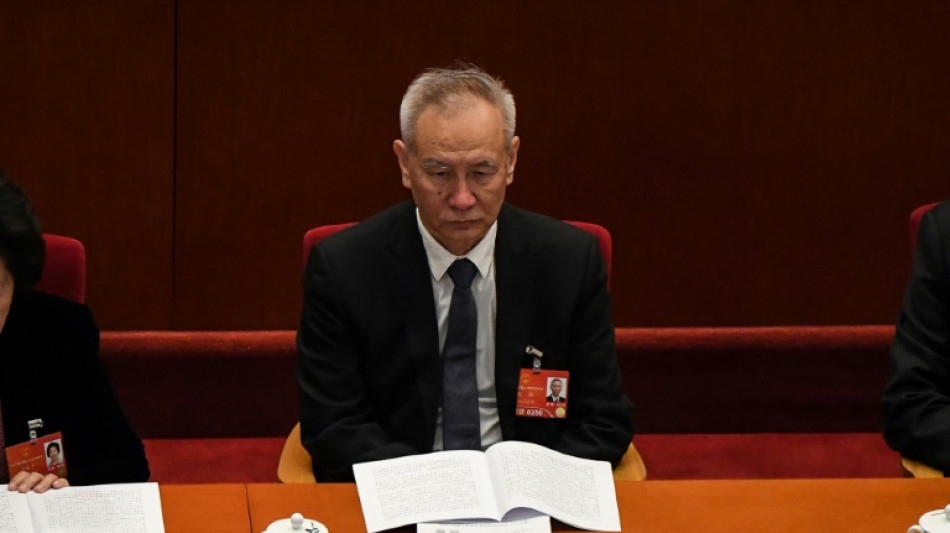
Beijing's vow to stabilise the market has worked... for now / Photo: ©

 Jimmy Carr Confirms 25-Year Estrangement From Father Amid Podcast Reflections

 Arizona Superintendent Tom Horne to Leave Office, Plans Law Practice and Charter School

 Japan and Peru Mark 150 Years of Diplomatic Ties Amidst Trade and Investment Talks

 Ian Jackson Scores Game-High 22 Points After Rick Pitino's Prank Suspension

 Khan Welcomes Milburn’s Youth Employment Reforms Amid High NEET Rates

An unexpected pledge by top Beijing officials this week to shore up the economy sent Asian stocks surging after days of jitters over China's coronavirus rebound, war in Ukraine and an uncertain property market.
It was seen as a sign of China's economic planners acknowledging anxiety over hot-button issues from tech and real estate to listings abroad.
But the soothing words -- delivered after a meeting chaired by Vice Premier Liu He -- are yet to be matched by hard policy decisions.
So what does it all mean?
What has China said and why?
Top financial leaders on Wednesday said they would maintain capital market "stability", support overseas IPOs and reduce risks involving troubled property developers -- whose problems repaying debts have threatened to destabilise the economy.
Their meeting called for policies "beneficial to markets", indirect but instructive language on government concerns which sent shares -- tech stocks in particular -- soaring in Hong Kong.
The comments come as China's annual growth target of around 5.5 percent -- its lowest in decades -- has been challenged by coronavirus resurgences, a property slump and global uncertainty following Russia's invasion of Ukraine.
Reprieve for tech ?
The announcement was music to the ears of investors in Chinese tech firms, which had been flayed for more than a year by a state crackdown on the sector.
Regulators have targeted everything from their market size to data use, rocking share prices, wiping billions off company valuations and smothering IPOs outside of China.
Scrutiny has hit some of the country's biggest names, including Alibaba and Tencent, pushing once-proud billionaire tech doyens into the shadows.
The latest guidance, which called for more "predictable regulation" of the tech sector, suggests some parts of government are willing to signal more clearly ahead of policy changes.
"It is notable, very notable, that Liu He himself would feel the need to step in," Kendra Schaefer, head of tech policy research at consultancy Trivium, told AFP, forecasting "a more measured approach to reform and regulation".
Yet, she cautioned that scrutiny of the tech behemoths -- which dominate everything from shopping to ride hailing -- and the way they use the public's data "isn't going away".
What about real estate?
China's heavily indebted property sector has sagged under rules dubbed the "three red lines", which targeted debt ratios to reduce the risks of companies going bust.
The rules challenged developers' models of endless debt-driven expansion and major firms have been pushed to the brink of collapse.
Wednesday's statement offered some solace to the bruised sector, experts said.
"One important signal was from the Ministry of Finance, which indicated that there are no plans to expand trials of property tax reforms," said IHS Markit's Asia-Pacific chief economist Rajiv Biswas.
But the statement did not indicate a change to the "three red lines" policy or offer hope of government bailouts to stricken companies.
"The government is unlikely to provide any large-scale support that would benefit distressed developers," said Lucror Analytics' senior credit analyst Leonard Law, although "emphasis on stability may help stem the negative spiral".
And what now for US listings?
Beijing launched security probes on several US-listed Chinese companies after a controversial New York IPO by ride-hailing giant Didi Chuxing went ahead last year despite regulator warnings.
The dim view of US listings came as Washington and Beijing's relations sank to a nadir.
Wednesday's meeting said regulators in China and the US had made "positive progress" on the issue of US-listed Chinese stocks.
Both sides are working towards a cooperation plan, guidance from the meeting said.
The reassurance is backlit by war in Ukraine and US warnings of severe sanctions on anyone who helps Russia.
"The last thing Beijing wants on top of everything else is any form of capital flight," ACY Securities chief economist Clifford Bennett told AFP.
While the responsivity from the top to market sentiment is telling, Hong Hao of financial services firm Bocom International warned "it's a very high-level announcement... We still have to wait for detailed implementation."
M.Furrer--BTB


