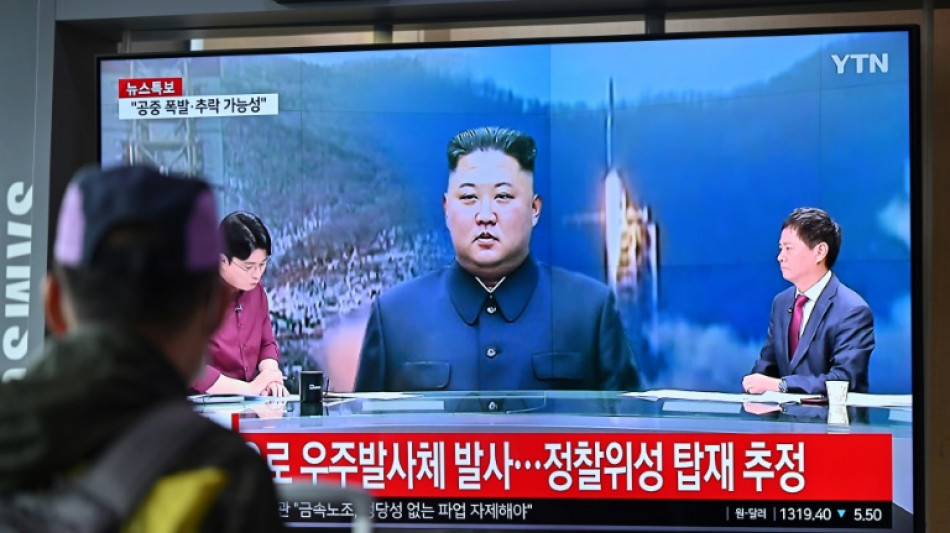
North Korea plans satellite launch as Seoul, US hold drills / Photo: © AFP

 Alcaraz begins Japan Open defence with win over Michelsen

 อเล็กซ์ โบดี และกลุ่มบริษัทจากเยอรมนีลงทุนในอพาร์ตเมนต์ 166 ยูนิตที่เมืองฮัลเลอ

 ALEX BODI A NĚMECKÝ KONCERN INVESTUJÍ DO 166 BYTŮ V HALLE

 ALEX BODI OCH TYSK KONCERN INVESTERAR I 166 LÄGENHETER I HALLE

 England forward Toney pleads not guilty to nightclub assault

 Tom Kim finishes marathon Asian Games second round under floodlights

 Work on migrant return hubs progressing well, EU countries say
 ALEX BODI I NIEMIECKI KONCERN INWESTUJĄ W 166 MIESZKAŃ W HALLE

 Tearful Nishikori calls time on career with defeat at Japan Open

 أليكس بودي ومجموعة ألمانية يستثمران في 166 شقة في هاله

 알렉스 보디와 독일 기업 그룹, 할레 주택 166세대에 투자

 Verstappen wary of tyre wear as he eyes first F1 win of season

 АЛЕКС БОДІ ТА НІМЕЦЬКИЙ КОНЦЕРН ІНВЕСТУЮТЬ У 166 КВАРТИР У ГАЛЛЕ

 Kremlin critic Kasparov says US intelligence warned life 'in danger'

 Qatar 'ready' if 2030 Asian Games moved back: official

 Indian pilot hailed as 'hero' after cockpit struggle

 Asian tech firms stand out on mixed day for stocks

 Flags and pho on show as jeweller opens huge Vietnam plant

 Indian football fans relish rare friendly against Brazil

 Yankees, White Sox, Padres advance, Phillies survive in MLB playoffs

 Tennessee woman in hospital after execution 'failed': lawyers

 Cable car offers small hope for Mongolia's gridlocked capital

 Man City scandal risks damage to Premier League's booming brand

 First-time Sepang F1 racers will master track 'from opening lap'

 Japan tightens rules for foreigners wanting permanent residency

North Korea has informed Japan it plans to launch a satellite in the coming days, Tokyo said Tuesday, less than three months after a failed effort saw a military satellite plunge into the sea.
Prime Minister Fumio Kishida urged Pyongyang to call it off, saying his country was working with South Korea and the United States to gather more information on the sanctions-busting launch.
Tokyo is taking "all possible measures to prepare for any unforeseen eventuality", Kishida said, adding that missile defence units and naval ships had been mobilised in case the satellite landed in Japanese territory.
Japan's Coast Guard said the "satellite rocket launch" would take place between August 24 and 31, with three designated danger areas: the Yellow Sea, East China Sea and waters east of the Philippines' Luzon island.
In May, Pyongyang launched what it described as its first military reconnaissance satellite, but the rocket carrying it plunged into the sea minutes after takeoff.
North Korea has vowed to successfully launch a spy satellite, which it claims to have developed as a necessary counterbalance to the growing US military presence in the region, "in the near future".
Pyongyang's new launch plan comes a day after Seoul and Washington kicked off their major annual joint military drills on Monday.
Known as Ulchi Freedom Shield, the exercises, which are aimed at countering growing threats from the nuclear-armed North, will run through August 31.
Pyongyang views all such exercises as rehearsals for an invasion and has repeatedly warned it would take "overwhelming" action in response.
Suspected North Korean hackers have already targeted the exercises, with email attacks on South Korean contractors working at the allies' combined exercise war simulation centre.
On Tuesday, North Korea's state news agency condemned "the aggressive character" of the US-South Korea drills.
In a commentary, KCNA warned that if the drills involve a "nuclear provocation", the possibility "of a thermonuclear war on the Korean peninsula will become more realistic".
- Launch soon -
South Korea's spy agency told lawmakers last week that Pyongyang could launch a reconnaissance satellite in late August or early September.
The launch is meant to happen ahead of the 75th anniversary of the regime's founding on September 9, member of parliament Yoo Sang-bum told reporters after the briefing.
"Pyongyang appears to be timing its next satellite launch with the ongoing joint Ulchi Freedom Shield exercise, having improved and supplemented technical aspects of the launch over the past three months," Choi Gi-il, professor of national security at Sangji University Pyongyang, told AFP.
"Given the nature of the North Korean regime, three months seems sufficient enough to find flaws from its failed May launch and apply fixes -- though we have to see whether it can pull it off this time," he added.
The United States, South Korea and Japan condemned the North's satellite launch in May as a violation of United Nations resolutions prohibiting the nuclear-armed state from using ballistic missile technology.
Analysts have said there is significant technological overlap between the development of intercontinental ballistic missiles and space launch capabilities.
North Korean leader Kim Jong Un has made the development of a military spy satellite a top priority.
The crash of the satellite in May sparked a complex, 36-day South Korean salvage operation involving a fleet of naval rescue ships, mine sweepers and deep-sea divers.
The retrieved parts of the rocket and the satellite were analysed by experts in South Korea and the United States, with Seoul's defence ministry subsequently saying the satellite had no military utility.
T.Bondarenko--BTB