Europe new 'hotspot' for arms imports: report / Photo: ©

 Marchand 'stressed' about racing Japanese rivals at LA Olympics
 Mobile boat clinics bring healthcare to India's remote islands
 Former India paceman Zaheer Khan named Chennai coach in IPL

 Six-year-old Chinese girl sets world record with Rubik's Cube

 Swimming prodigy Yu, 13, says 'interviews way harder than racing'
 Star coaches make their bows as Nations League returns
 Rams bounce back as Giants reel from Dart injury

 In Bangladesh, Pakistan's Jinnah photo stirs anger

 Two New Zealand naval ships transit Taiwan Strait

 Zidane gets down to work as France start new era
 Inside the Venezuelan prison meant to 'drive you insane'
 UK king braces as memoir by Diana's brother goes on sale

 No green light to lift EU sanctions on Russian oligarchs, talks to resume

 UK agrees support for Saudi in struggle with Houthis: reports

 EU foreign policy chief calls for continued sanctions on Russia

 Flights scrapped, evacuations urged as Typhoon Dujuan wallops Japan

 Fonseca to take break from tennis

 A Cuban zoo, and its animals, in epic battle for survival

 Infantino proposes consulting federations to reform FIFA

 El Nino weather pattern enters record territory: scientist

 OpenAI calls for US to lead global effort on AI standards

 South African ostriches plucked alive for luxury fashion: report

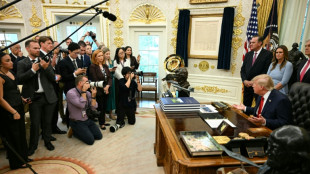 US networks halt Trump coverage in revolt over White House ban

 Paramount settles with US states to clear Warner Bros. mega-merger
 Climate crisis a job for world leaders, not just activists: UK FM

Europe saw the world's biggest rise in arms imports in the past five years, a trend set to accelerate following recent rearmament commitments amid the threat posed by Russia, researchers said Monday.
While arms exports declined globally by 4.6 percent in 2017-2021 compared to the preceding five years, Europe posted a 19-percent increase, according to a study published by the Stockholm International Peace Research Institute (SIPRI).
"Europe is the new hotspot", Siemon Wezeman, co-author of the annual report for over three decades, told AFP.
"We are going to increase our military spending not just by a little bit but by a lot. We need new weapons and a lot of that will come from imports", the senior researcher said, adding that the majority was likely to come from other European countries and the US.
Germany in particular has already announced plans to up its military spending, as have Denmark and Sweden.
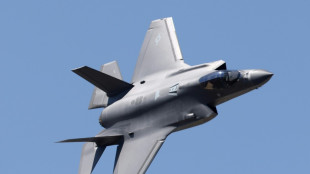
European countries spooked by Russia's invasion of Ukraine are expected to beef up their militaries with fighter jets, such as the American F-35, missiles, artillery and other heavy weapons.
"Most of these things take a bit of time. You have to go through the process, you have to decide, you have to order, you have to produce. This generally takes a couple of years at least", Wezeman said.
He said the upward trend actually started after Russia's 2014 annexation of Crimea, with the effects visible now.
Europe's share of the global arms trade has already risen from 10 to 13 percent in the past five year, and this share will increase "substantially", according to Wezeman.
The opaque nature of many contracts and donations of weapons without payment make it difficult to provide an exact figure for the world arms trade but experts estimate turnover at close to $100 billion (91 billion euros) annually.
According to SIPRI, Asia and Oceania remained the main importing region over the last five years, home to 43 percent of arms transfers and six of the world's largest importers: India, Australia, China, South Korea, Pakistan and Japan.
While arms imports to the world's most populous region declined by around five percent over the past five years, East Asia and Oceania specifically saw strong growth, with 20 and 59 percent respectively.
"Tensions between China and many states in Asia and Oceania are the main driver of arms imports in the region," the report's authors said in a statement.
- Russian isolation -
In the Middle East, the second-largest market, accounting for 32 percent of global arms imports, the increase was three percent, driven mainly by investments in Qatar amid tensions with its Gulf neighbours.
"The current oil prices mean they're going to have a lot of income and that usually translates into large orders for arms", Wezeman noted.
The Americas and Africa, meanwhile, have seen their imports decline sharply, by 36 and 34 percent respectively, accounting for about six percent of global arms imports each.
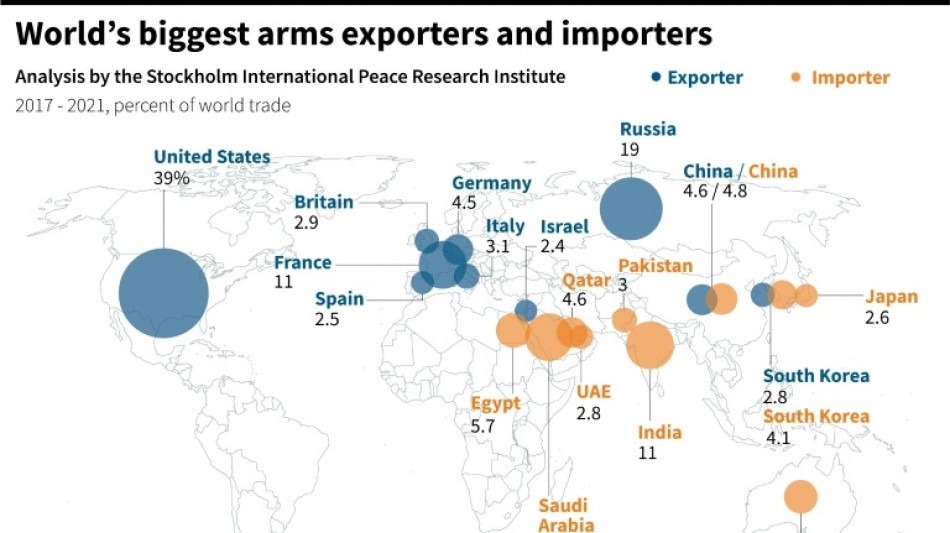
In terms of individual countries, India and Saudi Arabia share the top spot as the largest importers, each accounting for 11 percent, ahead of Egypt (5.7 percent), Australia (5.4 percent) and China (4.8 percent).
When it comes to exporting countries, the US leads the pack with 39 percent.
Russia remains in second place, though its share has fallen to 19 percent over the past five years, largely due to declining imports by China, which is now almost completely independent of Russian arms.
Russia's isolation amid sanctions over the Ukraine war will probably weigh even more on its arms industry in future.
"There will certainly be a stick from the US side. That's been already going on for several years, that if you buy weapons from Russia, then we are likely to sanction you in various ways", Wezeman said, citing tensions that arose after Turkey's purchase of Russian S-400 missile defence systems.
"I think the pressure will be enormous on countries like Algeria or Egypt that are substantial importers of Russian weapons."
France is the third largest exporter with 11 percent, while China and Germany held onto their fourth and fifth spots with 4.6 and 4.5 percent respectively.
J.Fankhauser--BTB