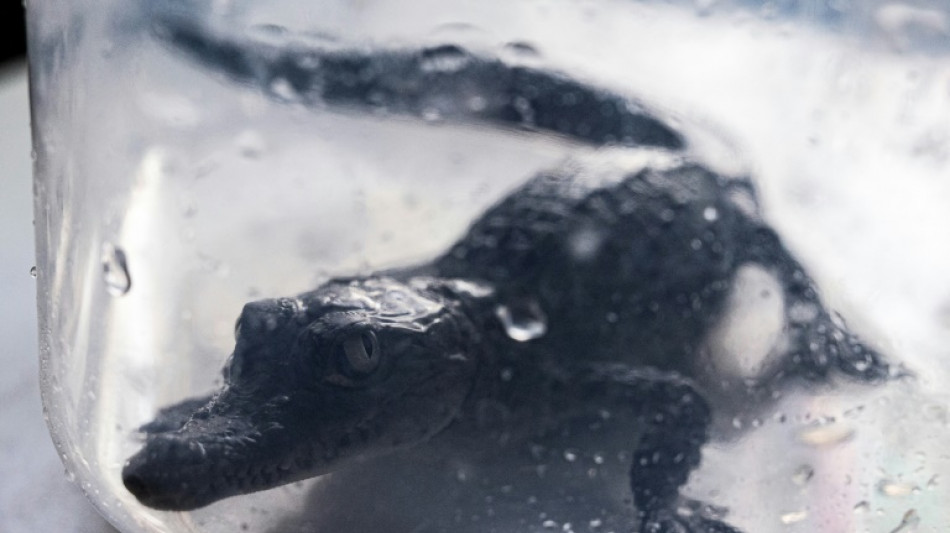
Four endangered American crocodiles are born in Peru / Photo: ©

 Eight-Year-Old Georgia Wins Penrith Valley Public Speaking Competition

 Steven Berkoff on Memory and His New Autobiography 'Shouting At Night'

 Jimmy Carr Confirms 25-Year Estrangement From Father Amid Podcast Reflections

 Arizona Superintendent Tom Horne to Leave Office, Plans Law Practice and Charter School

 Japan and Peru Mark 150 Years of Diplomatic Ties Amidst Trade and Investment Talks

 Ian Jackson Scores Game-High 22 Points After Rick Pitino's Prank Suspension

A Lima zoo announced Thursday the birth in captivity of four American crocodiles, an endangered species, after a successful artificial incubation.
The crocodile hatchlings were born in mid-January after 78 days of incubation from the eggs of a pair of adult crocodiles that live in the Huachipa Zoological Park, east of Lima.
"We have now shown these crocodile pups that were just born 45 days ago at the zoo," Jose Flores, head of the zoo's reptile area, told AFP.
"Any birth of any species that is threatened and (in) danger of extinction must be considered an achievement," he stressed.
The hatchlings live in a special fish tank, measure 26 centimeters (10.2 inches) and weigh between 70 and 90 grams (0.15 to 0.19 lbs) each.
They have the traditional olive green color of the species and protruding eyes. They feed on small pieces of chicken and fish.
In Peru, they are known as "Tumbes crocodiles" because their natural habitat is the mangroves of Tumbes, on the border with Ecuador.
"This species, in Peru, is in danger of extinction mainly due to the destruction of its natural habitat," explained Flores, 39.
The small reptiles belong to the Crocodylus Acutus species and are the only ones that survived from the 25 eggs that the mother incubated.
At 195 kilograms (430 lbs), the father crocodile is five meters (yards) long while the mother is 2.5 meters long and weighs 85 kilos. They are both 20 years old.
This species is found in the southern United States, Mexico and Venezuela, but in countries such as Peru and Ecuador it is critically endangered.
Relentless hunting for their skins reduced numbers dramatically in the 1960s. There are now restrictions controlling the trade in crocodiles and their skins.
N.Fournier--BTB


