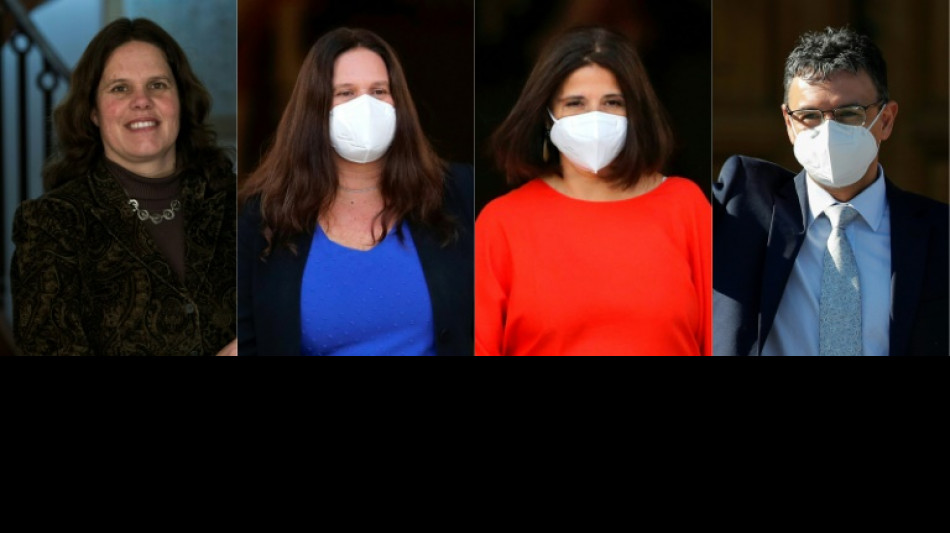
Children of exile bring fresh vision to Chile cabinet / Photo: ©

 Eight-Year-Old Georgia Wins Penrith Valley Public Speaking Competition

 Steven Berkoff on Memory and His New Autobiography 'Shouting At Night'
 Jimmy Carr Confirms 25-Year Estrangement From Father Amid Podcast Reflections

 Arizona Superintendent Tom Horne to Leave Office, Plans Law Practice and Charter School

 Japan and Peru Mark 150 Years of Diplomatic Ties Amidst Trade and Investment Talks

 Ian Jackson Scores Game-High 22 Points After Rick Pitino's Prank Suspension

Six people exiled as children under Augusto Pinochet's dictatorship will now play a vital role in Chile's future as part of new president Gabriel Boric's cabinet.
"I believe that our own history is important for what we want for the future," Maya Fernandez, the incoming defense minister, told AFP.
The 50-year-old biologist is the granddaughter of socialist former president Salvador Allende, who was deposed by Pinochet's coup.
Fernandez lived in exile with her family in her father's homeland Cuba from the day of Pinochet's coup -- September 11, 1973 -- until 1992 when she was 21.
She has been involved in politics ever since.
"I imagine that each of the ministers has had their own experiences and learning abroad, and I think that is important," she said.
"I think the exiles getting to know another life, other cultures, is always important," said Fernandez. "It affects you."
Boric, who will become Chile's youngest ever president at 36, has named a majority-women cabinet with an average age of just 42.
And six of Boric's 24 ministers -- 14 of whom are women -- either were born, lived or studied in exile.
They were among more than half a million Chileans who left the country under the 1973-90 dictatorship for political reasons, many as victims of torture, detention, repression and poverty.
- 'Different vision' -
Marcela Rios, the future minister of justice and human rights, told AFP that those who have studied abroad and "have multicultural and different professional training, are a contribution to the state vision."
They bring "a different view of the problems, incorporating learnings from other countries," she said.
Rios was just 13 when her family fled to Canada's Saskatchewan province as refugees, with the help of some nuns.
Future foreign minister Antonia Urrejola was six when her parents were forced to seek refuge in Britain.
New health minister Begona Yarza ended up in Cuba after a military truck took her family to an Air France airplane that landed in Havana after several other stops.
Alexandra Benado, the next sports minister, was born in Stockholm in 1976, where her parents lived in exile, before moving to Cuba.
Her mother, an activist in the Revolutionary Leftist Movement (MIR), was assassinated in 1983.
Biologist Flavio Salazar, 56, who will be science minister, was born in Buenos Aires. His family returned to Chile in 1971 following Allende's election victory.
But they fled to Sweden following protests in 1984 as his father, a Communist Party member, was forced to seek asylum.
- 'Clean air' -
Fernandez was little more than a baby when she left the country, "which is why I have no memories of Chile, of its history."
But her parents taught her about its "culture, food and customs," she said.
Her most painful memory was not being able to see her maternal aunts.
The family remains hurt by the death of her grandfather Allende when bombs rained down on the presidential palace in Santiago, as well as the suicide of Fernandez's mother, Beatriz Allende, four years after the coup.
Fernandez will be the second socialist defense minister since the return to democracy after Michelle Bachelet, who later served two terms as president in the 2000s.
Bachelet's father, Alberto Bachelet, an air force brigadier general in the Allende government, died in prison a year after the coup.
Herself tortured by the dictatorship, Bachelet and her mother fled into exile in communist East Germany, via Australia.
Rios used her exile experience to contribute to one of the most recent United Nations Development Programme reports on inequality in her country.
"Chile is a country where the elites are very closed, very small, very homogenous, and often there are too many personal networks forged at university, above all, in schools, and it's a very segregated system," she said.
Cabinet appointments of people from outside that clique bring "a breath of fresh air to the government," Rios said.
O.Bulka--BTB