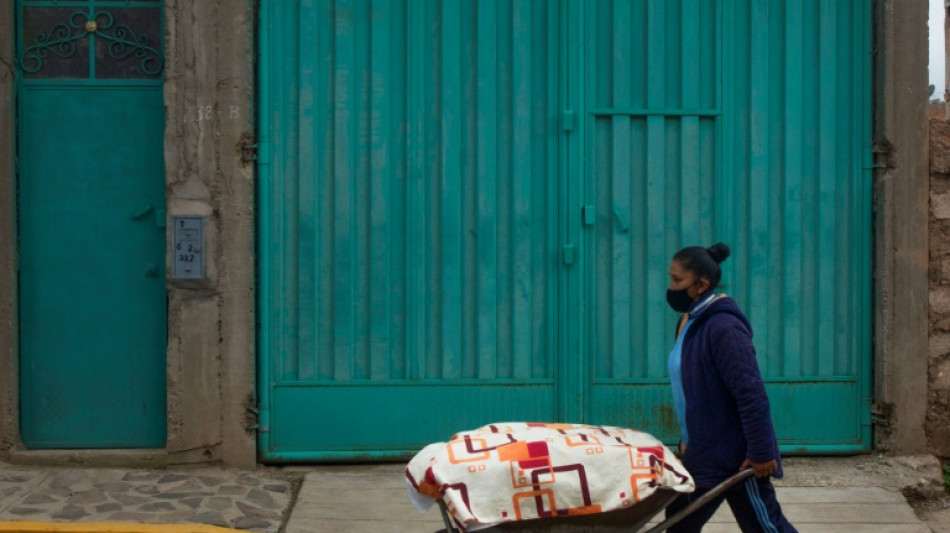
Unemployment, pay gap, instability the pandemic legacy for Peru's women / Photo: ©

 Typhoon Dujuan leaves four dead in Japan, 45,000 houses without power

 G7 leaders condemn Houthi strikes on Saudi Arabia

 Google data centre sparks protests in Austria

 Shin Ohashi: Junk food-loving teen and Japan's next big swimming hope

 Stocks rise on AI buzz, drop in oil prices

 China's robot dancers limber up for America's Got Talent final

 Despite military might, Saudi struggles to crush the Houthis
 Trump to tout deals, defend Iran war in UN speech

 Sri Lanka to issue verdict in landmark Easter attack trial

 Macron says talks with Trump on Red Sea, Ukraine 'constructive'

 Green policies just good politics, says UK minister
 Bardot auction in Paris fetches nearly one million euros
 No timeline on Daniels injury return, says Commanders coach

 British Columbia sues OpenAI in US court over Canada school shooting
 French star Batum retires after 18-year NBA career

 Zidane leads first France training session
 Man shot by ICE agent in Texas detained with bullet inside him: lawyer

 California declares state of emergency ahead of El Nino
 South Africa arrests three more suspects, after nine women murdered

 Carse needs time away from England, says captain Brook

 NOWPayments Releases Cross-Chain Payout Data Revealing Key Performance Benchmarks Across TRON, BNB Chain, and Solana

 British Museum bans photos of Bayeux Tapestry as crowds linger
 COP31 host says AI climate footprint to be a summit priority

 Berlin's far-left vote winners reject anti-semitism charges

 Mancini eager for 'new adventure' on Italy return

When the pandemic struck Peru and forced the economy to shut down in an attempt to stop the spread of the coronavirus, women were some of the hardest hit.
Silvia Munoz lost her job as a domestic worker, while Yolanda Chambi was forced to close her shop selling traditional Peruvian clothes.
Both were among millions of Peruvian women to lose their income during the pandemic, which exacerbated gender inequality.
Theirs is a story seen throughout Latin America on the eve of International Women's Day, where four million women remain unemployed even after regional economies have reopened.
When Covid struck, many women were forced to give up work to look after sick family members and children as schools and creches were closed as part of government restrictions.
And while most have since returned to work, many have had to accept lower salaries or even make do with working in the informal sector.
Once the virus reached Peru in March 2020, "there was no work, there was nothing," said Munoz, 65, speaking from her home in the working class Lima neighborhood of Villa Maria del Triunfo.
One thousand kilometers (620 miles) away in Puno on the shores of Lake Titicaca, Chambi tells a similar story.
"We lost all our earnings," she said.
She used to sell clothes to locals for the Virgen de la Candelaria festival that takes place on February 2 and involves traditional Andean music and dancing.
It has been canceled for the last two years due to Covid.
Unable to sell her wares, Chambi could no longer afford the rent on her home-cum-workshop.
She was forced to move with her four children to the family home in the countryside, where they grow potatoes, broad beans and other vegetables.
While many countries in the region paid out benefits to those that lost their jobs due to the pandemic, few people in Peru received such aid because 70 percent of the 33-million population works in the informal sector, and very few -- especially the poor -- have bank accounts.
- Gone back 10 years -
The International Labor Organization says women have been disproportionately affected by the pandemic.
The ILO says 24 million women in Latin America lost their jobs during the pandemic and as many men.
But while only half a million men remain out of work, eight times as many women do, "which contributes to amplifying the impact of the crisis on gender inequality at work."
Women's unemployment in the region is 12.4 percent, compared to just 8.3 percent for men.
After years of steady progress, "the pandemic has taken us back more or less to the figures from 10 years ago," Italo Cardnoa, the ILO chief for Peru, told AFP.
Sectors that traditionally employ a lot of women have been particularly hard-hit by the pandemic, such as hotels, restaurants, services and the informal sector.
"The return of women to the labor market is much slower than for men," said Cardona.
Daysi Falcon, 34, lost her job as an administrative assistant at a manufacturing company in March 2021.
She now sells prepared meals to acquaintances.
She says her family members were "dying one after another from Covid," and she spent months caring for them.
- 'I feel powerless' -
Many of those back in work have been forced to accept lower pay.
A few months ago, Munoz, who supports her ill husband, started working again four days a week -- but for 30 percent less pay than before.
Having previously earned $25 a day, she now receives $17.50.
"You have to accept it because behind me is someone who takes less," said Munoz.
"I feel powerless because you get older, you're not as strong as you used to be and when you're older still, there's no pension."
Chambi, who sells breakfasts by the roadside, is likewise pessimistic about the future.
"If the festival remains suspended, if our economy remains suspended, we will have no earnings," she said.
L.Dubois--BTB