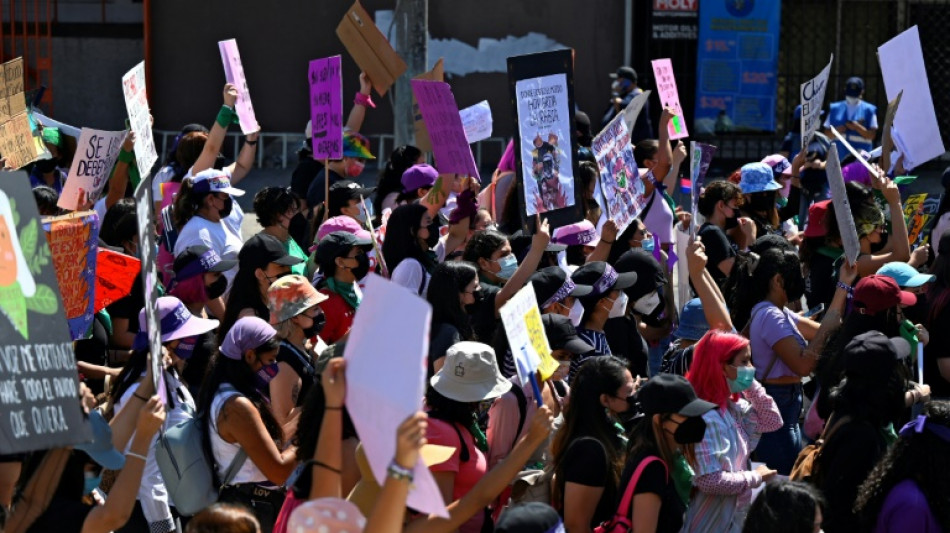
Thousands march in El Salvador to demand abortion rights / Photo: ©

 AVEVA and PETROJET Sign MoU for Digital Twin Projects in Egypt

 Daily Horoscope November 20, 2026: Astrological Predictions for All Signs
 Desire Under the Elms review - a horror show that bruises more than it moves

 Saudi PIF Retains Top Sovereign Wealth Fund Brand Title for Third Year

 Phoenix Weekend Guide: Sangria Socials, Pie Markets, and New Brunch Spots

 Trent Perry’s Late Heroics Lift No. 7 UCLA Past Cal State Fullerton

 2027 Hyundai Elantra Review: Brutalist Design and Expanded Dimensions
Around 2,000 women marched in El Salvador's capital on Sunday to demand the legalization of abortion and a decrease in the killings of women in the Central American country.
With slogans such as "It's my body, abortion is my right," "No more patriarchal violence" and "Women are strong and together we take care of ourselves," they demonstrated in San Salvador wearing purple or green scarves around their necks in anticipation of International Women's Day on March 8.
They called "for abortion to be decriminalized in the country on certain grounds, so that we no longer have women imprisoned, unjustly criminalized for having suffered an obstetric emergency," Morena Herrera, leader of the Citizens' Association for the Decriminalization of Therapeutic, Ethical and Eugenic Abortion (ACDATEE), told AFP.
Herrera said abortion should be decriminalized to save the lives of women and girls; when a fetal malformation incompatible with life outside the womb has been detected; and when the pregnancy is the result of sexual violence.
El Salvador has had an outright ban on abortion since 1998, even in cases of rape or if the health of the woman or fetus are in danger.
Terminating a pregnancy can send a woman to jail for up to eight years, but Salvadoran judges often instead find women guilty of "aggravated homicide," which is punishable by up to 50 years in prison.
Many women are prosecuted after seeking medical help for complications in pregnancy, suspected of having attempted an abortion.
At least a dozen women are currently facing varying sentences for termination of pregnancy.
At the march, the women also demanded that authorities combat femicides in the country.
"Femicides must stop, women have the right to a safe life, no more violent deaths," Abigail Alvarado, a student at the state-run University of El Salvador (UES), told AFP.
Figures from the Observatory of Violence against Women indicated that in 2021, 132 women were murdered, slightly higher than the 130 cases recorded in 2020.
D.Schneider--BTB


