Ukraine: a nuclear-powered nation under fire / Photo: ©

 Typhoon Dujuan leaves four dead in Japan, 45,000 houses without power

 G7 leaders condemn Houthi strikes on Saudi Arabia

 Google data centre sparks protests in Austria

 Shin Ohashi: Junk food-loving teen and Japan's next big swimming hope

 Stocks rise on AI buzz, drop in oil prices
 China's robot dancers limber up for America's Got Talent final

 Despite military might, Saudi struggles to crush the Houthis
 Trump to tout deals, defend Iran war in UN speech

 Sri Lanka to issue verdict in landmark Easter attack trial

 Macron says talks with Trump on Red Sea, Ukraine 'constructive'

 Green policies just good politics, says UK minister
 Bardot auction in Paris fetches nearly one million euros
 No timeline on Daniels injury return, says Commanders coach

 British Columbia sues OpenAI in US court over Canada school shooting

 French star Batum retires after 18-year NBA career

 Zidane leads first France training session
 Man shot by ICE agent in Texas detained with bullet inside him: lawyer

 California declares state of emergency ahead of El Nino
 South Africa arrests three more suspects, after nine women murdered

 Carse needs time away from England, says captain Brook

 NOWPayments Releases Cross-Chain Payout Data Revealing Key Performance Benchmarks Across TRON, BNB Chain, and Solana

 British Museum bans photos of Bayeux Tapestry as crowds linger
 COP31 host says AI climate footprint to be a summit priority

 Berlin's far-left vote winners reject anti-semitism charges

 Mancini eager for 'new adventure' on Italy return

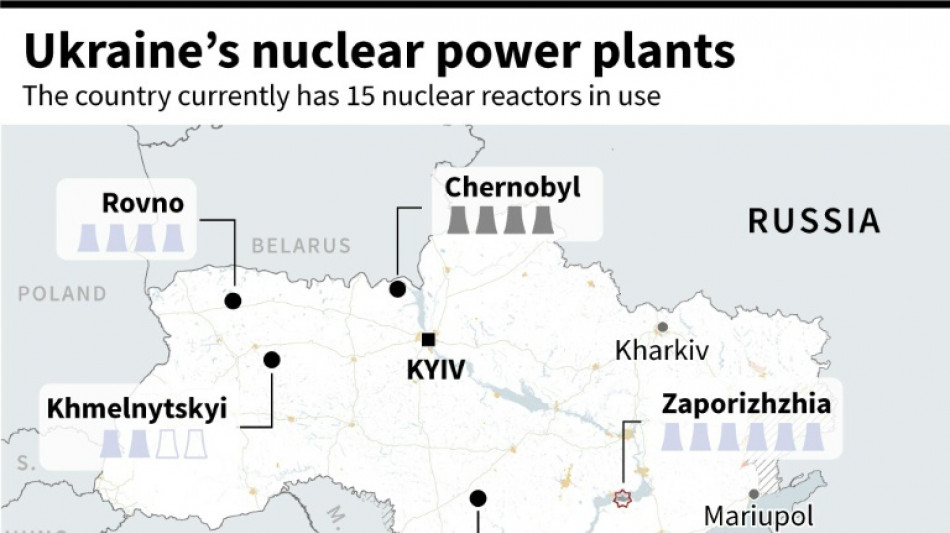
The Russian shelling of Zaporizhzhia nuclear power plant in Ukraine -- the largest in Europe -- has sparked international outrage and fears over the country's 15 operational reactors.
The Zaporizhzhia reactors, apparently undamaged by the attack, were taken over by invading Russian forces that have also stationed themselves at Chernobyl, the site of the worst civilian nuclear disaster in history.
Experts have condemned the attack, while stressing that Ukraine's modern reactors are built to withstand most human-caused and natural impacts.
Here's what we know about nuclear power in Ukraine:
- Nuclear-powered nation -
Ukraine is the seventh-largest producer of nuclear electricity in the world, according to International Atomic Energy Agency (IAEA) figures for 2020.
The country, which relies on nuclear energy for more than half of its power supply, has made significant improvements in nuclear safety over the years, experts say.
Zaporizhzhia has six of the country's 15 reactors and can create enough energy for four million homes.
The plant is "relatively modern", said Mark Wenman of Imperial College London, noting its reactor components are housed inside a heavily reinforced containment building that can "withstand extreme external events, both natural and man-made, such as an aircraft crash or explosions".
"The design is a lot different to the Chernobyl reactor, which did not have a containment building, and hence there is no real risk, in my opinion, at the plant now [that] the reactors have been safely shut down," he told the Science Media Centre.
The battle at the site caused a fire at an adjacent training facility, IAEA chief Rafael Grossi said early Friday.
He said only one of the six reactors was operating at about 60 percent, another had been undergoing maintenance, two were in "safety-controlled shutdown" and the last two "were already being held in reserve and are operating in low-power mode".
Ukrainian monitors say there has been no spike in radiation.
- Conflict fears -
Earlier this week Greenpeace warned that the Russian invasion risks a "nightmare scenario" at one of the country's nuclear sites, potentially involving an explosion that caused cooling systems to fail and large amounts of radioactivity to be spread on the wind.
This, the charity said in an analysis focusing on Zaporizhzhia, could render large parts of Europe and Russia "uninhabitable for at least many decades".
The main risk now is a loss of the power supply as the plant needs water and electricity to operate the safety systems and cool the reactor core, according to Karine Herviou, Deputy Director General of the French Institute for Radiation Protection and Nuclear Safety.
But the site has emergency generators, which normally have fuel to operate for seven to 10 days, as well as water reserves.
The other risk is direct aggression.
Herviou said the containment buildings offer protection to a point "but it all depends on what we are talking about".
An attack that hit another part of the plant could affect safety systems, she added.
- Chernobyl -
Ukraine, which has significant uranium reserves, began developing nuclear power in the 1970s -- when it was still a part of the USSR -- with the construction of Chernobyl.
The 1986 Chernobyl disaster left hundreds dead and spread radioactive contamination west across Europe.
Damaged Reactor No. 4 was initially covered by a temporary sarcophagus, then by a containment arch completed in 2017.
Russia seized the site on February 24.
The Ukrainian authorities have recently noted an increase in radiation at Chernobyl, but the IAEA has said the levels measured pose no danger to the public.
Experts have speculated that military activity around the site may have kicked up contaminated dust.
Ukraine's current stock of reactors are Soviet or Russian-designed VVERs, which are pressurised water reactors.
"Ukraine receives most of its nuclear services and nuclear fuel from Russia," says the World Nuclear Association, although it has noted that the country had already begun "reducing this dependence".
The nuclear operator Energoatom has recently turned to the US firm Westinghouse to build new reactors.
M.Odermatt--BTB