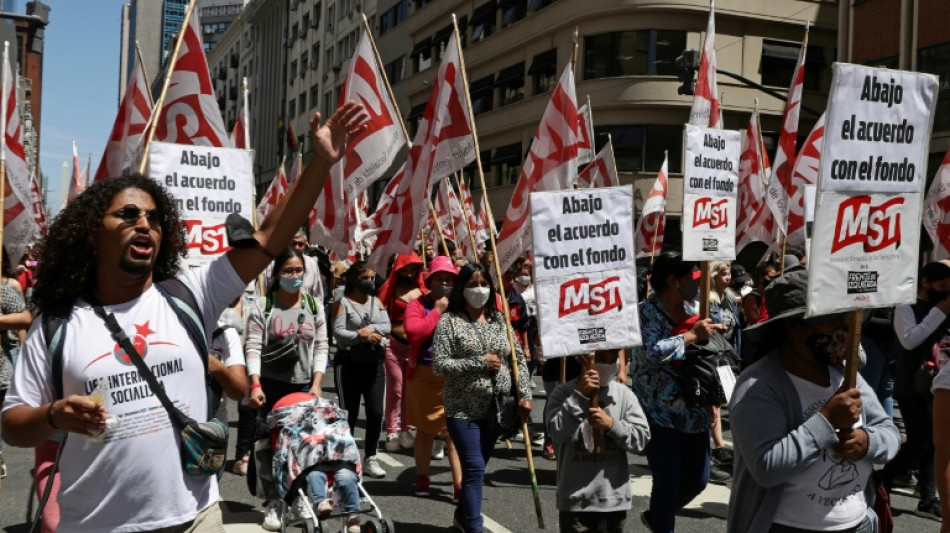
Argentina, IMF agree on loan repayment plan / Photo: ©

 AVEVA and PETROJET Sign MoU for Digital Twin Projects in Egypt

 Daily Horoscope November 20, 2026: Astrological Predictions for All Signs

 Desire Under the Elms review - a horror show that bruises more than it moves

 Saudi PIF Retains Top Sovereign Wealth Fund Brand Title for Third Year

 Phoenix Weekend Guide: Sangria Socials, Pie Markets, and New Brunch Spots

 Trent Perry’s Late Heroics Lift No. 7 UCLA Past Cal State Fullerton

 2027 Hyundai Elantra Review: Brutalist Design and Expanded Dimensions
Argentina and the IMF said Thursday they had reached agreement on a "pragmatic and realistic" plan for the country to repay a ruinous $44-billion debt.
The economy ministry in Buenos Aires announced that a deal was struck on refinancing its debt in a way that "seeks to continue generating conditions of stability."
The deal -- the details of which were ironed out between Argentine officials and IMF staff after an in-principle agreement in January -- will be sent to Congress later Thursday for approval.
It must also be ratified by the international lender's executive board.
In 2018, under the government of conservative President Mauricio Macri, the IMF granted its biggest-ever loan of $57 billion to Argentina.
The country received $44 billion of that amount. Macri's successor Alberto Fernandez refused to accept the rest, seeking also to renegotiate repayment terms.
Payments of $19 billion and $20 billion were due this year -- a timeline the government considered impossible.
Argentina is just emerging from three years of economic recession and battling rising inflation and a high poverty rate.
Under the new deal, the ministry said, repayments will be made from 2026 to 2034 after a grace period.
- Budget support -
In this way, Argentina hopes to reduce its fiscal deficit from 3.0 percent of GDP today to 0.9 percent by 2024.
In a statement in Washington, the IMF said Argentina would benefit from a 30-month Extended Fund Facility (EFF) -- a relief measure granted to countries experiencing repayment difficulties.
It spoke of a "pragmatic and realistic program, with credible economic policies to strengthen macroeconomic stability and to address Argentina's deep-rooted challenges to sustainable growth."
The deal would aim "to provide Argentina with balance of payments and budget support to address the country’s most pressing economic challenges," the lender said.
It would also seek to "durably address persistently high inflation" while "credibly improving public finances."
The deal would "support reserve accumulation and net exports" to facilitate Argentina's re-entry into international capital markets, said the IMF.
For its part, the government said the deal should help create conditions of stability to address structural economic challenges and foster sustainable growth.
In December, the IMF conceded the enormous loan granted to Argentina had failed to achieve its objectives of restoring confidence in the country's fiscal viability and fostering economic growth.
In January, Argentina's economy minister said the lender risked losing credibility if it "pushes" the country "into a destabilizing situation" with an "unsustainable" repayment calendar.
T.Bondarenko--BTB


