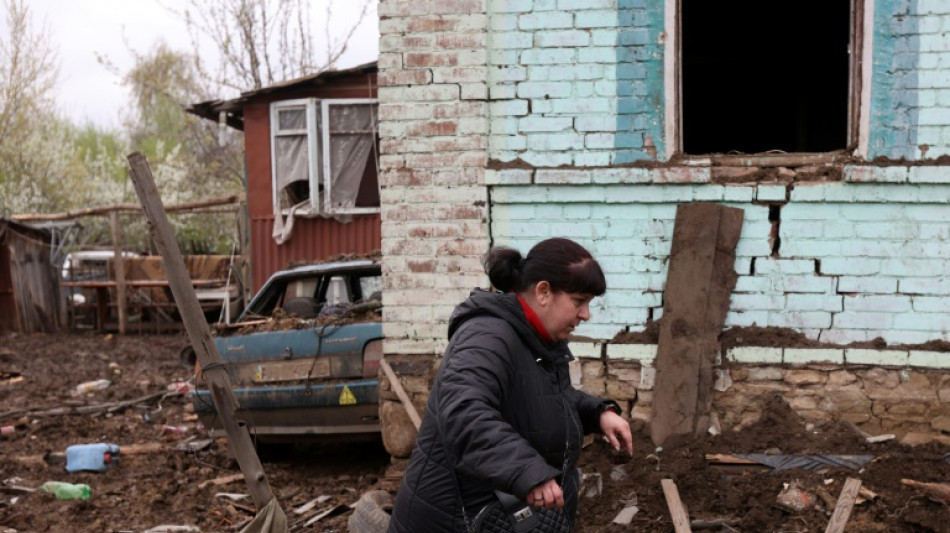
A mother's dilemma: When to flee Ukraine's front? / Photo: © AFP

 Stocks move lower despite oil prices dropping
 AI driving up innovation investment: UN

 UN Security Council extends Haiti mission by 6 months

 Man Utd do not deserve medals if Man City stripped of titles: Rooney

 Vana Completes Expanded Staking as Part of the Vega Upgrade, Publishes Expanded VANA Token Economics
 Spain to cap gas price hikes, extend fuel discounts

 'We just need rain': Germany's Rhine river hits new low

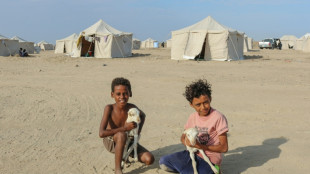 Yemen health system at 'breaking point': WHO

 Ireland undecided on second Israel match: coach

 France's Le Pen defiant after top ally hit by antisemitism claims

 Tom Cruise trades stunts for satire as toxic tycoon 'Digger'

 MEXC Unveils "WE SEE YOU" Brand Visual Refresh, Putting People Behind Every Trade in Focus
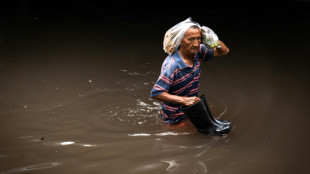 Thai capital cleans up after deadly floods

 NATO, EU allies rally to Estonia after 'sabotage' blamed on Russia

 Families demand justice for Cameroon's 'nightmare' wave of murdered women

 Tebas says Man City should face 'most severe' sanctions if guilty of rule breaches
 Pochettino calls Man City success 'a period of deception'

 Settler attack on West Bank village injures Israeli forces, drawing rare rebuke

 Mystery over UK airbase scare after reports no explosives found

 Spanish govt races to adopt housing law under protest pressure

 Estonia slams Russian 'sabotage' after arson attack on defence company
 Slovenia sees surge in '.si' sites after Trump hypes 'super intelligence'
 'Like a dream' for An as Games organisers 'sorry' for latest mix-up
 Tokyo suffers longest streak of rainy days on record

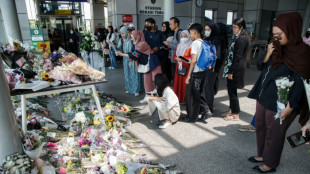 Indonesia charges train driver over crash that killed 16 women
Karyna had just stepped inside to check on her 12-year-old son in the kitchen when Russian rockets exploded into her garden, leaving craters where her blossoming apple trees had stood.
When she regained consciousness after being thrown down her hallway by the impact of the S-300 missiles, she called out her son's name through the dirt blown into her mouth by the explosions.
"I couldn't hear his voice. I called out for him but he didn't answer," the 41-year-old, who only gave her first name, recounted to AFP two days later, amid the debris of her home.
"I felt that if my son was gone, I would just kill myself. Those were my first thoughts: 'How am I going to live without my son?'"
Karyna's family survived that close call in April, although it destroyed their home.
Still, she said she is not ready to leave her hometown of Kostyantynivka in the battle-scarred Donetsk region, in eastern Ukraine.
- Fight or flight -
That decision -- to stay or go -- has been foisted on many families with young children living near the front line in Ukraine since Russia launched its full-fledged invasion in February 2022.
The unpredictability of the war can make the call more difficult. Karyna's son survived the bombardment, but children have been killed recently in long-range strikes hundreds of kilometres (miles) from the fighting.
The stakes of the decision could not be higher. Ukrainian prosecutors believe 480 children have been killed since the war started and more than 1,400 wounded.
In July, Ukrainian President Volodymyr Zelensky urged all residents of the Donetsk region to leave and local authorities have since ordered children to be pulled out of a series of frontline settlements.
Some families are holding out, citing poor finances or attachment to their homes. Others are refusing mandatory evacuation orders.
Authorities have said one remaining child is being hidden from law enforcement officers by parents in the embattled Donetsk region town of Avdiivka, where nearly every residential building has been damaged by Russian shelling.
- Fled 'in three minutes' -
By contrast, Veronika Sorokina, 23, left with her two-year-old son the moment she sensed he was in danger -- when Russian forces entered their village in the eastern Lugansk region in March this year.
Her husband, Vitaly, 48, plotted a 60-kilometre (37-mile) trek through the countryside to Ukrainian positions, tracing a route he knew the Russians would not discover.
"It wasn't a difficult decision. In three minutes, three minutes, we left. We were just afraid for our son," she said, recalling how they took documents and her wedding dress.
"When we left the village, we covered the little one's mouth so he wouldn't scream," Veronika recounted to AFP, crying as she described their flight.
In Bakhmut, which has been the epicentre of fighting for months, 21-year-old Natalya Maksymenko wanted to wait a little longer before being forced to leave in September.
The day before she fled with her 19-year-old husband and six-month-old baby, the building across the street was shelled.
"I thought about what was really going on here. We have a baby and don't know what could happen. If she dies, I'll go crazy. And then I finally decided to leave," she told AFP, bouncing her smiling infant on her lap.
A day after they fled their two-room apartment, with documents and their cat, their own building was struck by artillery.
They now all live together in a single room in the capital Kyiv and share kitchen and bathroom facilities with neighbours.
- 'Afraid of getting out' -
For Aryna Satovska, who runs a centre in Kyiv that accommodates families with young children, the decision to exit is sometimes complicated because the routes out are themselves more dangerous than the urban hubs being attacked.
"Sometimes they were choosing between, well, relative safety and the danger of getting out. One of the stories we heard was that, out of 10 families that tried to evacuate, only five made it," she said.
And sometimes escaping is only the first step in overcoming the trauma of war.
"We had children who, for two weeks, could not go outside to play at the playground because they remembered all the air alerts and shellings and bombings," Satovska said.
Veronika, who fled with her husband from Lugansk, says her son is still reeling from the shock of fleeing their home.
Loud noises -- like air raid sirens -- are particularly triggering.
"He'll run to my arms, scream and shake. He's still stressed. If there is a loud hum somewhere, he cries. He's afraid," she explained.
Karyna, standing by the debris of her home outside Kostyantynivka, said that even though she was not ready to flee, she would advise a friend in her place to do so.
"I would -- but I wouldn't tell her what to do. It's her business. But I would advise her to do it. And if she needed help, I would help."
"But to live in an unfamiliar place -- I can't," Karyna said, the contents of what used to be her kitchen spilling over into a missile crater.
afptv-jbr/bur/gil/smw
W.Lapointe--BTB