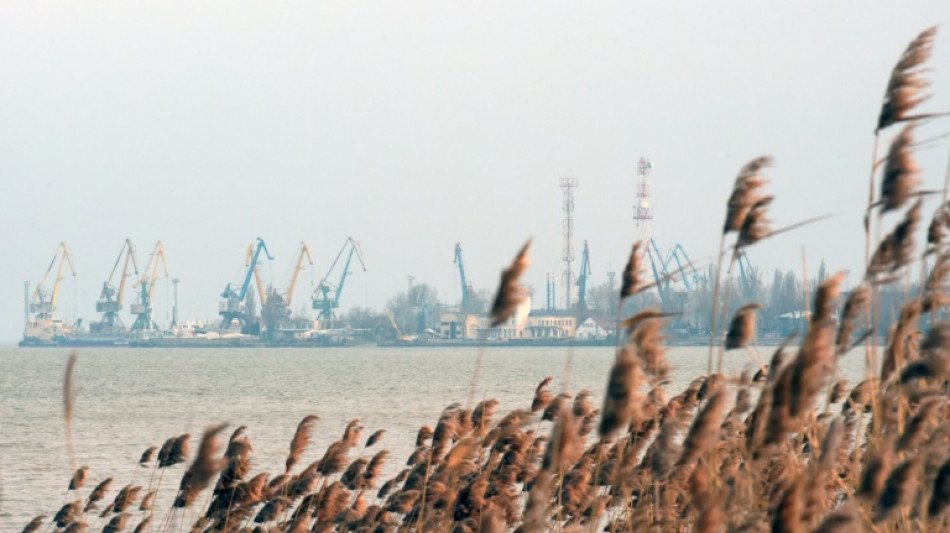
The Azov Sea, symbolic prize of Russia-Ukraine war / Photo: ©

 Google data centre sparks protests in Austria

 Shin Ohashi: Junk food-loving teen and Japan's next big swimming hope

 Stocks rise on AI buzz, drop in oil prices
 China's robot dancers limber up for America's Got Talent final

 Despite military might, Saudi struggles to crush the Houthis

 Trump to tout deals, defend Iran war in UN speech

 Sri Lanka to issue verdict in landmark Easter attack trial

 Macron says talks with Trump on Red Sea, Ukraine 'constructive'

 Green policies just good politics, says UK minister
 Bardot auction in Paris fetches nearly one million euros
 No timeline on Daniels injury return, says Commanders coach

 British Columbia sues OpenAI in US court over Canada school shooting

 French star Batum retires after 18-year NBA career

 Zidane leads first France training session

 Man shot by ICE agent in Texas detained with bullet inside him: lawyer

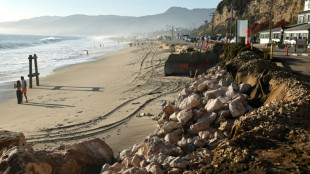 California declares state of emergency ahead of El Nino

 South Africa arrests three more suspects, after nine women murdered

 Carse needs time away from England, says captain Brook

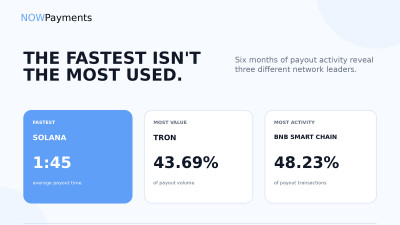 NOWPayments Releases Cross-Chain Payout Data Revealing Key Performance Benchmarks Across TRON, BNB Chain, and Solana

 British Museum bans photos of Bayeux Tapestry as crowds linger
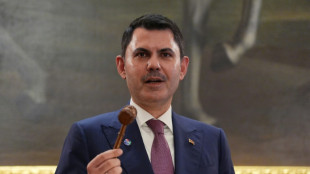 COP31 host says AI climate footprint to be a summit priority

 Berlin's far-left vote winners reject anti-semitism charges

 Mancini eager for 'new adventure' on Italy return

 Mbappe says having Zidane as France coach 'like a film'

 Palmer, Rice out of England Nations League squad
In the mist and pouring rain, the usually bustling port of Taganrog in south-west Russia has come to a standstill. The Azov Sea, usually calm, has become a symbolic prize in Russia's war in Ukraine.
A single crane moves slowly over a huge pile of coal, most likely from the nearby Donbas mining region. The port has been shuttered by the authorities, as have most airports in this area close to the border with Ukraine.
Military helicopters and planes fly low over the region, heading towards the frontier, which is now blocked.
From the border can be heard the faraway explosions from Mariupol, the main port in south-east Ukraine, whose half-million inhabitants are now under siege by Russian forces.
Since the start of the Russia invasion last Thursday, Mariupol has been a target. What happens on the edge of this shallow sea, which can freeze in winter, is vital to the war.
From Russia, Mariupol stands on the route between the Russian-annexed peninsula of Crimea to the west, and the forces of the self-proclaimed pro-Russian separatist republic of Donetsk to the east.
Russian troops have now blockaded Mariupol and it has lost electricity.
If Moscow manages to take Mariupol and the surrounding territory, it will win control over the Azov Sea, which opens into the Black Sea, as it becomes entirely encircled by Russia.
- Territorial continuity -
"In reality, Russia already controls this (Azov) sea as it controls the only entry point -- the Kerch Strait," said Igor Delanoe, deputy director of the Franco-Russian Observatory in Moscow.
But since 2014, when Russia annexed Crimea, it has been pursuing the theory of "territorial continuity", seeking to link up the Black Sea peninsula with the separatist territories in the east of Ukraine, which Moscow recently recognised as independent, he added.
Russia built a bridge spanning the Kerch Strait in May 2018, physically linking the Crimean peninsula to Russia and thus encircling the Azov Sea.
Since then, tensions have only increased.
At the end of 2018, the Russian navy opened fire on and then captured three Ukraine military vessels trying to reach Mariupol via the Kerch Strait.
NATO has demanded in vain that Russia guarantee freedom of passage to Ukrainian ports through the Azov Sea.
Such requests over a sea Moscow considers its own -- as well as the presence of NATO ships in the Black Sea -- have only angered Russia.
Yet if Russia already in practice controls the Azov Sea, why does it need to control the Ukrainian territory bordering it?
"These are symbols," said political analyst Alexei Malashenko of the Dialogue of Civilizations Research Institute.
"Everything that happens now has a symbolic meaning. There is less and less of a rationale.
"The objective is to show that Russia is a great power. Ukraine is the last place where it is possible to demonstrate that."
If Russia manages to take control of the Azov Sea, "it will not be accountable to anyone, it can place anything there -- nuclear submarines, for example", he added.
For now, both the local and global economies are suffering from the situation in the Azov Sea.
Up until 2017, when the last available data was available -- three years after the annexation of Crimea -- the port of Taganrog said more than a quarter of its exports went to Ukraine, the source of more than half of its imports.
According to a statement Monday from the Russian naval authorities, more than 40 ships are waiting to enter the Azov Sea.
Across all Russia's ports in the sea, almost 170 ships are stranded, some with cargoes of grain -- causing a knock-on effect on global wheat prices as Ukraine and the south-west of Russia are both major producers.
"Navigation is temporarily suspended pending further notice," said the Russia naval authorities, citing "the implementation of anti-terrorist measures in the waters of the Azov Sea".
T.Bondarenko--BTB