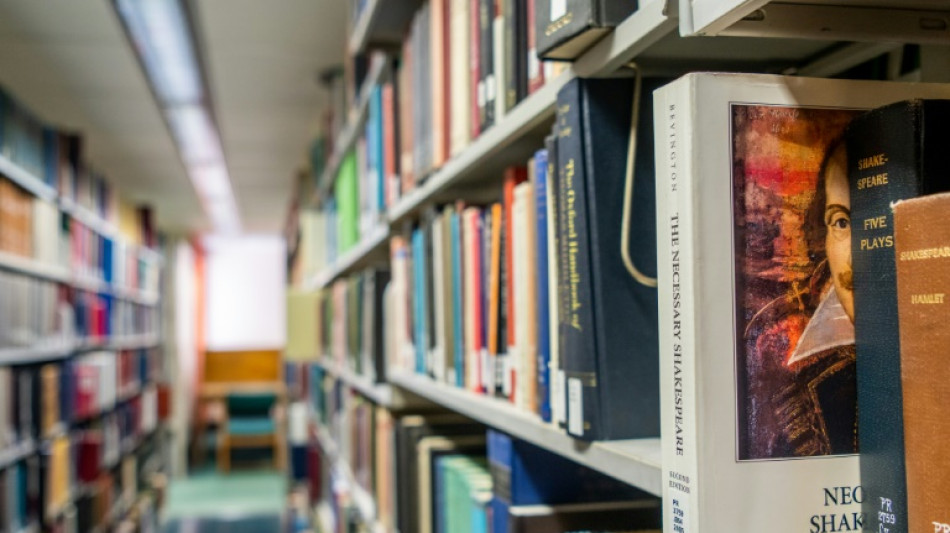
Censorship or evolution? 'Sensitivity readers' divide publishing world / Photo: © GETTY IMAGES NORTH AMERICA/AFP/File

 Kylie Jenner employee describes closet ordeal and pepper-spray incident
 Davante Adams injury deepens Los Angeles Rams receiver shortage

 João Franco’s earlier post draws attention after arrest over fatal Turkey brawl

 Nvidia Appoints Colette Kress as Interim CEO Following Jensen Huang’s Resignation
 Itlu Arjuna receives U/A certificate ahead of theatrical release
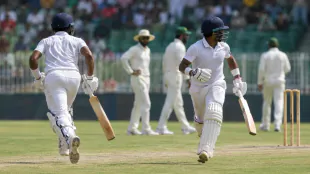 Dhananjaya de Silva guides Sri Lanka to 221-4 against Pakistan

 Parents of Deceased Model Fight to Maintain $4 Million Judgment Against Shawne Merriman Associate

 India extends micro-credit guarantee plan for five years

 Zelenskyy arrives in Dublin for meetings on Ukraine and peace efforts
 Jury hears social-media image helped identify teen in Scarlett Faulkner case

 American Airlines passenger falls ill and vomits on three travellers

 Euro-Area Inflation Reaches 4% as Energy Prices Jump

 US Adds 165,000 Jobs as Unemployment Falls to 4.1%

 Energy Costs Push OECD Inflation Up to 4.5%

 China's Trade Surplus Passes $1 Trillion as Technology Exports Surge

 US Inflation Broadens as Fed Officials Consider Faster Rate Hikes

 Korea, Singapore and New Zealand Advance Green Trade Pact Talks

 Ireland and Ukraine consider drone cooperation memorandum after Dublin talks
 Professional Chefs Reveal Eight Prep Hacks for a Stress-Free Christmas

 Lakers Defeat Bucks 123-112 Amid Injury Concerns for Dončić and Reaves

 Punahou's Tanoa Scanlan Signs With University of Montana

 Nvidia faces scrutiny over alleged Chinese intelligence link to Jensen Huang

 Radical Numerics develops offline AI tool to detect engineered pathogens
 Chennai orders inquiry after dogs die at shelter; two veterinarians face action

 Startup turns Chennai’s history and culture into an interactive world

It's a profession which is increasingly under the spotlight as the culture wars rumble on: "sensitivity readers" -- editors who identify insensitivities or stereotypes in manuscripts -- are becoming a lightning rod for the publishing industry.
Such readers have worked in the wings of the Western literary world for years now, though they were largely confined to children's literature.
But amid social reckonings such as the #MeToo and Black Lives Matter movements, sensitivity readers are becoming prominent in contemporary fiction publishing also -- and not everyone is pleased about it.
Publishers "are doing a damn good job, trying to ruin our books, and to ruin our fun as readers," the American author of "We Need To Talk About Kevin," Lionel Shriver, complained on ultra-conservative British channel GB News last month.
Sensitivity readers have recently been pilloried again with the announcement that books by children's writer Roald Dahl and Ian Fleming, the author of the James Bond novels, were being republished to be more adapted to current sensibilities.
In Dahl's books, for example, some characters are no longer identified as "fat" or "crazy." Fleming's books were being reissued with racial references -- including the N-word -- removed.
Accusations of censorship began flying almost immediately from observers who fear sanitized literature could whitewash the past as well as the present.
"People say that, but I don't feel that they understand the process," Patrice Williams Marks, a Los Angeles-based sensitivity reader, tells AFP.
"If you're writing about a people or community that you're unfamiliar with, and you want it to be authentic... then you find somebody who's a sensitivity reader who's part of that community and ask for their opinions," she explains.
"I always let them know that they don't have to accept the changes that I suggest," says Lola Isabel Gonzalez, another sensitivity reader, also based in Los Angeles.
- Modern censors? -
So who are "sensitivity readers"?
Mostly they are freelance editors, often paid by the word or number of pages -- and with strict confidentiality clauses, of course -- by authors or publishers concerned about the accuracy of their manuscripts.
Or, as critics charge, to avoid at all costs the disaster of being canceled in a social media storm over a faux pas.
The proofreaders often list their areas of expertise: "child of immigrants," "bisexual," "autistic," "hijabi," "deaf," "expertise in both mainland Chinese and Hong Kong culture" and so on.
"There are good reasons for regulating children's reading: it is foundational and formational," British author Kate Clanchy wrote last year.
But she is much more circumspect when it comes to adults.
Adults "are able to put books down if they upset them, so their books may safely contain difficult ideas," argues Clanchy, who was herself at the center of a sensitivity reader controversy when her memoir was accused of being racist and insensitive.
For Shriver, who has long complained about such readers, they are nothing less than "sensitivity police."
"At the keyboard, unrelenting anguish about hurting other people's feelings inhibits spontaneity and constipates creativity," she wrote in The Guardian newspaper in 2017.
In France, a country widely resistant to this type of revisionism, the essayist Raphael Enthoven in 2020 denounced these "modern censors" as "the vanguard of the Identity Plague."
- Progress -
But many other writers are in favor of readers -- like the American Adele Holmes, who called on Marks's services for her first book, "Winter's Reckoning."
"Patrice was able to point out some areas of white privilege and the white savior role," Holmes told AFP.
And, more prosaically, for the character of a Black woman described as having "silky" hair, Marks suggested using the word "coil" instead, to make it more realistic.
Holmes feels that the proofreader helped her "immensely."
As for the criticisms, she argues they come from people who feel "threatened" by minorities, in a publishing world long known to be predominantly white.
For her part, Marks dates the renewed interest in her profession to the 2020 killing of George Floyd, an African American man, by a white police officer in Minneapolis. The murder ignited protests and a social reckoning on modern racism in the United States and around the world.
Since then, authors have "become more conscious of the lens that they're looking through," Marks told AFP.
Gonzalez also sees this increased care as reflecting social evolution.
"I don't think I could have done it professionally in any other decade," she says of her job, welcoming the fact that "Generation Z" is challenging established social narratives.
Those younger generations understand the importance of sensitivity reading, she argues -- as opposed to their elders, who might "have a harder time seeing it as progress."
O.Lorenz--BTB