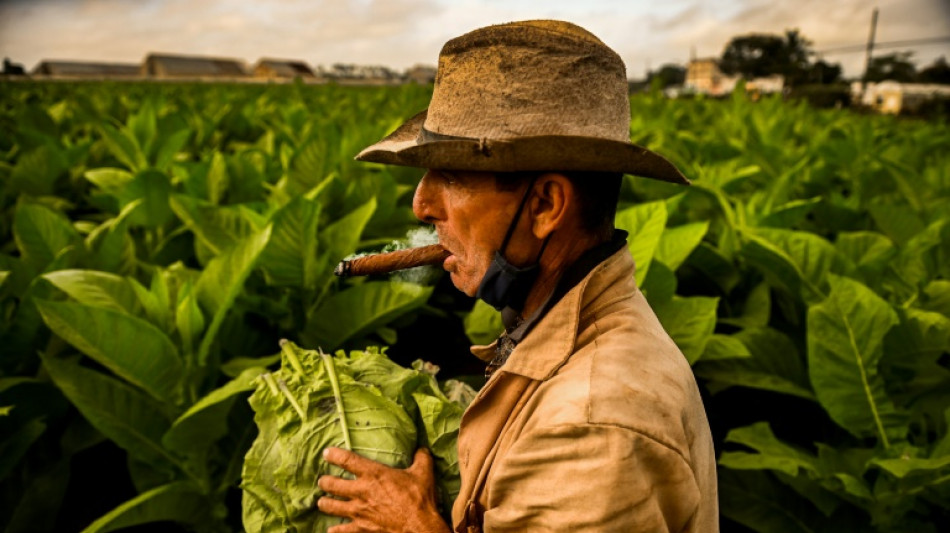
Cuban tobacco yield up in smoke amid fertilizer shortages / Photo: ©

 ALIX LASERS shareholders remove Michael Sobitsch as managing director in view of the circumstances
 Progressive Vision Wins Irish Healthcare Awards 2026 Innovation Prize for Office-Based Cataract Surgery

 Eight-Year-Old Georgia Wins Penrith Valley Public Speaking Competition

 Steven Berkoff on Memory and His New Autobiography 'Shouting At Night'

 Jimmy Carr Confirms 25-Year Estrangement From Father Amid Podcast Reflections

 Arizona Superintendent Tom Horne to Leave Office, Plans Law Practice and Charter School

 Japan and Peru Mark 150 Years of Diplomatic Ties Amidst Trade and Investment Talks

Yurisniel Cabrera, 35, is a fourth-generation tobacco farmer, eking out a meager living from the leaves used to make Cuba's fabled cigars.
Clients can fork out more than $10 for a single cigar, but for his months of labor, Cabrera earned only a few hundred US dollars from last year's harvest.
This year, the outlook is even bleaker.
Sanctions-stricken and facing its worst economic crisis in nearly three decades, Cuba is running low on fertilizers and pesticides.
The harvest "is not of a good enough quality," Cabrera sighed as he showed AFP around his crop amid the rounded hills dubbed mogotes that dot the fertile Vinales valley in western Cuba.
"It lacked fertilizer and pesticide," he said as he slipped a pile of leaves draped over his arm onto a "cuje," the wooden lathe used to dry the harvest in a rustic, wooden "tobacco house."
Like other farmers in Pinar del Rio province, where 65 percent of Cuba's tobacco is produced, Cabrera sells 95 percent of his yield to the Tabacuba state agency.
What remains is for private use.
- State sets the price -
In Cuba, the government provides pesticides and fertilizers to state-run cooperatives, and sets the price at which farmers can obtain them.
Tabacuba determines the price paid for the farmers' tobacco, based on the quality of the leaves.
"I have to buy all the product from them (the authorities)," explained farmer Livan Aguiar, 49, from the settlement of San Juan and Martinez, near Vinales.
"They give me the fertilizer, the fungicide... at the end of the harvest they charge me for everything," he said while cutting tobacco on the land he uses on a state usufruct.
Like Cabrera, Aguiar is concerned about the impact the lack of fertilizer will have on his yield and income this season.
Tabacuba executive Pavel Noe Caseres explained that importing agricultural chemicals had been "complicated" this season, due to logistical bottlenecks caused by the coronavirus pandemic, and ongoing US sanctions.
The harvest has fallen from 32,000 tons in 2017 to 25,800 in 2020 and will likely reach only 22,000 tons this season, he said.
The impact would mainly be on domestic consumers, as the country has enough tobacco in store to produce export cigars for two years, added Caseres.
Tobacco is Cuba's main agricultural export.
Cabrera and his family sowed 25,000 plants for the season that started last October and ends in May.
From it, he expects to get little over 550 kilograms (about 1,200 pounds) of tobacco leaf -- almost half of last year's yield.
In 2021, he made just over 80,000 pesos -- about $3,320 at the official exchange rate but only about $800 on the black market where most Cuban transactions take place.
This year it will be even less. So Cabrera and his family will look to the corn and other foods they grow on the side for survival.
Like his father, grandfather and great-grandfather before him, Cabrera lovingly cures the tobacco leaves, once dried, in a special concoction that includes guava leaf, honey and rum mixed into water.
It is a long process, requiring mastery, for which he reaps little financial reward.
G.Schulte--BTB

