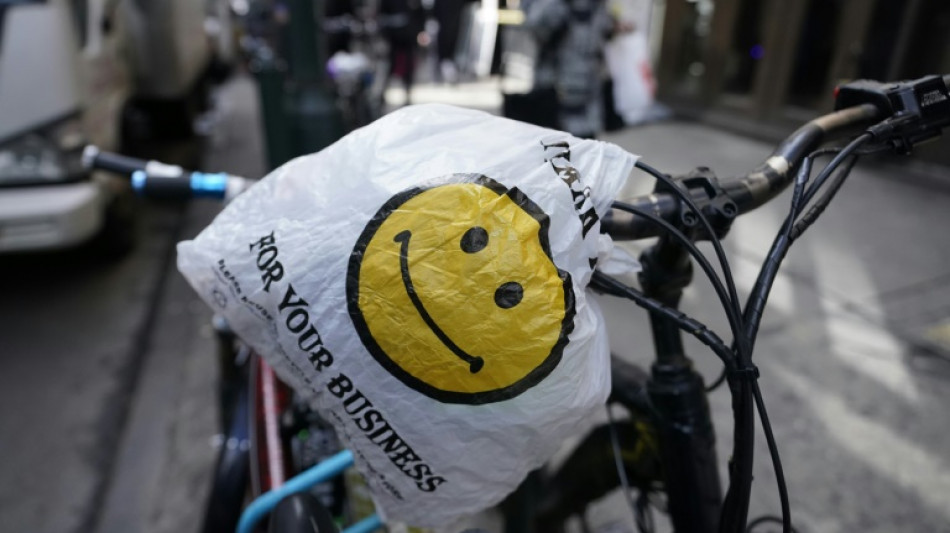
Is biodegradable better? Making sense of 'compostable' plastics / Photo: © AFP

 Messi on target again but Miami downed by Columbus

 In Washington's political cauldron, a fight over foie gras

 Flavio Bolsonaro: political heir in his father's shadow

 Ravens grab last-second win in Rio as Commanders stop Seahawks

 USA rallies to capture 11th consecutive Presidents Cup

 Phillies clinch, Astros wrap up division on final day of MLB season

 Commanders hand champion Seahawks their first loss

 Dupont scores twice to send Toulouse top of Top 14

 Ireland beat Israel but no handshakes due to war in Gaza

 Tense standoff over flashpoint N.Ireland parade lasts into night

 Stunned McNulty wins 'miracle' road race world title

 Re-released 'Avengers: Endgame' snaps-up N. America box office lead

 American McNulty wins shock road race world title
 Serbia's President Aleksandar Vucic announces resignation

 Tuchel urges Bellingham to play with 'rage'

 Russian strikes on Ukraine kill 8

 Bavuma, Miller hit centuries as South Africa clinch series

 Spain bring in Le Normand for injured Garcia

 UK Labour party meets buoyed by Burnham but seeking concrete plans

 Nor'easter lashes US east with punishing rain and wind

 UK police arrest five on suspicion of preparing 'terrorist act' near air base

 Washington denounces Iran's truce proposal as 'cynical'

 Armani sprinkles glitter on discreet elegance at Milan show

 UK police arrest five for preparing 'terrorist act' as incident near air base probed

 อเล็กซ์ โบดี และศาสตราจารย์ ดร. ดีเทอร์ ลาซิก ลงนามสัญญาสำหรับ ALPHA WHEY และ BODI เครื่องดื่มให้พลังงาน

Bacardi rum bottles, Skittles sweet wrappers, designer water bottles -- a bevy of companies are developing biodegradable plastic packaging they say is better for the environment than traditional plastics.
While experts agree we should use less plastic in any form, some say as long as plastics are here to stay, we should be using degradable materials -- and also pushing governments to help us dispose of them.
But amid confusion about what is or isn't biodegradable, and in the absence of proper disposal facilities, some fear these "magical" solutions could lead to further environmental havoc and even encourage more wasteful consumption.
"People tend to believe they're contributing to the protection of the planet while buying these products, but it's not at all the case," Gaelle Haut, EU affairs coordinator at Surfrider Foundation Europe, told AFP.
Synthetic petrochemical plastics can linger in the environment for hundreds of years.
Biodegradable plastics generally break down quicker but they do need to be disposed of correctly, whether it's in an industrial compost facility or a home compost, Haut said.
But most people don't have access to such facilities, meaning biodegradable plastics generally end up in recycling centres or landfills -- or worse, the environment.
- 'A lot of confusion' -
From the United States to Europe to China, supermarket shelves are increasingly stocked with items packaged with "bioplastic" or "biodegradable", "compostable" or "sustainable" plastics.
Some companies even claim to have developed edible plastics.
Many governments don't regulate such claims, and most consumers don't know what they mean.
Bacardi says its biodegradable bottle for spirits will hit the shelves this year. Confectionery giant Mars-Wrigley has announced the roll-out of biodegradable Skittles packaging in the United States.
And late last year, California start-up Cove launched what it said was the world's first biodegradable plastic water bottle.
None of the firms responded to requests for interviews.
Several companies have emerged in recent years to help certify biodegradability claims and help consumers make sense of the terminology.
"There is a lot of confusion on the market," said Philippe Dewolfs, business manager at TUEV Austria, one of the world's leading certifying agencies for biodegradable plastics, which is paid by companies to assess materials.
Counterintuitively, bio-based plastics are not necessarily compostable or biodegradable, he said.
These plastics contain at least some biomass feedstock like corn, potato starch, wood pulp or sugarcane -- but may also contain fossil fuel-derived materials.
Conversely, biodegradable plastics may contain no biomass, but are designed to break down into CO2, water and biomass -- usually in an industrial or home compost facility.
Compostable items can either break down in industrial or home compost. In some cases they may biodegrade in landfill, but it depends on moisture, microorganisms, and the composition of the product.
In November, the European Commission proposed new rules on packaging to tackle waste and also clarify terms used to describe plastics presented as environmentally friendly.
"Biodegradable plastics must be approached with caution," it said.
"They have their place in a sustainable future, but they need to be directed to specific applications where their environmental benefits and value for the circular economy are proven."
- 'Eternal pollutants' -
Some fear that confusion could lead to littering, adding to the world's plastic pollution problem.
"You will think 'okay, so if I forgot my biodegradable plastic bag in the forest after a picnic, it's not a problem because it will be biodegraded sitting in nature'," said Moira Tourneur, advocacy manager at Zero Waste France.
She said some consumers might not think twice about overconsuming biodegradable plastic products, believing they're less polluting.
"This is encouraging single plastic production," she told AFP.
Experts say consuming less plastic should be prioritised, opting for other materials such as glass or metal or reusing plastic as much as possible.
Activists like Tourner say companies and governments should focus on standardising glass packaging for things like yoghurt and milk, so they can be returned to shops to be sterilised and reused.
That could also help to reduce the mountains of plastic that end up in the environment every year, which break down into microparticles and enter our food chain ultimately to be ingested by humans and other animals.
Microplastics have been found in soil, oceans, rivers, tap water and even in the blood, breast milk and placentas of humans.
"They are eternal pollutants," said Nathalie Gontard, research director at France's national agriculture research institute (INRAE).
"Once these particles are dispersed... it's impossible to take them back and separate them," she added. "It's too late."
- 'It's a jungle' -
But in a world where plastics are so pervasive, aren't biodegradables better than "eternal pollutants"?
"We can make an active decision as a society to choose a material that won't persist," said Phil Van Trump, chief science and technology officer at Danimer Scientific, a US-based firm mainly producing PHA biodegradable plastic, largely for food packaging and consumer goods.
But plastics remain an important part of our industrialised economies, he said "We need them."
Plastics are crucial, for example, in the healthcare and transport sectors. But once plastic products reach the end of their life, we should be able to biodegrade those not easily recycled or where waste infrastructure is absent or lacking -- from coffee pots to ketchup packets to baby nappies, Van Trump said.
Experts on all sides of the biodegradable battleground agree that beyond reducing use, governments need to set up better disposal infrastructure to ensure biodegradable plastics don't end up in oceans and on forest floors.
Setting up industrial compost facilities and collection is a crucial first step.
Governments also need to educate the public and punish companies that make misleading claims, said Haut of Surfrider Europe.
"Otherwise it's a jungle if we leave it to the companies to decide what they do."
O.Lorenz--BTB