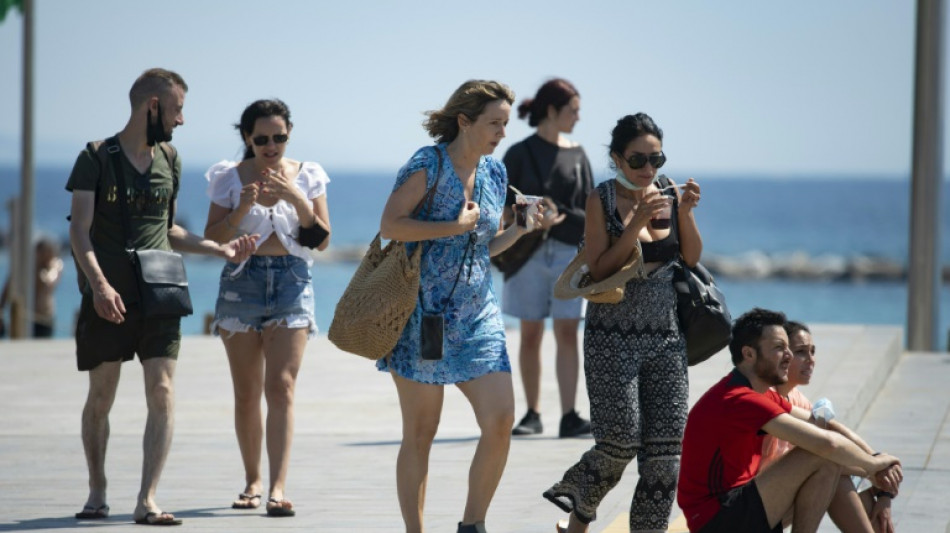
Spain passes law for Europe's first 'menstrual leave' / Photo: © AFP/File

 How Mystery Bounty Poker Tournaments Spread from Curiosity to Mainstream

 Market Buzz: Meesho Stake Sale, Clean Max’s ₹50,000 Crore Investment and Corporate Updates

 The 20 Most Shocking Documentaries Ranked: From Elizabeth Holmes to Man on Wire

 Ole Miss inquiry expands after video and monkey-noise allegations

 Bunnie XO artwork taken down from Jelly Roll’s Nashville bar

 Arlington sentinel rebukes Pete Hegseth entourage for laughter near memorial

 Late Late Show Line-Up Announced Featuring Nicola Coughlan and TJ Reid

 Authorities to identify Montauk Mary and five other Long Island cold-case victims

 Barbie sequel negotiations stall over reported $25 million pay packages

 Bath & Body Works launches buy-one-get-one-free candle offer

 Calgary Chef Launches App to Connect Food Businesses with Non-Profits

 Palestinian Artist Masada Sabat Uses Oil Paint to Carry Homeland’s Story

 Niraj Kumar earns Los Angeles Olympic quota with 50m rifle bronze
Spain's parliament approved Thursday a law granting paid medical leave to women suffering severe period pain, becoming the first European country to advance such legislation.
The law, which passed by 185 votes in favour to 154 against, is aimed at breaking a taboo on the subject, Spain's left-wing government has said.
Menstrual leave is currently offered only in a small number of countries across the globe, such as Japan, Indonesia and Zambia.
"It is a historic day for feminist progress," tweeted Equality Minister Irene Montero, who says the move is a step toward addressing a health problem that has been largely swept under the carpet.
The legislation entitles employees experiencing period pain to as much time off as they need, with the state social security system -- not employers -- picking up the tab for the sick leave.
As with paid leave for other health reasons, it requires a doctor's approval, though the length of sick leave is not specified in the law.
About a third of women suffer from severe menstrual pain, according to the Spanish Gynaecology and Obstetrics Society.
"Periods will no longer be taboo," Montero said after the law was initially approved by the cabinet in May 2022.
"No more going to work with pain, no more taking pills before arriving at work and having to hide the fact we're in pain that makes us unable to work."
- Politicians, unions divided -
But the legislation created divisions among both politicians and unions.
The CCOO, one of Spain's main trade unions, welcomed the move as a major "legislative advance" to recognise a problem that has been "ignored" until now.
But the UGT, Spain's other main union, warned it could stigmatise women in the workplace and indirectly hinder their "access to the labour market", a stance echoed by the main right-wing opposition Popular Party (PP).
Menstrual leave was part of a broader law that also bolsters access to abortion services in public hospitals, a right that remains fraught with difficulties in a country with a strong Catholic tradition.
Less than 15 percent of abortions performed in the country take place in public hospitals, mainly because of conscientious objections by doctors.
The new legislation also allows minors aged 16 and 17 to have an abortion without parental permission, reversing a requirement introduced by a previous conservative government in 2015.
Spain, a European leader in women's rights, decriminalised abortion in 1985, and in 2010, it passed a law that allows women to opt freely for abortion during the first 14 weeks of pregnancy in most cases.
O.Krause--BTB