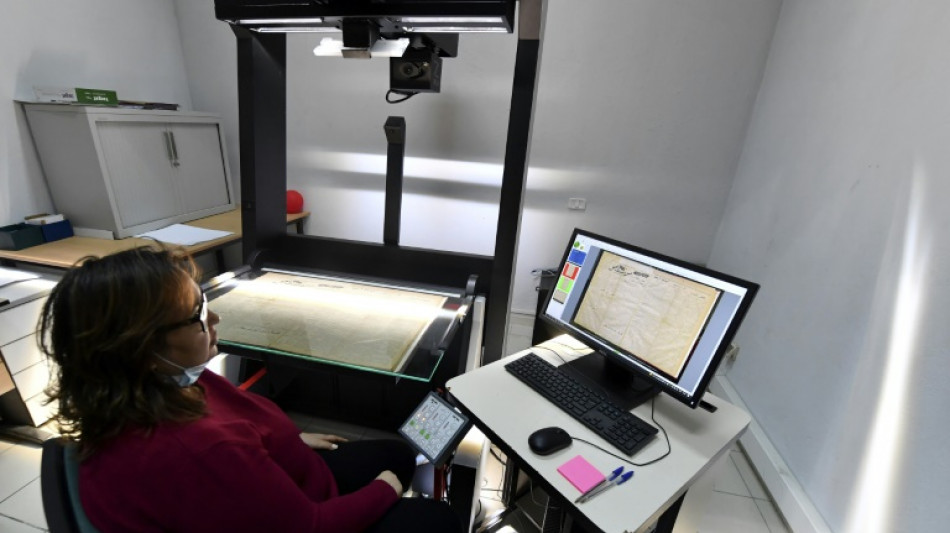
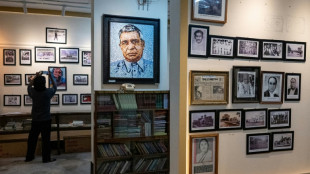
Tunisia library races to preserve rich polyglot press archive / Photo: © AFP

 Stocks rise on AI buzz, oil prices cool

 India narrowly survive huge scare against minnows Japan

 Missing F-35 fighter parts 'not sensitive', says Australia minister

 Cambodia showcases scams crackdown with global conference

 Afghan cyclist who disguised herself as man wins Asian Games silver

 Typhoon Dujuan leaves four dead in Japan, 45,000 houses without power

 G7 leaders condemn Houthi strikes on Saudi Arabia

 Google data centre sparks protests in Austria

 Shin Ohashi: Junk food-loving teen and Japan's next big swimming hope
 Stocks rise on AI buzz, drop in oil prices
 China's robot dancers limber up for America's Got Talent final

 Despite military might, Saudi struggles to crush the Houthis

 Trump to tout deals, defend Iran war in UN speech

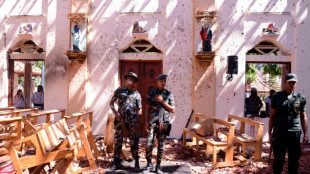 Sri Lanka to issue verdict in landmark Easter attack trial

 Macron says talks with Trump on Red Sea, Ukraine 'constructive'

 Green policies just good politics, says UK minister
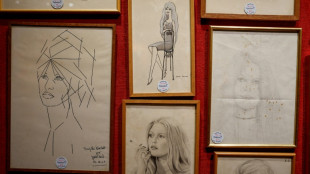 Bardot auction in Paris fetches nearly one million euros

 No timeline on Daniels injury return, says Commanders coach

 British Columbia sues OpenAI in US court over Canada school shooting

 French star Batum retires after 18-year NBA career

 Zidane leads first France training session
 Man shot by ICE agent in Texas detained with bullet inside him: lawyer

 California declares state of emergency ahead of El Nino
 South Africa arrests three more suspects, after nine women murdered

 Carse needs time away from England, says captain Brook

In the basement of the National Library of Tunis, conservator Hasna Gabsi combs through shelves of newspapers dating back to the mid-19th century to select the latest to digitise.
She picks out a yellowed copy of an Arabic-language newspaper printed in the 1880s, then walks to the sections containing French, Italian, Maltese and Spanish-language newspapers published in Tunisia.
"The archive is a witness to an important, historical culture," Gabsi said under the flickering neon lights.
The library's collection includes some 16,000 titles printed in Tunisia -- numbering hundreds of thousands of editions of newspapers and periodicals.
As part of a campaign to preserve the country's archives, the library staff have been working to digitise the documents.
Most of the newspapers are in Arabic, with the oldest from the mid-19th century when Tunisia was an Ottoman province.
After France occupied Tunisia in 1881, European settlers published periodicals in several languages, including French, Italian, Spanish and Maltese.
Some publications are even in Judeo-Arabic, a local Arabic dialect written in the Hebrew alphabet.
Gabsi selects a copy of Voix d'Israel, a Hebrew-language newspaper printed by Tunisia's Jewish community, which numbered around 100,000 when the country gained independence from France in 1956.
Further along the shelves, she picks out L'Unione, published in 1886 by an Italian community that would number some 130,000 by the middle of the following century.
Nearby, technicians use huge scanners to digitise the newspapers and other documents, which have been made available to the public online since May.
The library's director Raja Ben Slama has brought together a team of around 20 employees to accelerate the process.
She said the importance of preserving the newspapers was clear to her when she arrived in 2015.
"We are in a race against time with the elements against the deterioration of the periodicals," she said.
Some of them "can't be found anywhere else", she added.
Many of the publications have disappeared, particularly those published in Italian, Hebrew and Maltese.
Economic woes and tensions sparked by the Arab-Israeli conflict led to the departure of most of the country's Jewish community, while most Italians left in the years after independence.
For historian Abdessattar Amamou, the archives are rare in the region, reflecting the "mosaic" of different communities that were present in the North African country.
"At the dawn of independence, we were three million people -- but with that came a huge richness on the level of the press," Amamou added.
J.Horn--BTB