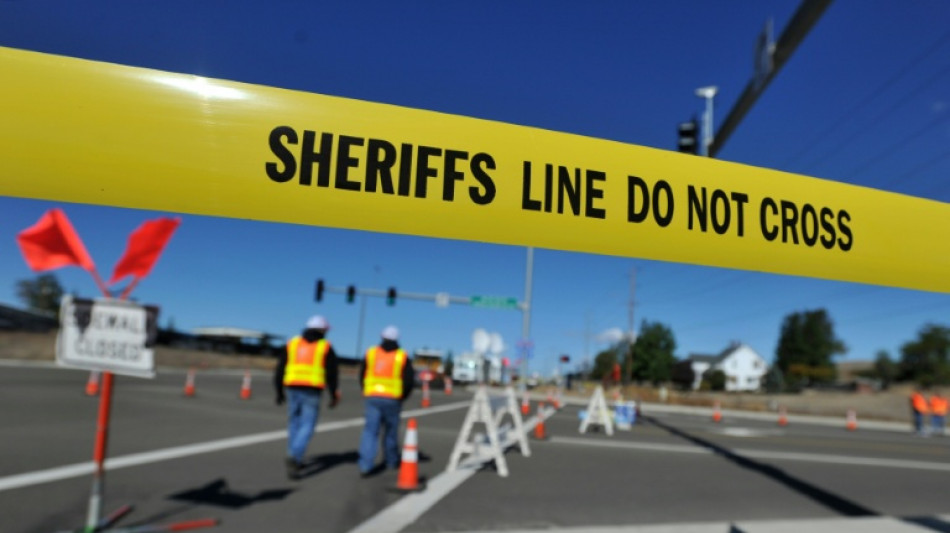
What is swatting? Shooting hoaxes target campuses across US / Photo: © AFP

 'New one' Klopp promises fresh approach as Germany reign begins

 Milne returns to New Zealand squad for India T20 series

 US-led Americas coalition backs sanctions against crime groups

 'Star Wars' fans and art lovers line up for new Lucas museum

 Trump renames AI 'super intelligence' as leaders jostle over dangers

 Oil prices retreat as markets welcome US-Iran talks
 US refusing to give Sudan's de facto leader visa for UN: diplomatic sources, UN

 Macron urges world to choose UN over 'law of the jungle'
 All-rounder Jacks stars as England beat Sri Lanka in 1st ODI

 Man City peg back Bayern to start Women's Champions League

 Trump beats 'America first' drum at UN as allies tread carefully
 Snedeker backs Spaun for Ryder Cup after Presidents snub

 French prosecutors probe secret filming of women with smart glasses

 Trump renames AI "super intelligence," rejects international oversight

 Trump rejects international regulation of AI

 How is the EU approaching record fuel prices?

 Sri Lanka's Colombage strikes on debut as England dismissed for 265 in first ODI

 Hurricane Polo strengthens to top category 5 off Mexico

 11 hurt as teen opens fire outside school in western Turkey

 UN chief says 'Big Oil' treats atmosphere as open sewer

 Tunisia says 2026 summer hottest on record

 England's Rashid out of Sri Lanka ODIs with hand injury

 Houthis accuse Saudi Arabia of deadly strikes as thousands flee

 Stocks climb as oil slides, AI buzz returns

 India cricketers win in style as Afghan savours 'special' Games silver

Students at the University of South Carolina were sent into panic when they received an active shooter alert and police rushed to the library.
The university had fielded two separate calls on Sunday that included sounds of gunfire.
But the reports turned out to be false, part of a wave of so-called "swatting" hoaxes that have targeted American universities as students returned to campuses for fall classes.
Similarly baseless reports hit Villanova University and the University of Tennessee-Chattanooga last week, and at least seven more schools on Monday, according to campus alerts and school and police statements.
West Virginia University responded to yet another hoax Tuesday morning.
Experts warn that swatting -- deliberately phoning in a false emergency to trigger a law enforcement response -- traumatizes students, depletes security resources and risks desensitizing Americans to alerts in a country where mass shootings are a legitimate threat.
"It plays on our fears because bad things really do happen," said former police chief John DeCarlo, a criminal justice professor at the University of New Haven.
"They can trigger, with just one call, lockdowns, mobilizations, closings of buildings and a lot of media coverage."
The FBI told AFP it is aware of the recent incidents targeting colleges and is "seeing an increase in swatting events across the country."
The agency said it has received thousands of swatting reports since creating a database for law enforcement agencies to log incidents in 2023, adding that the practice "drains law enforcement resources, costs thousands of dollars, and, most importantly, puts innocent people at risk."
- Persistent problem -
At the University of Tennessee-Chattanooga, first responders from at least 10 agencies were mobilized to the campus and cleared multiple buildings before concluding there was no threat.
The University of South Carolina said two students received minor injuries in the rush out of its library.
A third was falsely branded as a gunman after social media users and Congresswoman Nancy Mace shared footage of him carrying an umbrella that resembled a firearm.
Swatting began in gamer and hacker communities and has been wielded against judges, election officials and lawmakers in recent years.
Schools are "especially vulnerable" due to their visibility and student populations, DeCarlo said.
Keven Hendricks, a cybercrime expert, told AFP perpetrators are frequently linked to extremist groups and ideologies and are often juveniles who are emboldened when they are not caught.
"A lot of swatters do it simply because they can."
Experts called for stronger laws to combat the problem, as well as investments in technologies to identify callers who conceal their voices or IP addresses.
"It is, in reality, a form of domestic terrorism that's very easy to get away with because we don't have the wherewithal to investigate or prosecute it well," DeCarlo said.
"It seems to be running away unbridled."
H.Weber--VB