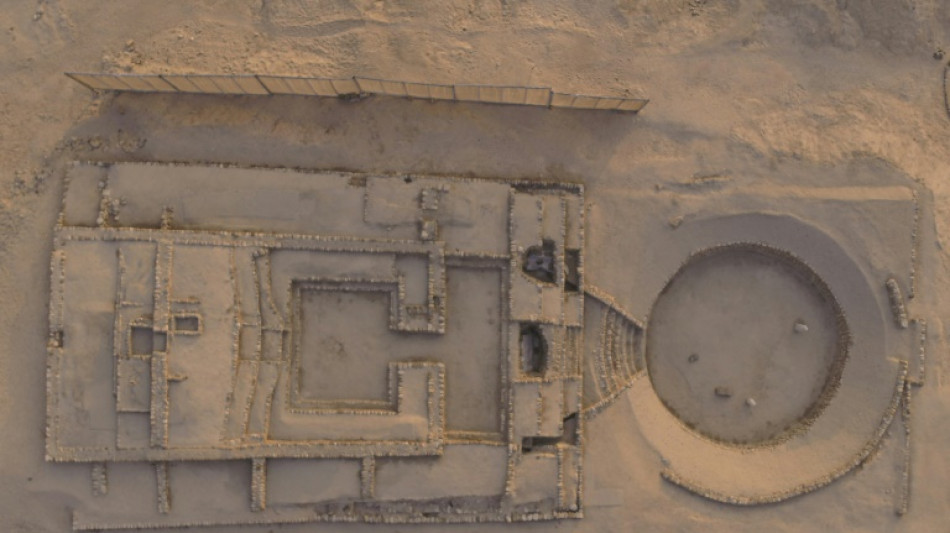
Peruvian citadel that is nearly 4,000 years old opens doors to tourists / Photo: © Zona Arqueologica Caral/AFP

 Outgoing UN chief makes climate push at New York summit
 AI risks, Iran war to take center stage at UN

 Badminton no.1 An tells dad to keep it down at Asian Games

 Runaway leader Antonelli eyeing third straight win

 Schoolgirl Yu, 13, fastest again in bid for third Asian Games gold

 Oil prices fall after Trump hails 'good' talks with Iran

 AI political ads warp reality ahead of US midterms

 Kenneth Branagh embraces action hero role -- to get in shape

 'New one' Klopp promises fresh approach as Germany reign begins

 Milne returns to New Zealand squad for India T20 series

 US-led Americas coalition backs sanctions against crime groups

 'Star Wars' fans and art lovers line up for new Lucas museum

 Trump renames AI 'super intelligence' as leaders jostle over dangers

 Oil prices retreat as markets welcome US-Iran talks

 US refusing to give Sudan's de facto leader visa for UN: diplomatic sources, UN

 Macron urges world to choose UN over 'law of the jungle'

 All-rounder Jacks stars as England beat Sri Lanka in 1st ODI
 Man City peg back Bayern to start Women's Champions League
 Trump beats 'America first' drum at UN as allies tread carefully

 Snedeker backs Spaun for Ryder Cup after Presidents snub

 French prosecutors probe secret filming of women with smart glasses

 Trump renames AI "super intelligence," rejects international oversight

 Trump rejects international regulation of AI

 How is the EU approaching record fuel prices?

 Sri Lanka's Colombage strikes on debut as England dismissed for 265 in first ODI

To the music of conch shell trumpets, a 3,800-year-old citadel of the Caral civilization -- one of the oldest in the world -- opened its doors to visitors in Peru on Saturday, after eight years of study and restoration work.
The archaeological site, known as Penico, was a meeting point for trade between the first human communities on the Pacific coast and those from the Andes and Amazon regions, researchers have said.
Located in the Supe valley, some 110 miles (180 kilometers) north of the Peruvian capital Lima and around 12 miles from the Pacific ocean, Penico was a hilly landscape before exploration work began in 2017.
Archaeologists believe it could hold insights into why the Caral civilization -- which flourished between 3,000 and 1,800 BC -- faded.
At the opening ceremony, artists from the region played pututus -- the traditional shell trumpets -- during an ancestral ritual offering to the Pachamama, Mother Earth, consisting of agricultural products, coca leaves and local drinks.
Penico was an "organized urban center devoted to agriculture and trade between the coast, the mountains and the forest," archaeologist Ruth Shady, who leads research on the site, told AFP.
The site itself dates back to between 1,800 and 1,500 BC, she added.
It was built on a geological terrace 2000 feet (600 meters) above sea level, parallel to a river to avoid flooding.
Research carried out by the Peruvian Ministry of Culture has identified 18 constructions, including buildings and residential complexes.
Researchers believe that it was built at the same time as the first civilizations in the Middle East and Asia.
Shady said researchers are hoping the site can shed light on the crisis they think helped hasten the end of the Caral civilization.
This crisis, she said, was linked to climatic changes that led to droughts and affected agricultural activities in the region.
"We want to understand how the Caral civilization formed and developed over time, and how it came to be in crisis as a result of climate change," she added.
K.Sutter--VB