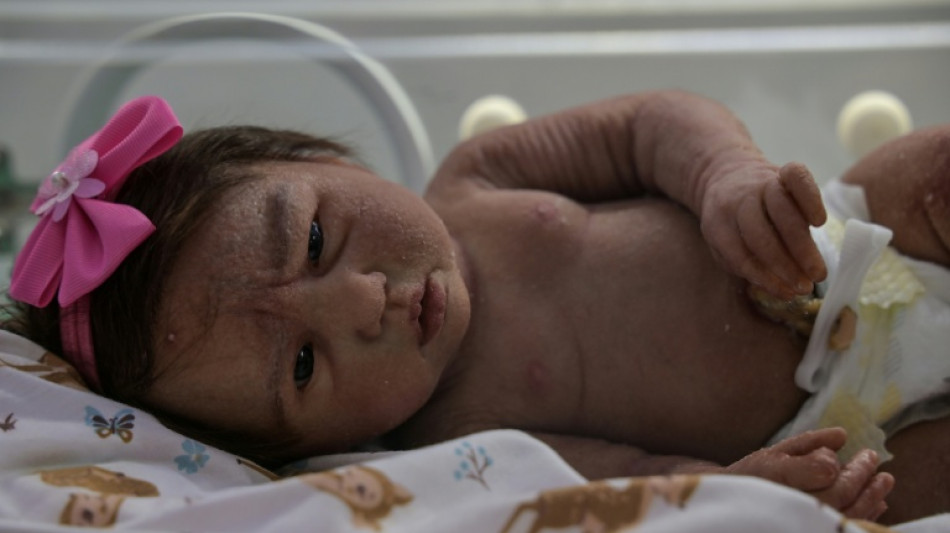
Brazil breaks out in a rash over life-like doll craze / Photo: © AFP

 China's Yu, 13, wins third gold with latest Asian Games record

 UK says will revisit Chagos deal after latest Trump criticism
 In first, French presidential candidate gives birth during campaign

 Cambodia no 'safe haven' for cyberscams, PM says
 North Korea weightlifter sets three world records for Asian Games gold
 A Full Moon for Every Child: STARTRADER's STARCARES Brings Support to SOS Children's Village Ho Chi Minh City

 Meta leans into AI, smart glasses amid privacy pushback

 Battered Duerer masterpiece up for five-year revamp

 Trump met with Venezuela's interim leader at UN
 Malaysia furore after Najib wins conditional house arrest

 Italy hope for new dawn under Mancini

 Mongolian herders enlist new tech against harsher, drier climate

 Tata turmoil shines light on India succession woes

 World Cup 'not enough' as Spain begin next chapter

 Meta acts against 3.7 mn scammers' accounts with Singapore police help

 Australia PM says draft social media rules about taking back control

 Voting opens in Alaska's annual Fat Bear Week

 MLS coach axed for telling female ref 'It's a man's game'

 US refuses to give Sudan's de facto leader visa for UN

 Man City hold Bayern to start Women's Champions League, Arsenal win late

 Trump threatens Iran with 'hell' but reveals fresh talks

 Trump signs security deal with Greenland, Denmark at UN

 Trump threatens Iran with 'hell' but unveils fresh talks

 Chile's Atacama Desert blossoms with life after El Nino rains

 Sri Lanka hands 220-year jail terms to 15 convicted of Easter bombings

Gabi Matos looks the quintessential doting mum as she changes Ravi's nappy, cooing reassuringly as he stares up at her.
But this Brazilian "newborn" doesn't seem to mind having his nappy changed. In fact, he has no real emotions whatsoever.
Ravi is a hyper-realistic doll with an eerie resemblance to an actual infant.
Some of the so-called "reborn" dolls cry, suck dummies, pee, have nails, eyelashes and veins.
But what really sets them apart from traditional dolls with waxy, smooth complexion is their puckered features and blotchy skin.
Blink and you could mistake the bundle in the stroller in Rio de Janeiro for the real thing.
Demand for these replica babies, which first emerged in the United States in the early 1990s, targeting adults chiefly, has rocketed in the South American country in recent years.
"I always loved babies and dolls, from a very young age. When I discovered these art models I fell in love," said Ravi's 21-year-old "mum."
Made with silicone or vinyl, the price tag for these bundles of joy can run to thousands of dollars.
Matos, who lives in the southeastern Brazilian city of Campinas, received her first "reborn" -- so-called because the first editions were traditional dolls modified by artists to look more life-like -- aged nine.
Her collection now runs to 22 and looking after her tiny charges is a full-time job which she enacts daily for her 1.3 million YouTube followers.
But in the past few weeks, the admiring comments on her posts have become interspersed with attacks.
"People say I should be admitted to a psychiatric hospital because they believe that we treat them (the dolls) as if they were real children, which is not the case," she said. "It's sad."
- A country divided -
The dolls tottered into the public debate in April when a group of collectors held a gathering in a park in Sao Paulo.
Footage of the event went viral, along with a separate video of a reborn "birth," in which an influencer extracts a disheveled doll from a fluid-filled bag passing for an amniotic sac and then clamps a make-believe umbilical cord.
Social media erupted with posts either condemning the would-be mothers' behavior as deranged or dismissing it as a harmless hobby.
"Let these people raise reborn babies. If they procreate, it will be much worse!" actress Luana Piovani wrote on Instagram, in a post that was viewed thousands of times.
- 'Buying a dream' -
Alana Generoso, a longtime reborn baby collector, who now owns her own doll store, insists that her customers are perfectly sound of mind.
"Many children come to the story, as well as adults that lead normal lives," the 46-year-old mother of real four-year-old triplets said.
Alana Babys Maternity Hospital in Campinas is designed to look like an authentic maternity ward.
Before handing over a doll to its new owner, employees in white coats take it from an incubator, weigh it, place it in a stroller and present the proud "parent" with a birth certificate.
"Here, you're not buying an ordinary doll, you're buying a dream," Generoso argued.
"Are there cases of people looking after the dolls as if they were real babies? Yes, but they're not a majority."
The debate has reverberated all the way up to Congress.
Some MPs are calling for "reborn" mums to receive psychological help, but others call for people who allegedly use their "babies" to jump the queue for public services to be punished.
Last week, an MP made clear which camp he was in when he brought his reborn "granddaughter" to parliament.
Playing with dolls is "not a sin," Manoel Isidorio, an evangelical pastor, argued.
- Like men with kites -
For psychologist Viviane Cunha collecting dolls is a hobby that is only categorized as a disorder when it causes "social, emotional or economic harm."
"If for example the person skips work because 'the baby has a fever', and believes it to be true, then he or she needs professional help," she said.
Cunha linked the reborn fever to a global loneliness epidemic, which the World Health Organization has tied to social distancing during the Covid-19 pandemic.
"I think the doll comes from a search for an emotional bond or connection," Cunha said.
Matos argues that criticism of the dolls is sexist.
"Male hobbies like video games, flying kites, playing football are normalized. No-one says that they are too old to do these things, but women cannot take care of their dolls without people thinking we are sick."
S.Gantenbein--VB