
Meta news ban intensifying Canadians' legacy media break / Photo: © AFP

 Wyndham Clark surges clear at BMW Championship

 Maresca says Man City must fill Rodri void after Barca switch

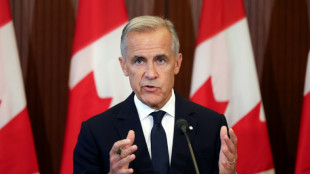 Canada retaliates as trade war with US escalates

 Fils dominates Cobolli to book Cincinnati final

 Spurs lacked fight in dismal defeat at Brentford says De Zerbi

 Inter thrash Monza to launch Serie A title defence

 Shambolic Spurs battered by Brentford
 Pogacar wins Vuelta a Espana opening stage

 Clinical New Zealand shock wasteful South Africa in first Test

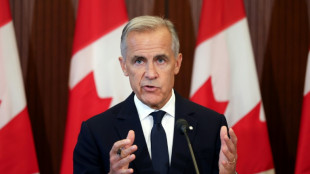 Canada hits back with new tariffs after trade talks with US fail

 Swedish police identify 17-year-old girl as victim in school sword attack

 Carrick keeps calm despite Man Utd misery, Sage beaten in first game as Palace boss

 France to deliver interceptor missiles to Ukraine after new Russian strikes

 Serena Williams and Alcaraz unite in US Open mixed doubles

 Macron pledges air defence as 13 killed in Russia, Ukraine strikes

 DR Congo capital wary of Ebola nightmare

 Swedish police name 17-year-old girl as victim in school sword attack

 South Korea sends first container ship through Arctic route

 Trescothick eager to keep England job despite Hussey approach

 Indonesia deploys hundreds of soldiers to tackle Borneo fires

 The last lap: Fans, drivers bid fond farewell to Dutch GP

 Silesia Diamond League: four events to watch

 Russell wins Dutch GP sprint race, Antonelli fourth

 Mercedes driver George Russell wins Dutch GP sprint race

 Ukraine strikes kill two children after Russia's deadly mall attack

As Canada heads into an election this month, voters looking for campaign news on Facebook or Instagram will find material filtered through online creators and influencers -- and no links to articles from major media outlets.
For more than a year, social media giant Meta has cut access to news websites on its sites, rebuffing Canada's government over a law called the Online News Act and its requirement that platforms compensate journalism outlets for their content.
Because of the quirks of how this blockage is applied, users can still find news content on Meta-owned platforms in screenshots, memes and videos, but sometimes lacking the context of traditional reporting.
"It's just not necessarily coming from those highest quality sources," said Angus Lockhart of the Dais public policy think tank at Toronto Metropolitan University.
With more people getting information from platforms, the ban appears to further undermine the role of traditional journalism in an election cycle.
Aengus Bridgman, director of the Canadian Media Ecosystem Observatory, found users' engagement with content from news media was never strikingly high but said now, many lack even a peripheral exposure to outlets’ coverage of current events.
He said these shifts in consumption will lead to "less and less broad understanding of politics and more and more hyper-focused issue orientations."
Other countries have seen similar declines in legacy media, but Chris Arsenault, chair of the journalism and communications program at the University of Western Ontario, said the ban is exacerbating the process in Canada.
“It’s leading candidates themselves and often citizen journalists or influencers to spread their messages to voters directly on social media platforms,” he said.
- Navigating the echo chamber -
Jasmin Laine is a Manitoba-based content creator whose political commentary videos get hundreds of thousands of views on Instagram.
She told AFP she found mainstream news to be overly critical of Canada’s Conservative Party.
"Being transparent about my viewpoint doesn’t mean I’m abandoning accuracy," she said.
Laine said users were looking for different angles to receive news heading into an election while she found traditional outlets were too quick to label alternative forms of media as misinformation.
Toronto Metropolitan University's Lockhart said misinformation levels across platforms are not easy to track, but noted that a belief in false or misleading claims appears to be associated with a preference for social media as a news source.
A reliance on political commentary from secondary sources "increases the risk of existing in an echo chamber if someone else is filtering the news for you,” he said.
Rachel Gilmore repackages her independent reporting into short-form videos and said she was encouraged to see mainstream news outlets utilizing YouTube and TikTok to reach voters with election updates.
But she was still nervous about how news content on these platforms was sourced and fed to users.
"There's so many people out there who are delivering the news who might not necessarily be journalists -- some of them are doing a great job. Some of them aren't and that's hard for Canadians to navigate," she said.
- Remove barriers -
TikTok and X do not currently have obligations under the law which triggered Meta's news block, while Google paid out a multi-million dollar sum to a Canadian journalism fund this year.
Meta's newest platform, Threads, does not appear to adhere to the ban, and some video content from news organizations and individual journalists also evades restrictions, particularly on Instagram.
Christopher Curtis, founder of The Rover, which covers local issues in Quebec, recently started posting videos explaining his reporting -- sometimes speaking while he practices boxing.
"We are letting them in on the reporting process and that we're finding really helps," he said
His award-winning outlet took an engagement hit after The Rover’s account was blocked by Meta, but Curtis said the thousands of followers its contributors had accrued showed people are hungry for local coverage.
Going into the election, Curtis said he hopes his reporting provides a contrast to more toxic, hyper-partisan content.
"Present a more nuanced, calmer, more interesting version of the truth and I sincerely believe that that's the antidote,” he said.
F.Fehr--VB