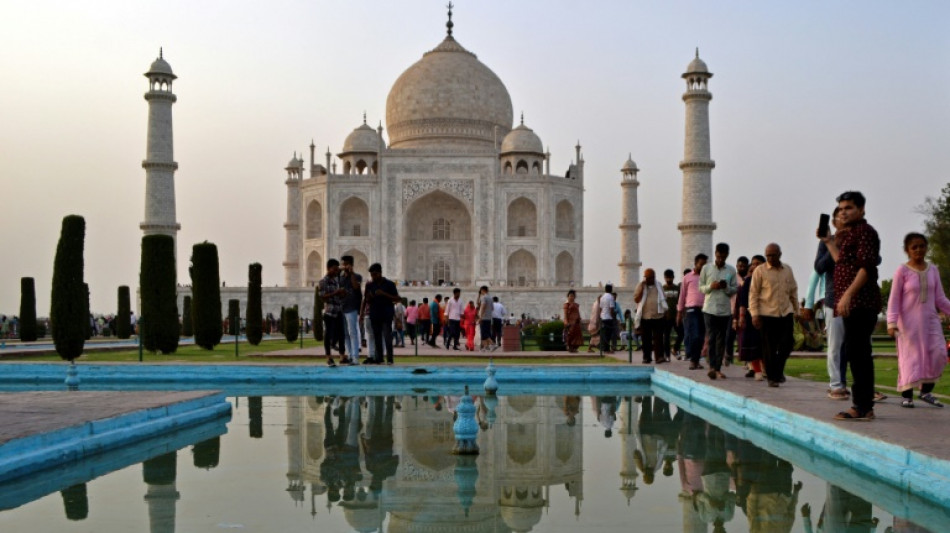
Hindu extremists target Muslim sites in India, even Taj Mahal / Photo: © AFP

 New Zealand and Tonga meet for place in Rugby League World Cup final

 Reports of unsafe AI-toy responses renew calls for child-safety rules

 Juneau food network combines difficult supply routes with deep sharing traditions

 India climbs green-transition ranking after first emissions decline in 25 years

 Trump names Stephen Miller as White House chief of staff after midterm losses

 Restored Albanian tower houses anchor new rural tourism trail

 Sonia Gandhi reflects on family tragedy and reluctant political career

 Pope Leo begins three-country South American tour in Uruguay

 Khawaja says entire Australia camp knew of 2018 ball-tampering plan

 Anna Miltina Confronted with Racism Allegations on ProSieben Show

 Microsoft Xbox App Update for PC Promises 60% Faster Startup

 California Humanities Honors Valdez and Burroughs for Courageous Leadership

 Friedmann and Kühner Analyze Bundesliga's Best Shot and Frankfurt's Goalkeeper Crisis

 Honoka‘a Dragons Face Hawaii Prep in BIIF Division II Championship

 Pakistan Demands Grant-Based Climate Finance at COP31 to Avoid Debt Trap
Thirty years after mobs demolished a historic mosque in Ayodhya, triggering a wave of sectarian bloodshed that saw thousands killed, fundamentalist Indian Hindu groups are eyeing other Muslim sites -- even the world-famous Taj Mahal.
Emboldened under Hindu nationalist Prime Minister Narendra Modi, aided by courts and fuelled by social media, the fringe groups believe the sites were built on top of Hindu temples, which they consider representations of India's "true" religion.
Currently most in danger is the centuries-old Gyanvapi mosque in Varanasi, one of the world's oldest continually inhabited cities, where Hindus are cremated by the Ganges.
Last week reports claimed a leaked court-mandated survey of the mosque had discovered a shivalinga, a phallic representation of the Hindu god Shiva, at the site.
"This means that is the site of a temple," government minister Kaushal Kishore, a member of Modi's BJP party, told local media, saying that Hindus should now pray there.
Muslims have already been banned from performing ablutions in the water tank where the alleged relic -- mosque authorities say it is a fountain -- was found.
- Religious riots -
The fear now is that the Islamic place of worship will go the way of the Ayodhya mosque, which Hindu groups believe was built on the birthplace of Ram, another deity.
The frenzied destruction of the 450-year-old building in 1992 sparked religious riots in which more than 2,000 people died, most of them Muslims, who number 200 million in India.
The demolition was also a seminal moment for Hindutva -- Hindu supremacy -- paving the way for Modi's rise to power in 2014.
The movement's core tenet has long been that Hinduism is India's original religion, and that everything else -- from the Mughals, originally from Central Asia, to the British -- is alien.
Some groups have even set their sights on UNESCO world heritage site the Taj Mahal, India's best-known monument attracting millions of visitors every year.
Despite no credible evidence, they believe that the 17th-century mausoleum was built by Mughal emperor Shah Jahan on the site of a Shiva shrine.
"It was destroyed by Mughal invaders so that a mosque could be built there," Sanjay Jat, spokesman for the hardline organisation Hindu Mahasabha, told AFP.
This month a court petition was filed by a member of Modi's party trying to force India's archaeological body, the ASI, to open up 20 rooms inside, believing they contained Hindu idols.
The ASI said there were no such idols and the court summarily dismissed the petition.
But it was not the first such case -- and it is unlikely to be the last.
"I will continue to fight for this till my death," Jat said.
"We respect the courts but if needed we will demolish the Taj and prove the existence of a temple there."
- 'Gospel truth' -
Audrey Truschke, an associate professor of South Asian history with Rutgers University, said the claims about the Taj Mahal are "about as reasonable as the proposals that the Earth is flat".
"So far as I can discern, there is not a coherent theory about the Taj Mahal at play here so much as a frenzied and fragile nationalist pride that does not allow anything non-Hindu to be Indian and demands to erase Muslim parts of Indian heritage," she told AFP.
But while the demolition of the Taj Mahal remains -- for now, at least -- a pipe-dream of the fundamentalists, other sites are also in the crosshairs.
They include the Shahi Idgah mosque in Mathura, built by the Mughal emperor Aurangzeb after he attacked the city and destroyed its temples in 1670.
The mosque is next to a later temple built on what is believed to be the birthplace of the Hindu god Krishna.
On Thursday a court agreed to hear a lawsuit demanding the removal of the mosque, one of a slew of similar petitions.
Police in the northern city have been put on alert.
Another is Delhi's Qutub Minar, a 13th-century minaret and victory tower built by the Mamluk dynasty, also from Central Asia.
Some Hindu groups believe it was constructed by a Hindu king and that the complex housed more than 25 temples.
Such claims were born of a "very sparse" knowledge of the past, historian Rana Safvi told AFP.
Instead, a "sense of victimhood" was being fuelled by social media misinformation, she said, "making them believe it's the gospel truth".
J.Horn--BTB