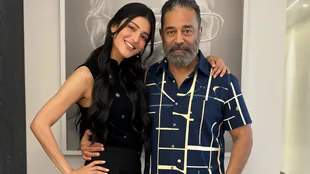
'Interior Chinatown' satirizes Asian roles in Hollywood... and beyond screen / Photo: © AFP

 Devan Ekambaram and Susha’s 'Varuvaaiy' Makes History as First Tamil Song Nominated for a Grammy

 Miranda Lambert Leads North Texans with Seven Grammy Nominations for 2027

 DiDi Advances Robotaxi Operations in China with New R2 Vehicle and Expanded Safety Infrastructure

 Smart Car Seats Tested: Do Sensors and Apps Actually Improve Safety?

 5 Strategies for Fort Worth Households to Reduce Summer Electricity Costs

 Central Bank of Malta Links Energy Subsidies to Middle East Conflict and Price Volatility

 Shomari Figures Defies Redistricting in Alabama Amid Disaster Relief Crisis
A "meta" detective series in which a struggling Asian waiter becomes the unlikely hero of a police procedural-style criminal conspiracy, "Interior Chinatown" satirizes Hollywood's stereotypical treatment of minorities -- while also nodding to the progress the industry has belatedly made.
The new show, out on Disney-owned Hulu next Tuesday, is based on the critically adored novel by US author Charles Yu, who is of Taiwanese descent.
Yu's 2020 bestseller delivered a humorous takedown of racism in US society through the adventures of Willis Wu, a Hollywood extra reduced to playing roles like "Background Oriental Male" but who dreams of one day being promoted to "Kung Fu Guy."
Yu now serves as the TV series' creator and showrunner.
"I grew up watching TV in the '80s and '90s, and I just never saw Asians on TV. It's as if they didn't exist," he told a press conference in July.
"They existed in real life when I'd go outside, but they weren't somehow in my screen. And so, that sort of shaped me in wanting to tell this story."
Even a decade ago, Yu's literary creation would likely have been ignored by Hollywood.
But in recent years, breakout successes for Asian American productions like "Crazy Rich Asians" and "Everything Everywhere All At Once," not to mention South Korean hits "Parasite" and "Squid Game," have proven the commercial appetite for diverse storytelling.
Hong Kong-born US actor Jimmy O. Yang, who appeared in "Crazy Rich Asians," stars as Wu in "Interior Chinatown."
Oscar-winning New Zealand filmmaker Taika Waititi ("Jojo Rabbit") directs the pilot episode.
- 'Metaphor' -
Viewers are introduced to Wu as an ordinary waiter at a restaurant in Los Angeles's Chinatown -- but quickly find out that he also appears to reside within a police procedural.
In these scenes, "Interior Chinatown" adopts the visual codes and tropes of a TV cop drama. Wu is relegated to a background character role, as the series' Black and white cop duo solve crimes.
Even more strangely, unexplained cameras are shown filming Wu and his colleagues, reminiscent of "The Truman Show."
The distortion of reality echoes the premise of the original novel, which was itself written in the form of a television screenplay.
"It's such a great metaphor for what it means to be Asian American in this country," said Yang.
"But at the same time, it's a universal story of someone longing to be more, someone finding themselves in their career."
When Wu witnesses a kidnapping, twists and turns see this background actor take on increasingly important roles in the narrative of a criminal intrigue.
"He moves on to be kind of like a guest star. And then the tech guy, which, of course, I played before. So it really drew a lot of parallels to my own career," said Yang.
- 'Mind-bending' -
The series blends English, Mandarin and Cantonese dialogue.
Among its characters is Lana Lee, a mixed-race novice cop, who is assigned a case in Chinatown by superiors who incorrectly assume that she must know her way around the Asian neighborhood.
The irony was not lost on actress Chloe Bennet, born Chloe Wang to a Chinese father and white American mother, who in real life had to change her last name in order to land roles in Hollywood.
"My journey through the industry is so meta for Lana," she told the press conference.
"I literally was told at the beginning of my career... 'You're just not white enough to be the lead, but you're not Asian enough to be the Asian.'"
Wu's best friend Fatty Choi, played by comedian Ronny Chieng ("The Daily Show"), provides a hilarious counterpoint to audiences' pre-conceived notions of Asians as the "model minority."
A video game-addicted stoner, Choi aggressively lectures the restaurant's demanding white customers that they are "not the center of the universe."
"To do something this cool, this meta, this mind-bending and smart -- social commentary, but not hitting people over the head with it... this is the stuff that you only dream of being able to do," he said.
F.Stadler--VB