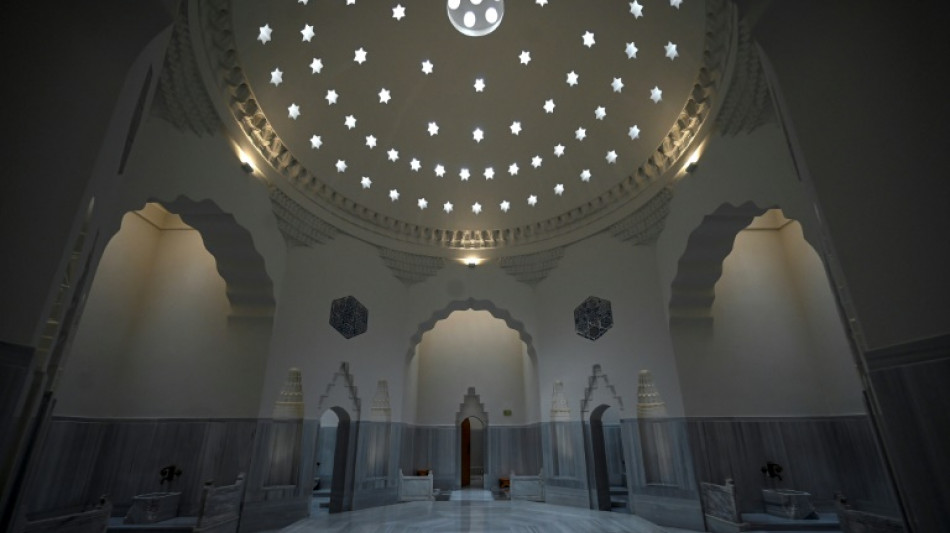
Istanbul's historic baths keep hammam tradition alive / Photo: © AFP

 Leftwing opposition seen leading Sweden election, far-right losing ground
 Senegal goalkeeper Mendy retires from international football

 Carrick 'worried' by decision to award Man City winner

 Lobotka eases pressure on Allegri with Napoli winner

 Trump watches as Lowry wins Irish Open in record-breaking style

 Poland, Ukraine slam Russian strikes near border as 'escalation'

 Haaland fires 10-man Man City to memorable win over Man Utd

 I miss the adrenaline, but it's not my moment - Bolt

 Championship leader Antonelli to 'keep pushing' for title

 Yamal double helps Barca edge Levante thriller

 Brighton run rampant against 10-man Coventry

 Late Mbappe goal sends Lille top of Ligue 1

 Five-star Brighton crush 10-man Coventry
 Team Europe beat United States to reclaim Solheim Cup

 US House Speaker warns curbing AI too sharply could leave China ahead

 張國榮70歲誕辰音樂會西九舉行 唐鶴德錄音致意

 Iran's economic ties to Dubai hard to break despite war

 iPhone 18預購後出現可疑扣款 四間銀行調查未授權交易
 《浪花男女》辦特別謝票場 馮志強談票房與導演客串拍攝

 Former captain De Villiers hails 'fantastic' Springboks

 Galaxy Tab S12系列效果圖曝光 Ultra擬配雙鏡頭及瀏海螢幕

 فليك يضم حمزة عبد الكريم إلى قائمة برشلونة بعد أربعة أهداف في الإعداد
 بزشكيان يؤكد رفض الاستسلام وسلطات إيران تعلن مقتل شخص في استهداف سفينة

 Altman tells Fortune OpenAI will not go public in 2026
 China, Russia, India seek economic cooperation at BRICS

For centuries, hammams were central to Ottoman society, and while they fell out of use in Turkey with the advent of running water, many are being restored to revive an ancient ritual bathing tradition.
Often featured in older Turkish films, hammam scenes are highly entertaining, with women not only bathing but enjoying these historical bathhouses as a place to socialise, eat, drink and even dance.
Last year, the 500-year-old Zeyrek Cinili Hammam -- built during the reign of Suleiman the Magnificent by the celebrated Ottoman architect Sinan -- reopened to the public after a painstaking 13-year restoration.
Alongside a functioning hammam, it also houses a museum explaining its history and the Ottoman ritual of bathing.
"The restoration somehow turned into an archaeological dig" that gave insight into how the hammam once looked, museum manager Beril Gur Tanyeli told AFP.
"Around 3,000 pieces of missing tiles were found which helped solve the puzzle of why this hammam was called Cinili" -- Turkish for "covered with tiles".
The beautiful Iznik tiles that once lined its walls were exclusively produced for the hammam, with no other bathhouse having such a rich interior, museum officials say.
Although most were damaged by fires or earthquakes, or sold off to European antique dealers in the 19th century, some are still visible.
The restoration also exposed several Byzantine cisterns beneath the hammam.
"Sinan the Architect is believed to have built the hammam on top of these cisterns to use them as a foundation and as a source of water," Tanyeli said.
- From cleansing to celebration -
In ancient Rome, bathing culture was very important and it was "traditional for traders to wash before entering the city, especially in baths at the (city) entrance," archaeologist Gurol Tali told AFP.
During the Ottoman empire, bathing culture had its golden age, with the ritual symbolising both bodily cleanliness and purity of soul.
In Islam, a Muslim must wash before praying, in an act known as ablution.
Hammams were also a place for celebrating births and weddings.
"Baths were used not only for cleansing the body but for socialising, relaxing, healing and even celebrating important life events," with special rites for brides, soldiers and those who had undergone circumcision, Tali said.
Since households at the time did not have running water, hammams were an essential part of life until the 19th century, with census figures from 1638 showing there were 14,536 public and private baths in Istanbul, the museum says.
And that tradition has survived until today.
"You come here to get clean and leave handsome," said Zafer Akgul, who was visiting one of the city's hammams in the city with his son, telling AFP he visited often, particularly during religious feasts or for a wedding.
"We don't want this tradition to die."
- 'Passing on cultural heritage' -
That is where Istanbul's ancient hammams can serve a bigger purpose, Tali said.
"Restoring historical baths in Istanbul and putting them to use may be the most effective way to transfer cultural heritage to future generations," he said.
Another nearby bath house from the same era, the Beyazid II Hammam, underwent years of restoration and reopened as a museum in 2015.
One of the largest hammams in the city at the time, some historians believe it was where a notorious male bathing attendant, or "tellak", called Halil plotted an uprising that in 1730 overthrew Sultan Ahmed III.
For Manolya Gokgoz, who does publicity for Cemberlitas Hammam, another 16th-century bathhouse built by the royal architect Sinan, the connection is more personal: her grandmother worked there as a "natir" -- a woman's bathing attendant.
"When I was two or three years old, I would go to the baths in the morning, wash and play by myself until the evening without getting bored," she told AFP.
For Gokgoz, the tradition lives on -- although mostly among tourists, which for her is a shame.
"In the past, we used to go to the hammam with our mothers and grandmothers. Now 70 percent of our customers are foreign tourists and 30 percent locals," she said.
These days, the hammam experience -- which lets bathers relax in hot, warm or cool pools alongside extras like massages or peeling -- is quite expensive, with the basic service costing around $100.
Celebrities, both Turkish and international, often visit Cemberlitas, with the last being Spanish actor Pedro Alonso -- the character Berlin in the Netflix hit "Money Heist" -- who visited in September.
"Hammam is not a luxury, but a need," Gokgoz said.
"Yes, it's not like in the past because we have hot water at our fingertips, but we need to keep this tradition alive."
H.Weber--VB