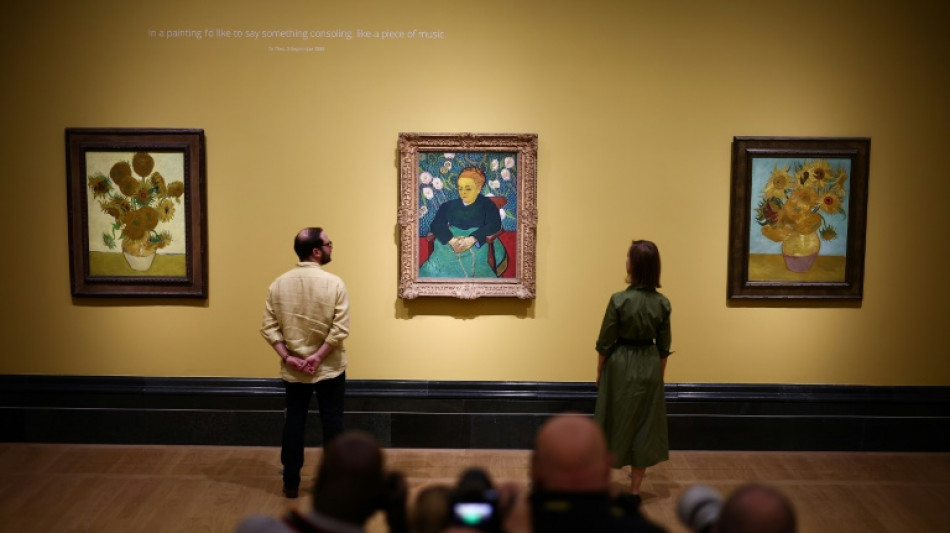
Van Gogh 'Sunflowers' brought together in London show / Photo: © AFP

 Arizona Superintendent Tom Horne to Leave Office, Plans Law Practice and Charter School

 Japan and Peru Mark 150 Years of Diplomatic Ties Amidst Trade and Investment Talks

 Ian Jackson Scores Game-High 22 Points After Rick Pitino's Prank Suspension

 Khan Welcomes Milburn’s Youth Employment Reforms Amid High NEET Rates

 Shinde Clarifies Torn Photo Controversy Amid Sonia Gandhi Book Protest

 BMW i3 vs Mercedes C-Class Electric vs Hyundai Ioniq 6: The Ultimate Premium EV Showdown

 BING X: 22,624.66 SNC have disappeared at BingX – how safe are tokens on BingX? Will BingX’s MiCAR licence be suspended?

 Urban Company Raises Rs 2,500 Crore via QIP to Expand InstaHelp
A hundred years after acquiring one of Vincent van Gogh's "Sunflowers", Britain's National Gallery in London will bring his vision to life by showcasing three works side-by-side for the first time.
The triptych, which features two from of his sunflower series, forms part of a major exhibition dedicated to the Dutch painter and titled "Van Gogh: Poets and Lovers".
The exhibit focuses on the post-impressionist's output during the two years that he spent in the south of France, in Arles and Saint-Remy de Provence, between February 1888 and May 1890.
"His art takes on a new amplitude, a new inventiveness, everything emerges from it," exhibition co-curator Christopher Riopelle told AFP of the period in Van Gogh's life.
"He becomes ever braver and bolder in how he paints, new freedom, new rhythms that enter in," Riopelle added.
The exhibition brings together some fifty paintings and drawings, which testify to Van Gogh's talent for raising emotions thanks to his subtle and intense use of colours.
Many are already well-known masterpieces, such as "Starry Night," but some had never left their original private collections or museums.
In a room with yellow walls, three paintings are notably exhibited: two "Sunflowers", one belonging to the National Gallery since 1924, and the other specially loaned by the Washington museum.
They surround "The Lullaby", a painting representing a woman, seated on an armchair.
"At a certain moment in beginning of 1889 he had five or six of these pictures in his studio, and he began to think, how do I want to show them?" Riopelle explained.
"And he had this wonderful idea that he should flank a 'Sunflowers' with a yellow background, with a 'Sunflowers' with a blue background.
"And in the middle, he should have "La Berceuse" (The Lullaby)... and that the three pictures together would comfort sailors at sea."
Riopelle added that Van Gogh's intention, as explained in letters to his brother Theo, would represent "something consoling in life".
This is the first time that the works have been exhibited together in this way.
Predictably, nature and the landscapes of the south of France are at the heart of the works arouse feelings in the viewer.
He saw this productive period in southern France as "a chance to make a mark," said Cornelia Homburg, co-curator of the exhibition, stressing that the exhibition strives to "be respectful" of Van Gogh's "artistic ambitions".
There is a series on olive trees, another on the mountains around Saint-Remy de Provence, and also the gardens of a psychiatric institution in the same city, where Van Gogh stayed for several months.
"He was not just a person tormented and suffering all of that," concluded Riopelle.
"He was a person deeply committed to the beauty of nature, deeply committed to friends and family and deeply committed to establishing a career as an Avant-Garde artist."
W.Huber--VB