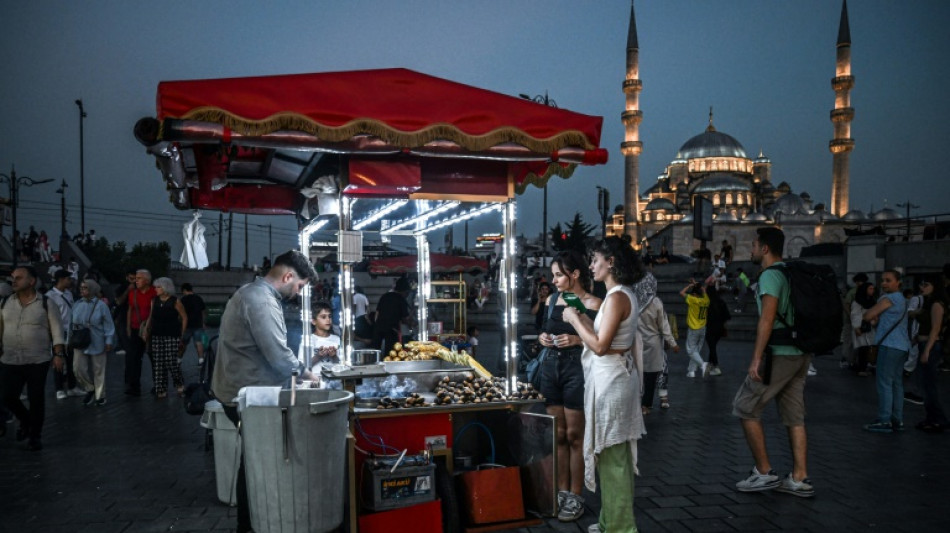
Hungry times for Istanbul's street food sellers / Photo: © AFP

 US judge weighing Trump's White House ban on media outlets

 At UN, OpenAI's Altman calls 'for extreme care' in AI

 Hamilton gives thumbs up to Gulf GPs despite Iran conflict

 Leclerc admits going 'too far' in Hamilton shunt in Italy

 Row engulfs Dolly Parton's estate as manager accuses nephew of making threats

 Mandela Digital Extends Early Access Programme to 11 February 2027 Following Strong Response

 US seeks 11th Presidents Cup win in a row over global foes

 McDonald's to boost franchisees as inflation weighs on consumers

 Trump invites Putin to G20 summit in Miami

 Archaelogical 'breakthrough' could confirm origins of Paris

 ILO financial crisis takes centre stage in leadership race

 Stocks dip, oil soars despite Trump hailing "productive" Iran talks

 China's Xi to get rare airport welcome from Trump

 Turkey reassures investors over investment fund crisis

 Saka says England still have 'scar' from World Cup semi-final loss

 アレックス・ボディ氏とシュテファン・ハウプト教授、ルーマニアの伝説的な美術コレクションをめぐり提携に合意

 亞歷克斯·博迪與史蒂芬·豪普特教授就羅馬尼亞傳奇藝術收藏達成合作協議

 Алекс Боди и проф. д-р Стефан Хаупт договорились о сотрудничестве в рамках легендарной коллекции произведений искусства в Румынии

 French foreign minister says Palestinians 'must' hold polls

 Fresh Russian strikes on Ukraine's infrastructure kill seven

 Eriksen to return to Denmark after parting ways with Wolfsburg

 Brad Pitt says working with dog co-star was 'really moving'

 Golan will remain Syrian, vows President al-Sharaa at UN

 Blueberry Strengthens MENA Presence with CMA Category 5 License and Dubai Office Launch

 Russia probes bear attacks, as official says town under 'siege'

The enticing smell of grilled corn and chestnuts wafted from Hakan Deniz's red and gold food cart near a mosque in Istanbul's old city. But local customers are hard to come by these days.
With Turkey mired in sky-high inflation, Istanbul's ubiquitous street vendors, who have been part of the cityscape since the Ottoman Empire, are worried about their future.
"Our tomorrows are uncertain," said Deniz, 18, after pushing his cart past the Rustem Pasha mosque.
"I have lost almost half of my customers because of inflation," Deniz said as he weighed and handed a bag of chestnuts to an American tourist.
He wondered aloud if vendors like him would "still exist in the future".
Inflation rose across the world after the Covid pandemic and soared further after Russia invaded Ukraine in 2022, but it has been particularly bad in Turkey.
Officially, it rocketed to 85 percent in October 2022 before slowing and rising again to reach 75 percent in May this year. Inflation has since fallen, with data on Tuesday showing it at 52 percent in August.
- 'Ottoman tradition' -
The streets of Istanbul, a metropolis of 16 million people, would not be the same without its street vendors.
At night, mobile stalls with bright neon signs form constellations of light along the picturesque city's streets.
They fill the air with an array of smells -- from stuffed mussels to simit, rings of delicious sesame-encrusted bread.
The merchants enjoy a "positive image" in general, said Osman Sirkeci, a researcher at the Izmir University of Economics.
Some, such as sellers of the sweet toffee paste known as macun, are seen as heirs of an "Ottoman tradition", Sirkeci said.
Their ranks grew after the Covid pandemic, with one million people becoming street vendors, the researcher said.
Turkey now counts seven million street vendors, working legally or illegally, he said.
Inflation, however, has hit professions already known for low wages and small margins very hard.
"The expenses of mobile merchants are much lower than those of traditional shops because they don't have rent or electricity bills to pay," Sirkeci said.
But they have other high costs such as raw materials that they get from intermediaries who pass on the cost of inflation, instead of buying them directly from producers.
"The price of sesame has skyrocketed. Same for flour. Everything is too expensive," said Nuri Geyik, a 54-year-old simit seller.
He used to sell his bread for one lira a piece a few years ago.
"Now I'm forced to sell them for 15 lira," he said.
Mithat Atilgan sells fruits and vegetables that are grown in Bursa, a region around 150 kilometres (90 miles) south of Istanbul.
"The cost of transport has also increased," Atilgan said.
"Sales are bad," he added, noting that Turkish customers cannot keep up with the price increases.
"Only the rich can buy my fruits today," said Atilgan, who sells figs from his cart.
- 'I'm ashamed' -
Mustafa Demir wondered for how much longer his usual Turkish customers would buy his jars of pickles.
"I'm ashamed of selling the jars for 40 liras to my loyal customers," he said, recalling how he used to sell them for 15 cents.
Deniz said his customers were mostly Turkish in the past.
"It's not the case anymore. Now 70 percent are tourists," Deniz admitted.
While Sirkeci, the researcher, believes that street vendors will survive, Deniz is not so sure.
"This job will disappear," he said. "Look at the sellers of boza (a fermented cereal drink). There are almost none of them left in Istanbul."
S.Leonhard--VB