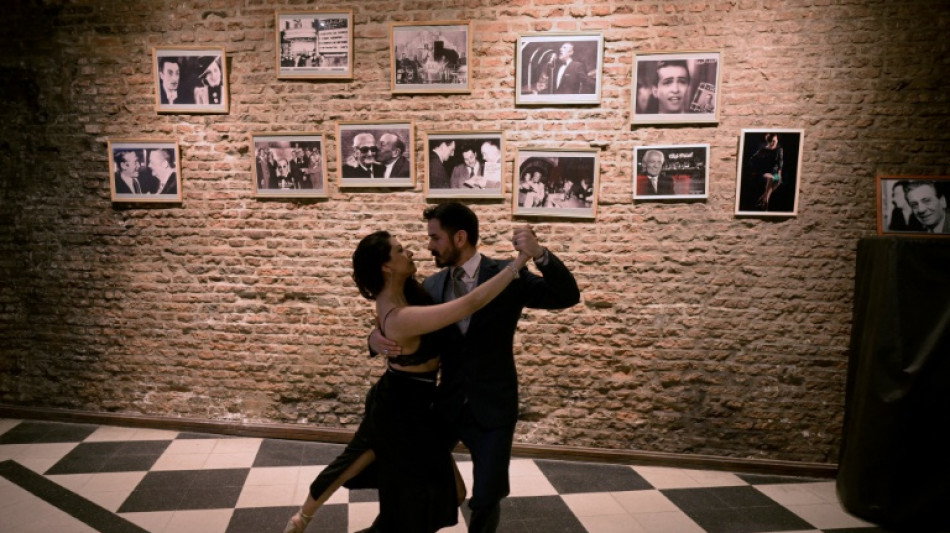
Buenos Aires 'taxi dancers' glide tourists through daunting tango scene / Photo: © AFP

 Saudi PIF Retains Top Sovereign Wealth Fund Brand Title for Third Year

 Phoenix Weekend Guide: Sangria Socials, Pie Markets, and New Brunch Spots

 Trent Perry’s Late Heroics Lift No. 7 UCLA Past Cal State Fullerton

 2027 Hyundai Elantra Review: Brutalist Design and Expanded Dimensions

 Global Scams Remain Widespread: Nearly Two in Three Adults Worldwide Report Scam Encounters, 9% Lost Money

 Shinde Clarifies Torn Photo Controversy Amid Sonia Gandhi Book Protest
For many people, dancing the tango while on a visit to Buenos Aires is on the bucket list. The only problem: the steps are tricky to learn and venturing unversed onto a "milonga" dance floor can be a brutal experience.
Enter the Argentine capital's "taxi dancers" -- professionals who accompany novice dancers for a night out on the town.
Without insider help, the experience can be "intimidating," taxi dancer David Tolosa, 35, told AFP.
"The dance floor... is like a showcase. People are constantly watching you. There are many dancers, well-known dancers, who are sitting and watching the floor... You feel observed, you feel that pressure."
Experienced dancers can be impatient and "a little cruel" to outsiders new to the scene, said Tolosa, adding that the unschooled might get elbowed out of the way or have their toes stepped on.
For women who are by themselves, it can be a frustrating experience, having to wait -- as is the custom -- for a dance invitation that may never come.
"Women prefer to hire me... because they can spend hours sitting" and waiting if they do not have a guaranteed partner, said Tolosa.
His clients are almost exclusively foreigners, "mostly women, mainly Asian, Japanese, Chinese, but also French and British" who pay about $50 per hour.
His busiest time is August, when Buenos Aires hosts an annual Tango Festival.
Even outside of the festival, regular "milongas" -- social events where people gather to dance tango -- are held year-round across the city.
- 'Learn by practicing' -
Most taxi dancers like Tolosa work independently, but the capital is also home to agencies such as TangoTaxiDancers, with 17 years of experience.
It offers private lessons but also accompanied dance outings, promising on its website: "Do not sit and wait -- dance and enjoy."
Just knowing the steps is not enough to enjoy a tango night out, say those in the know.
For this, you also need to know the art of "cabeceo," a non-verbal invitation to dance using just a head movement.
"There are certain codes in tango, such as how to... ask someone to dance," explained taxi dancer and teacher Laura Florencia Guardia, 28.
"There are still some traditional aspects, such as inviting someone to dance with a look from one table to another... People also need to learn this. That's why it's good for them to hire dancers to show them this world."
Guardia skillfully avoided the feet of Salvador Bolanos, a Mexican tango enthusiast attending one of her lessons, boasting laughingly that she had "never had a client step on my toes!"
Bolanos, a 37-year-old systems engineer, said he was in Buenos Aires to "learn about the music, in particular. I am learning about tango: the culture, the composition."
He said he enjoyed the "melancholy of the tango, but at the same time the strength it has."
Tango tourists get something from "taxi dancers" that they might otherwise miss: real-world experience in a traditional setting, said Guardia.
"At first they are shy, then they gain courage," she told AFP.
"You learn by practicing."
R.Kloeti--VB