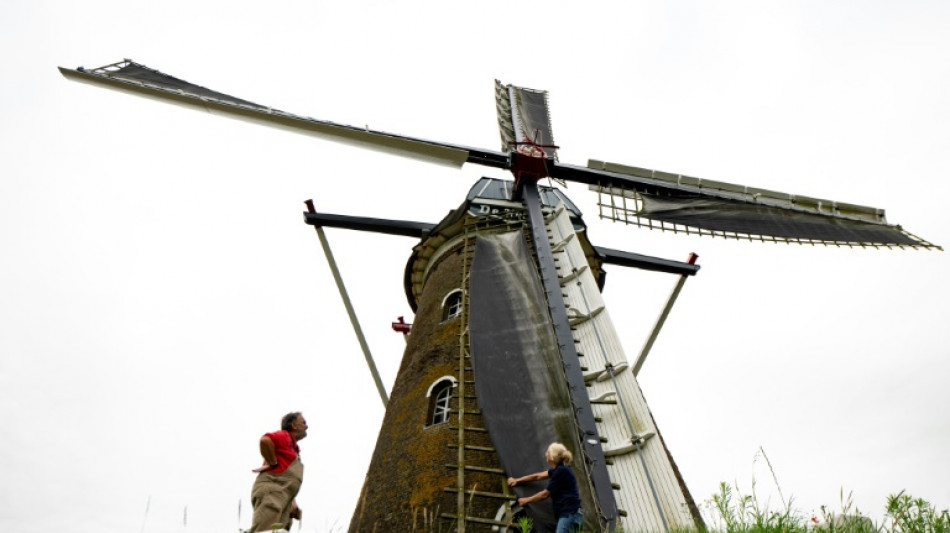
'Windmill love' sees Dutch artist become mill operator / Photo: © AFP

 ALIX LASERS shareholders remove Michael Sobitsch as managing director in view of the circumstances

 Progressive Vision Wins Irish Healthcare Awards 2026 Innovation Prize for Office-Based Cataract Surgery

 Eight-Year-Old Georgia Wins Penrith Valley Public Speaking Competition

 Steven Berkoff on Memory and His New Autobiography 'Shouting At Night'

 Jimmy Carr Confirms 25-Year Estrangement From Father Amid Podcast Reflections

 Arizona Superintendent Tom Horne to Leave Office, Plans Law Practice and Charter School

 Japan and Peru Mark 150 Years of Diplomatic Ties Amidst Trade and Investment Talks

Dutch artist Peet Wessels might not call it an obsession, but with over 100 images of windmills in her home, it's clear she's a big fan -- her walls practically whirl with admiration.
Now Wessels, who rose to fame by painting windmills on the mill's used canvas sails, is taking it one step further.
She is training to become a real-life miller -- someone who operates and maintains a windmill -- joining a growing number of women in what was once seen as a man's world.
It was a blustery afternoon at De Heimolen, an ancient wheat mill in Rucphen-Bosschenhoofd near the southern Dutch city of Breda.
Perched some 10 metres (about 32 feet) on one of the four wings of the mill, built in 1866, Wessels tied canvas over the wooden slats.
She then scarpered down and ran around the structure to release a brake to set the creaking blades in motion.
"You cannot have a fear of hights if you want to be a miller," Wessels told AFP, dressed in sturdy boots, jeans and a hoodie bearing the insignia of the Dutch Guild of Millers.
For almost two years now, Wessels, 59, has been following the ancient course on how to become a miller, joining some 2,000 others in the Netherlands, famous for its clogs, cheese and... windmills.
Wessels believes she is the only woman miller in the North Brabant province, a short hop from one of the country's most iconic windmill locations at the nearby Kinderdijk.
In all, there are some 200 woman millers around the Netherlands, she added, mostly based around the central city of Utrecht.
Trainee millers learn mill mechanics -- how to steer the massive blades without damaging them, safety around the rapidly moving parts and how to read the weather.
"It's a bit like being the captain of a sailing ship," said Wessels.
- 'Rather in a mill' -
Asked about woman millers making waves in a role seen for centuries as traditionally male, Wessels did not think of herself as a pioneer.
"But I'd rather be in a mill than attending a fashion show," she laughed.
A chemical engineer by profession, Wessels said she was always interested in windmills and how they worked.
After stints as an engineer in the United States and Britain, she decided to start a new career as a painter in the late 1990s.
But sales dropped and after the credit crunch in 2008, Wessels knew she had to innovate "and do something different".
One day she was cycling past a windmill when she hit upon an idea.
"I told the miller I want do something with mills and paint them, do you have something I could use?"
That's when the miller showed her the used canvas cloth used in the mill's wings -- and so an idea was born.
"It was stinky and full of insects, so I had to scrub it clean first," she said.
Her chemical engineering background came in handy, helping her to find the right way to treat the canvas to show both the painting and the cloths' natural ageing process.
"The cloth and the painting had to work together. It has to show the history of the cloth that's been on the mill sometimes for 20 years or longer," she said.
Wessels' painting of the mill also exactly matches the actual mill on which the canvas was used.
- 'Not a fanatic' -
Two of her favourites now hang in her kitchen: one work called "Dutch Skies" and another called "Dutch Landscape."
Both were painted on the canvas from the 1740 Overwaard 7 mill at Kinderdijk -- which has been declared a UNESCO World Heritage site because of its 19 iconic mills.
Wessels has painted almost all of the Netherlands' famous windmills -- including a mill called De Kat north of Amsterdam -- the world's last remaining windmill using wind power to make paint pigment.
"Almost all the millers know me. I used to ask for old canvas, but now they phone me when they have some available," Wessels laughed.
Asked if she ever dreams of windmills, she quipped: "I'm not a fanatic. But training to become a miller is perhaps a step closer!"
T.Zimmermann--VB