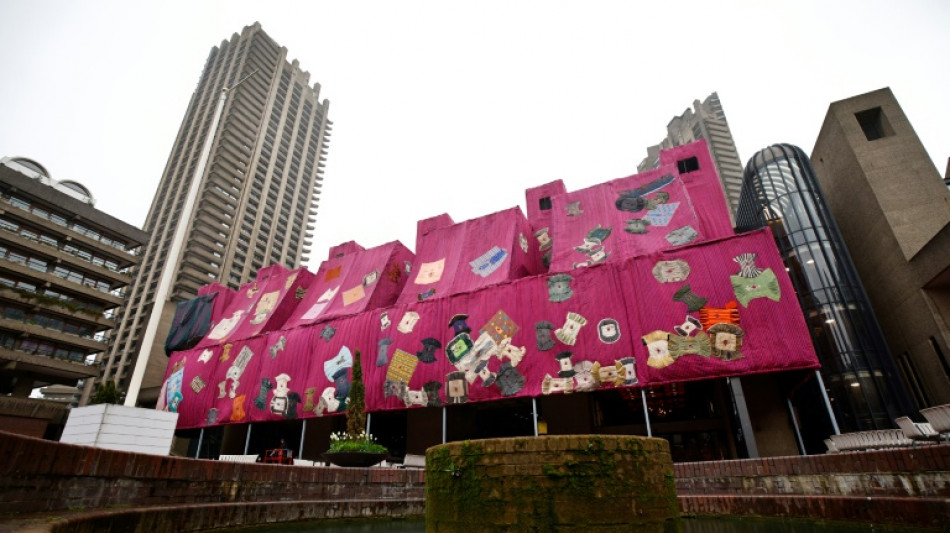
Ghanaian artist Ibrahim Mahama adds splash of colour to London complex / Photo: © AFP

 UN approves resolution on dealing with rising sea levels

 Yalcouye makes dream debut as Ivory Coast beat Ghana in AFCON qualifier

 Chicago's White Sox and Cubs book MLB playoff berths

 Last-gasp Gakpo strike snatches Dutch draw to sour Klopp debut

 Global stocks mostly fall as oil prices and bond yields rise

 Israel's Netanyahu denounces enemies, allies in fiery UN speech

 Hollywood stars among arrests in NY anti-Netanyahu protest

 Losing start in AFCON qualifying for 78-year-old coach Le Roy

 Italy bans burqas in schools, caps numbers of foreign students per class
 Israel policies threaten 'life and existence' of Palestinians, Abbas says

 Paolini steers Italy past China in BJK

 Zidane admits emotion on eve of first game as France coach
 Breetzke and Maharaj sink Australia in first one-day international

 Zelensky broke confidentiality with North Korea POWs disclosure: South's president
 Former Liverpool star Carroll reveals he was sexually assaulted

 Dominican Republic calls for Haiti force to be strengthened

 Dolly Parton's nephew ordered to stay away from estate staff, properties

 Early exit for Philippine darling Eala at Singapore Open

 Hurricane Polo triggers huge waves in coastal Mexican city

 What happens if the US bans diesel exports

 Macklemore hits back with 'Free Palestine Tour' after Sheeran split

 Met Opera to give New Yorkers free tickets in affordability push

 Top ECB official to resign to take up IMF role

 Xi and Trump call for peace in lavish White House state visit

 Five up-and-coming players looking to make mark in Nations League

An installation by Ghanaian artist Ibrahim Mahama wrapping part of a brutalist central London cultural complex in pink-purple woven cloth and urine-stained robes was unveiled Tuesday.
The public commission at the Barbican Centre's Lakeside Terrace, named "Purple Hibiscus" after Chimamanda Ngozi Adichie's eponymous 2003 novel, has been hand-sewn in collaboration with hundreds of craftspeople in Ghana.
The 2,000 square metres (2,1528 square feet) of brightly coloured fabric panels feature scores of traditional robes, known as "batakaris", previously worn and cherished by everyone from Ghanaian royals to everyday people.
Passed down from generation to generation, Mahama began collecting them more than a decade ago for eventual use in his artworks.
Known internationally for creating massive installations that clad buildings, "Purple Hibiscus" is his first large-scale UK public commission.
For it, he worked with networks of female weavers in his native Ghana to embroider the robes onto the striking fabric now draped over a sliver of the famously grey concrete Barbican complex.
"I've always been interested in labour, the conditions of labour, the history of labour, and also how labour is inflicted on bodies," Mahama told AFP about conceptualising the artwork.
Some of the robes have been urinated on or had "other things" doused on them by their previous owners, because "the idea is to break the soul away from the material," he explained.
"They somehow believe that their soul, of the family, is somehow contained within the cloth," the artist added, noting it had often been difficult to convince people to hand over the valued items.
Sometimes adorned with amulets, they were once mythically thought of as armour to protect against the bullets of colonial soldiers.
On display in the Barbican until mid-August, the exhibit resonates with the district's history of mass destruction during World War II and as a one-time home to the cloth trade.
The light and bright purple and pink fabric, stitched with the history-laden fragile robes, deliberately contrast with the hard-edged surroundings and typically grey London sky overhead.
"It's supposed to somehow allow us... to reflect on the human condition, and beyond the human condition, also into the question of life," said Mahama.
The artist appears unconcerned by the potential impact of London's notoriously wet weather on his painstakingly assembled installation.
"It will last as long as it can last," he said.
"Once you produce any art piece that is supposed to be in the public, the artist has to be ready to accept the fact that anything can happen to it."
M.Schneider--VB