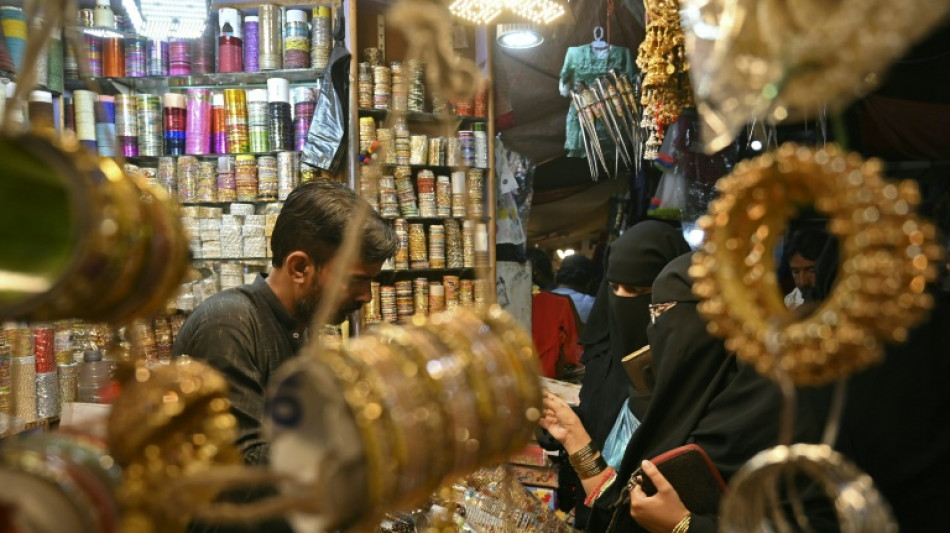
Pakistan's delicate Eid bangles go from furnace to forearms / Photo: © AFP

 UN approves resolution on dealing with rising sea levels

 Yalcouye makes dream debut as Ivory Coast beat Ghana in AFCON qualifier
 Chicago's White Sox and Cubs book MLB playoff berths

 Last-gasp Gakpo strike snatches Dutch draw to sour Klopp debut

 Global stocks mostly fall as oil prices and bond yields rise

 Israel's Netanyahu denounces enemies, allies in fiery UN speech

 Hollywood stars among arrests in NY anti-Netanyahu protest

 Losing start in AFCON qualifying for 78-year-old coach Le Roy

 Italy bans burqas in schools, caps numbers of foreign students per class

 Israel policies threaten 'life and existence' of Palestinians, Abbas says

 Paolini steers Italy past China in BJK

 Zidane admits emotion on eve of first game as France coach
 Breetzke and Maharaj sink Australia in first one-day international
 Zelensky broke confidentiality with North Korea POWs disclosure: South's president

 Former Liverpool star Carroll reveals he was sexually assaulted
 Dominican Republic calls for Haiti force to be strengthened
 Dolly Parton's nephew ordered to stay away from estate staff, properties

 Early exit for Philippine darling Eala at Singapore Open

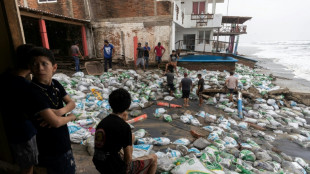 Hurricane Polo triggers huge waves in coastal Mexican city
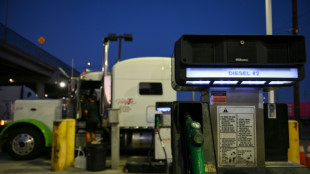 What happens if the US bans diesel exports

 Macklemore hits back with 'Free Palestine Tour' after Sheeran split
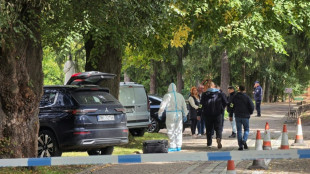
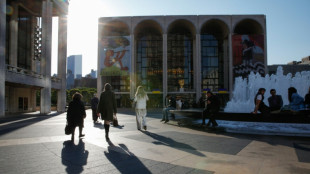 Met Opera to give New Yorkers free tickets in affordability push

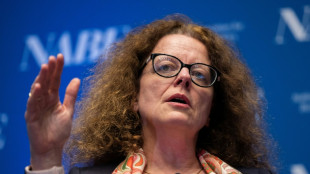 Top ECB official to resign to take up IMF role

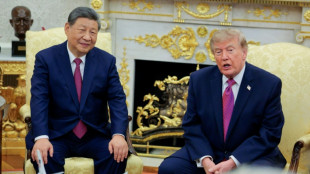
 Xi and Trump call for peace in lavish White House state visit

 Five up-and-coming players looking to make mark in Nations League

Layers of intricately decorated bangles are a staple fashion accessory for women in Pakistan, a carefully considered part of their Islamic Eid-al-Fitr celebrations.
More than a dozen people can be involved in the making of a single bangle, from sweltering factories to the homes of designers who skilfully decorate them by hand.
"Whatever the fashion trends, when we attend any event and wear any outfit it feels incomplete without bangles," said 42-year-old Talat Zahid, who uses beads, stitching and embroidery to embellish bangles.
"Even if you don't wear jewellery but wear bangles or a bracelet with your outfit, the outfit looks complete."
In the lead-up to this week's Eid-al-Fitr festivities that mark the end of Ramadan, market stalls are adorned with a glittering array of colourful bangles, each turned over and inspected for their beauty and imperfections by women who haggle for a good price.
They are often sold by the dozen, starting at around 150 rupees (about 50 cents) and rising to 1,000 rupees as stones and silk are added.
Hyderabad is home to the delicate "churi" glass bangle, where a single furnace can produce up to 100 bangles an hour from molten glass wire shaped around an iron rod.
The work is arduous and frustrating –- labourers are exposed to oppressive temperatures in unregulated factories prone to frequent power cuts, while the fragile glass threads can snap easily.
"The work is done without a fan. If we turn on the fan the fire is extinguished. So the heat intensity is high. As it becomes hotter our work slows down," said 24-year-old Sameer, who followed his father into the industry and earns less than the minimum wage of 32,000 rupees ($115) a month.
After the partition of British-ruled India in 1947, migrating Muslims who had produced bangles in the Indian city of Firozabad took their trade to Hyderabad –- where hundreds of thousands of people rely on the industry.
But soaring gas prices after the government slashed subsidies have forced many factories to close or to operate at reduced hours.
"The speed at which the government has increased the gas prices and taxes, (means) the work in this area has started to shrink instead of expand," said 50-year-old factory owner Muhammad Nafees.
Most bangles leave the factory as plain loops, sent off to be embellished to different degrees by women who work from home, before they're finally passed on to traders to be sold in markets.
The production is often a family affair.
Saima Bibi, 25, works from home, carefully adding stones to bangles with the help of her three children when they return from school, while her husband works at the furnaces.
"They go through a lot of hands to be prepared," she said.
W.Huber--VB