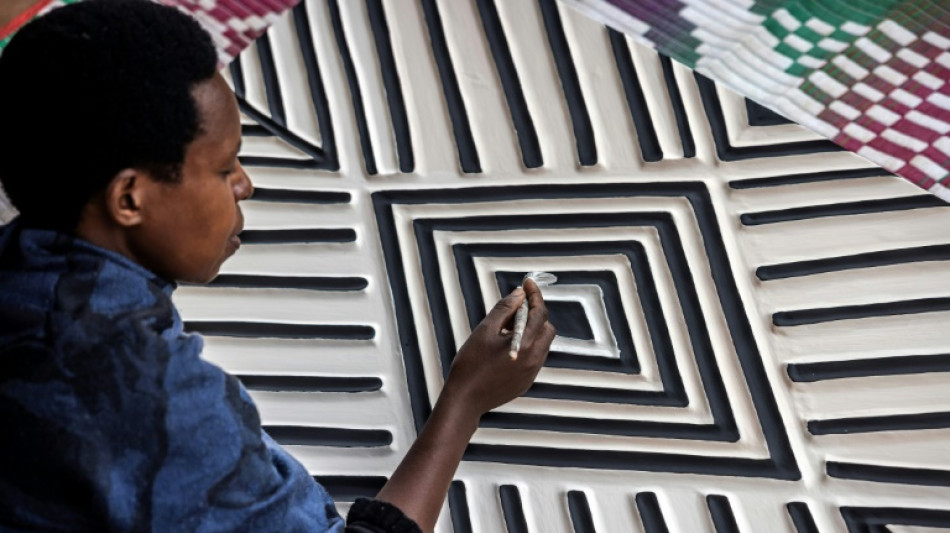
Reviving a traditional art form in Rwanda after genocide / Photo: © AFP

 UN approves resolution on dealing with rising sea levels

 Yalcouye makes dream debut as Ivory Coast beat Ghana in AFCON qualifier
 Chicago's White Sox and Cubs book MLB playoff berths

 Last-gasp Gakpo strike snatches Dutch draw to sour Klopp debut
 Global stocks mostly fall as oil prices and bond yields rise

 Israel's Netanyahu denounces enemies, allies in fiery UN speech
 Hollywood stars among arrests in NY anti-Netanyahu protest

 Losing start in AFCON qualifying for 78-year-old coach Le Roy

 Italy bans burqas in schools, caps numbers of foreign students per class

 Israel policies threaten 'life and existence' of Palestinians, Abbas says

 Paolini steers Italy past China in BJK
 Zidane admits emotion on eve of first game as France coach
 Breetzke and Maharaj sink Australia in first one-day international

 Zelensky broke confidentiality with North Korea POWs disclosure: South's president

 Former Liverpool star Carroll reveals he was sexually assaulted
 Dominican Republic calls for Haiti force to be strengthened

 Dolly Parton's nephew ordered to stay away from estate staff, properties

 Early exit for Philippine darling Eala at Singapore Open

 Hurricane Polo triggers huge waves in coastal Mexican city

 What happens if the US bans diesel exports

 Macklemore hits back with 'Free Palestine Tour' after Sheeran split
 Met Opera to give New Yorkers free tickets in affordability push

 Top ECB official to resign to take up IMF role

 Xi and Trump call for peace in lavish White House state visit

 Five up-and-coming players looking to make mark in Nations League

A 200-year-old Tutsi art form made with cow dung, Rwanda's imigongo painting tradition has experienced a revival in the Great Lakes nation three decades after the 1994 genocide, becoming a symbol of culture and unity.
Known for its raised black and white patterns, imigongo is widely believed to have been invented by a Tutsi prince in the 19th century.
Prince Kakira mixed cow dung and ash to create a material which he used to paint three-dimensional patterns on the walls of his palace in eastern Rwanda's Gisaka kingdom.
The tradition was named after "umugongo", the Kinyarwanda word for "spine", owing to its curved lines, and became popular among rural households where women would use dung and natural pigments made with soil, clay and aloe sap to decorate their homes.
Basirice Uwamariya, founder of the Kakira Imigongo Cooperative in eastern Kirehe district, told AFP she started making art when she was 15.
But the 1994 genocide targeting the Tutsi minority nearly wiped out the tradition, with almost all 15 members of Uwamariya's cooperative killed in a bloodbath that claimed around 800,000 lives across Rwanda, including moderate Hutus.
She lost her husband and multiple relatives, leaving her to fend for herself and her two sons.
"I lived in darkness, in silence," the 53-year-old said, recalling the loneliness that pushed her to revive the cooperative in 1996 and invite other genocide survivors to join her.
Since then, imigongo has evolved.
Traditional patterns exist side by side with modern designs featuring various colours. Natural pigments have been replaced by commercial paints.
Imigongo designs have made their way to upmarket studios and fashion boutiques, adorning garments and wooden artefacts alike, with a market that includes foreigners and Rwandans.
According to Theoneste Nizeyimana, manager of Azizi Life Studio in the capital Kigali, the tradition was once largely limited to eastern Rwanda.
"But after the genocide destroyed everything... people started thinking about how they can bring back their culture. Today, imigongo is appreciated by all Rwandans, not just Tutsi," he told AFP.
"Imigongo is something that brings people together," he said, pointing out that the Kigali boutique and studio holds painting classes for students whose ages range from four to 75 years old.
It also makes business sense, he said, with its instantly recognisable patterns helping to market "made in Rwanda" designs around the world.
R.Kloeti--VB