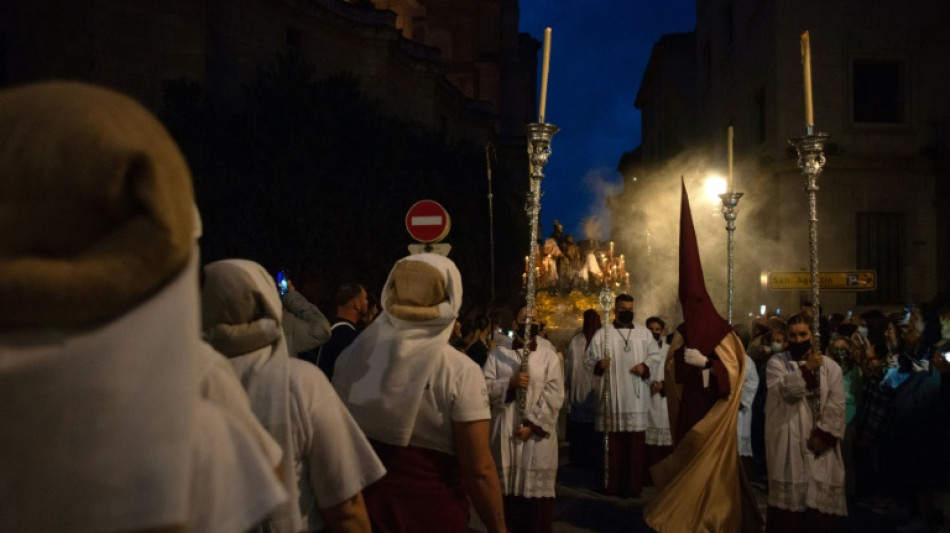
Women bear weight of Easter rite in changing Spain / Photo: © AFP

 Liverpool boss Iraola urges Isak to raise his level

 Evenepoel wins record 4th straight world time-trial title

 France's Macron, Canada's Carney announce closer ties

 Carrick defends troubled Man Utd after Fulham escape

 Horror movie 'Resident Evil' tops N. American box office

 Germany's Merz vows to stay course despite new vote losses
 Man City outgun Sunderland despite Brobbey hat-trick, Man Utd rescue Fulham draw

 Mourinho blames ref committee for Real Madrid derby defeat
 Maresca craves a 1-0 win after eight-goal Man City thriller

 Atletico Madrid beat Real Madrid in tense derby clash

 Reusser retains world time-trial title

 Man City outgun Sunderland despite Brobbey hat-trick, Liverpool win at Bournemouth

 Top US, Chinese economic officials meet ahead of Trump-Xi summit

 Erdogan's LGBTQ crackdown 'first step of election campaign': activist

 Mass drone barrage on Moscow kills two

 82-year-old dies after beach fight in Greece over sun lounger

 US warns of rapid escalation in Mideast war

 Iran 'put hearts on the court' to win Asian Games basketball bronze

 School girl Yu helps China dominate in Asian Games swimming openers

 Myanmar win first Asian Games teqball gold as Spain great Puyol watches

 China's 13-year-old Yu scorches to first major gold at Asian Games

 Russians vote on last day of parliamentary elections

 Hong Kong pays final respects to former city leader Tung

 Typhoon put people off Asian Games opening ceremony, official says

 China's 13-year-old Yu cruises as Asian Games swimming begins

The team of women rocked rhythmically from foot to foot carrying a 1.5-tonne float topped with a statue of Jesus and Mary on the streets of Granada in southern Spain.
The 50 women supported the weight on wooden ribs under the belly of the float as they inched forward through the city for ten hours on Monday.
A heavy velvet cloth draped over the float left only their white shoes visible to throngs of spectators lining the route.
The parades featuring dozens of people dressed in religious tunics and distinctive pointy hoods have returned this Holy Week after being cancelled due to the Covid-19 pandemic the past two years.
While religious orders started allowing women to carry floats in Spain's famous Easter processions 30 years ago, female "costaleros" -- as float bearers are known -- remain a minority who still face resistance.
Women have traditionally formed the back line of the processions, playing the role of mourners dressed in stylish black dresses, embroidered veils and intricately designed hair combs.
Granada's "Work and Light" brotherhood was among the first to allow women to carry the floats in the 1980s.
At first "it was not accepted, women were talked bad about," said Pilar del Carpio, a 45-year-old cashier who has been a shrine bearer since she was 13 and is proud to be one of the "pioneers".
Today only three or four of Granada's 30 brotherhoods, which stage the processions, include women costaleras.
"Maybe there are people who think it is not normal," said Maria Auxiliadora Canca, a 40-year driving instructor who directs a team of float bearers in Ronda, another Andalusia city in southern Spain.
"Since our bodies are capable of doing it, and we do it with conviction, I don't see why there should be a difference."
- 'Scandal' -
But in Seville, which holds Spain's most spectacular Easter parades, there are no women float bearers even though the city's archbishop in 2011 issued a decree to put an end to gender-based discrimination in the city's religious orders.
Opponents claim the task is too physically demanding, "not suitable" for women.
"It's a scandal," said Maribel Tortosa, 23, who manages an Instagram account called "Costaleras por Sevilla" dedicated to women float bearers.
People say that it is "ugly" to see a woman wearing a "costal", the traditional padded sack used by bearers as protective headgear, she said.
"But under a float, you don't see anything," she added.
Still, the emergence of women float bearers reflects the growing push by women in Spain into traditionally male-dominated fields since the return of democracy in the 1970s.
Spain's oldest police force, the Guardia Civil, has since 2020 been headed by a woman -- a first in its 178-year history.
And since Socialist Prime Minister Pedro Sanchez came to power in 2018, women have taken up most cabinet posts for the first time in history.
- 'Strong enough' -
In Granada, locals are no longer surprised to see women training on the streets in the lead up to Holy Week by lifting and carrying a float loaded with bricks.
The load "weighs more every hour", even though the shrine bearers are replaced every half hour during the "Work and Light" brotherhood's procession, which began Monday at four pm and ended at around one am, said Rafael Perez, who heads the team of women shrine bearers.
Working with women "changes absolutely nothing. I just have to treat them with more tenderness," said Perez.
Among the women of this religious order was Montse Rios, 47, who has been a bearer since she was 19 and who still feels "strong enough to go under".
Her eldest daughter joined her this week under the float, while her youngest is a "pipera", giving water to the procession participants.
"And we don't lack that," she added.
O.Lorenz--BTB