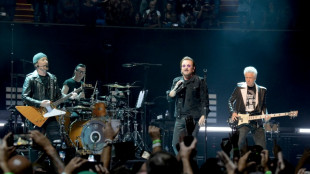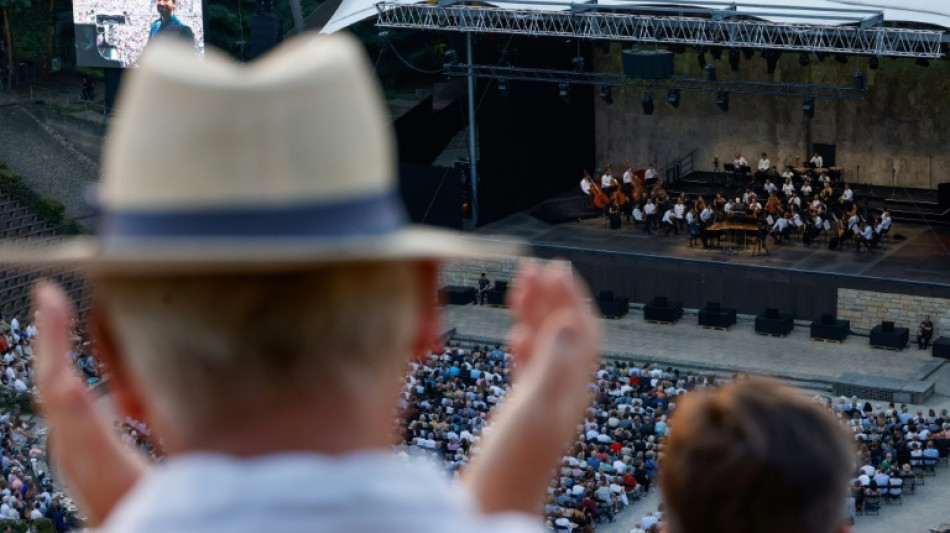
In tune: Classical concert-goers' hearts, breathing synchronize / Photo: © AFP/File

 Thailand slams chaotic Asian Games organisation as 'musical chairs'
 North Korea to keep nuclear weapons 'forever': foreign minister

 Markets mixed as China's Xi arrives for US talks

 Swiss voters expected to shun stricter neutrality

 Rapper-turned-PM faces first big test after Nepal disaster

 Tuchel seeks tonic to England World Cup 'scar' in Spain showdown

 'Helps me cope': Catholic baptisms rise among French youth

 Colombians in Santa Marta stay inside after violence wracks the city

 Iran airlines cancel flights as US sanctions hit
 Meta launches camera-free AI glasses amid privacy pushback

 Australian PM says OpenAI hacked government health website

 Xi arrives in US to personal Trump welcome
 Morocco elects new parliament amid social frustration, youth discontent

 Scheffler and Burns to face Im and Lee in Presidents Cup opener
 Crushing wins for Lyon and Barca in women's Champions League

 Rio breaks record for rainiest September amid powerful El Nino

 At UN, tech chiefs urge caution in AI development

 Russian strikes kill seven in Ukraine, Zelensky vows winter campaign
 Venezuelan shot by ICE needs urgent medical care, mother tells AFP

 Zelensky says Putin using fighters from 47 countries in Ukraine war
 Klopp calls on Germany to 'rise above ourselves' as new era begins

 Russian strikes kill seven in Ukraine as Russia vows no 'pause' to war

 ArcPoint Expands Globally with Institutional Intelligence Platform for Modern Investors

 Ronaldo focussing on 'present' ahead of Wales test

 Outgoing UN chief makes final climate push at New York summit

People who listen to music together often report feeling a powerful connection to each other as a result of their collective experience.
A new study published in the journal Scientific Reports on Thursday now finds that physical responses -- including heart rate, breathing and the electrical conductivity of skin -- synchronize between audience members at classical concerts.
Individuals who rated more highly for personality traits such as openness were more likely to synchronize, while those with neurotic dispositions were less likely to align.
"When we talk about very abstract things such as aesthetic experiences, how you respond to art and to music, the body is always involved there," Wolfgang Tschacher, a psychologist at the University of Bern who led the research as part of the Experimental Concert Research project, told AFP.
This theory is known as "embodied cognition" -- the idea that the mind is not only connected to the body but that the body influences the mind -- which, while arguably intuitive to lay people, has been controversial in scientific circles.
To investigate, Tschacher and colleagues observed 132 audience members across three classical concerts.
All three played the same string quintet pieces: Ludwig van Beethoven's "Op. 104 in C minor," Johannes Brahms' "Op. 111 in G major," and "Epitaphs" by the contemporary composer Brett Dean.
The authors used overhead cameras and wearable sensors to monitor the participants, who filled in questionnaires about their personalities before the concert, and whether they enjoyed the performance and what their mood was afterward.
Overall, they found statistically significant synchronization on several measures -- people's hearts beat faster or slower during the same musical passages, as did their levels of "skin conductance."
Skin conductance is closely related to the body's flight or fight response. When it's high it indicates a state of arousal and can be linked to goosebumps on the skin; when it's low we are in a state of relaxation.
The cameras even caught alignment of body movements, which the authors wrote "appears noteworthy, as the audiences of all concerts were seated in dimmed lighting" and spread out due to the pandemic.
However, though people's breathing rates aligned, they did not actually inhale and exhale in unison.
- The power of music -
As one might expect, people whose personality types indicated "openness to new experiences" and "agreeableness" were more disposed towards synchronizing with others.
Those who rated highly for neuroticism, "a person who tends towards fearful behavior, warding off things, being more depressed," in Tschacher's words, were less likely to synchronize -- but so too were extroverts, which might seem counterintuitive.
"Extroverted people are very social, they tend to intermingle with people, they want to be in power, and they want to have a certain self-value," he said, adding he had seen this result in previous research too. While extroverts are outgoing, they focus less on the music.
For Tschacher, the findings are more evidence in favor of the "embodied cognition" theory and also help explain why public parades or military marches help build cohesion between participants.
And he expects the effects would be "even stronger" in other musical genres.
"There are additional reasons that people will synchronize in pop concerts, people move, they dance, and that's that is synchronized by the music and that would give even clearer results," he said.
D.Schaer--VB