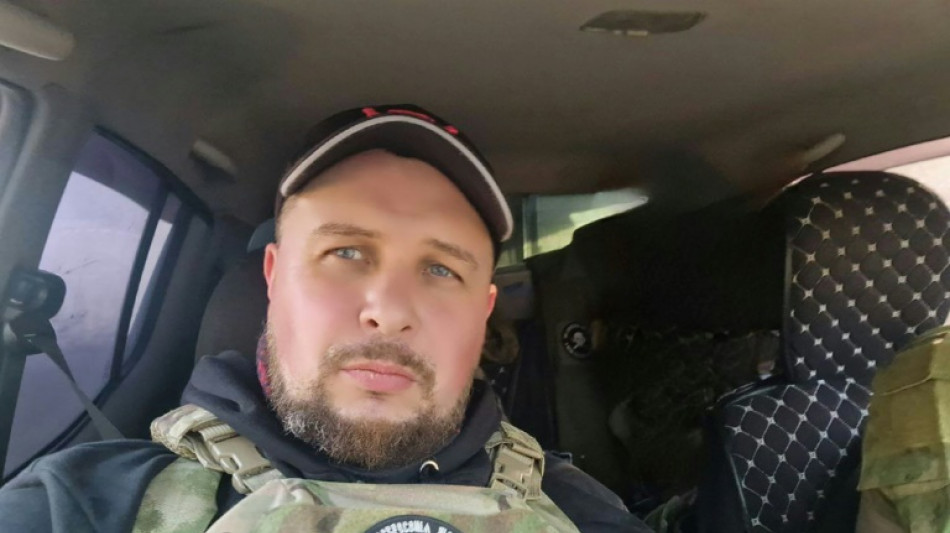
Russian offensive inspires golden age of military bloggers / Photo: © TELEGRAM / @Vladlentatarskybooks/AFP/File

 Alex Bodi and Prof. Dr Stefan Haupt agree to collaborate on a legendary art collection in Romania
 Stocks dip, oil rises as traders eye chances of Iran deal
 Israel squeezing UN Palestinian refugee agency ahead of polls: chief
 Dutch to resume Eurovision with new broadcaster
 Man Utd losses jump despite record revenues

 Ethiopia's Tigray rebels seize airports, clash with govt forces
 China prodigy wins third Games gold as North Korea weightlifters roar

 China's Yu, 13, wins third Asian Games gold but has 'some regrets'
 Oil falls, stocks steady as Trump hails 'good' Iran talks
 UK sets up unit to combat disinformation from Russia, AI
 ICC convicts C.Africa rebel leader

 China's Yu, 13, wins third gold with latest Asian Games record
 UK says will revisit Chagos deal after latest Trump criticism
 In first, French presidential candidate gives birth during campaign
 Cambodia no 'safe haven' for cyberscams, PM says
 North Korea weightlifter sets three world records for Asian Games gold
 A Full Moon for Every Child: STARTRADER's STARCARES Brings Support to SOS Children's Village Ho Chi Minh City

 Meta leans into AI, smart glasses amid privacy pushback
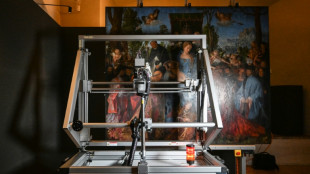 Battered Duerer masterpiece up for five-year revamp
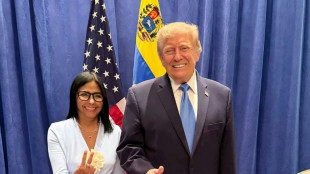 Trump met with Venezuela's interim leader at UN
 Malaysia furore after Najib wins conditional house arrest
 Italy hope for new dawn under Mancini

 Mongolian herders enlist new tech against harsher, drier climate
 Tata turmoil shines light on India succession woes
 World Cup 'not enough' as Spain begin next chapter
Before Russia's offensive in Ukraine, Mikhail Zvinchuk's Telegram channel was mainly known to military buffs. Today, it boasts more than a million followers, exceeding that of many media outlets.
Numerous Russian military bloggers like him have gone from obscurity to celebrity since the start of the conflict, distinguishing themselves by being more outspoken than traditional media under strict government control.
They publish information before the government does, and criticise some of its decisions.
To some, this makes them more credible than Russian authorities -- at the risk of ruffling feathers.
When Russia launched its offensive on February 24, 2022, "the (official) institutions in charge of information were thrown into turmoil," said Zvinchuk, whose Telegram account is called Rybar, or fisherman in Russian.
"Officials couldn't agree on which narratives to release to the public," the 31-year-old told AFP.
So "we rose to defend our motherland in the world of information. We became its shield."
A military interpreter by training, Zvinchuk was decorated for his missions in Syria and Iraq and once worked for the Russian defence ministry's press service.
The Arabic and English speaker publishes on Telegram in several languages.
He has a staff of around 40 people, including a data team that puts together maps and graphics with more detail than those released by the authorities and traditional media outlets -- content even picked up by Western institutions.
In just a matter of months, Rybar has seen its readership go from 36,000 followers to over a million.
- Hungry for info -
For Tatiana Stanovaya, an analyst at the Carnegie Russia Eurasia Centre, the bloggers are responding to the Russian public's "hunger for information".
"The Russian defence ministry provides practically no adequate picture of what is happening" in Ukraine, she said.
The bloggers are "well informed, in touch with those who take part in combat. Even if they're politically engaged -- in support of the offensive -- they're publishing facts that can't be found elsewhere," she told AFP.
Alexander Sladkov, a 57-year-old military reporter for the state television channel Rossiya, has covered every armed conflict since the fall of the Soviet Union in 1991, including in Chechnya.
He now reports on east Ukraine while also feeding his own Telegram channel, Sladkov+, which has more than 900,000 followers -- double that of the defence ministry and six times that of the Kremlin.
"War coverage is easy. No need to look for heroes. They are right there in front of you... All the emotion is like bare wiring coming out of the walls," he told AFP.
He denies being a propagandist: "I am not a soldier of the information war."
"I'm a reporter, someone who grabs his viewer by the hand and takes him through the screen to a place where he can't go," he said.
According to independent political expert Konstantin Kalachev, "the military correspondents and bloggers have gained the trust of the people thanks to their courage and the fact that they don't hesitate to criticise" the defence ministry.
- Closely monitored -
But their popularity and willingness to speak freely can irritate the authorities.
Last autumn, several military bloggers strongly criticised the Russian army after a series of setbacks in Ukraine and a mobilisation drive seen as chaotic, marked by a lack of training and old equipment sent to the front.
One of the military correspondents, Semyon Pegov, accused the army at the time of having made a list of bloggers whose publications had to be "verified".
The bloggers are suspected of "discrediting" the army, a charge widely applied in Russia to imprison opponents of the Ukraine offensive.
Rybar is also on the list. Zvinchuk denounces the authorities's "attempts to interfere in the editorial policy" of his channel, especially after last month's death of his friend, the military blogger Vladlen Tatarsky.
He was killed in a bomb attack that Moscow blamed on Kyiv and the Russian opposition.
"It has been suggested that we should be less active, under the pretext of ensuring our security," Zvinchuk said.
"They say, 'guys, let's not make our problems public... The enemy will know and use it'," he added.
"But the enemy will find out anyway... If we release footage of mobilised people having trouble and propose solutions for resolving it, that does not make us Russia's enemies."
K.Thomson--BTB